
You've got the feature working with one model provider, then product wants a fallback, finance wants one invoice, and platform wants to know why three dashboards disagree on the same request. That's the moment an AI API gateway stops sounding abstract and starts looking like the only sane way to keep model access under control.
At a high level, the problem isn't just routing traffic. It's that every new provider adds another key, another billing view, another retry policy, and another place for a production incident to hide.
Table of Contents
- The Multi-Provider Reality Teams Hit First
- What an AI API Gateway Is
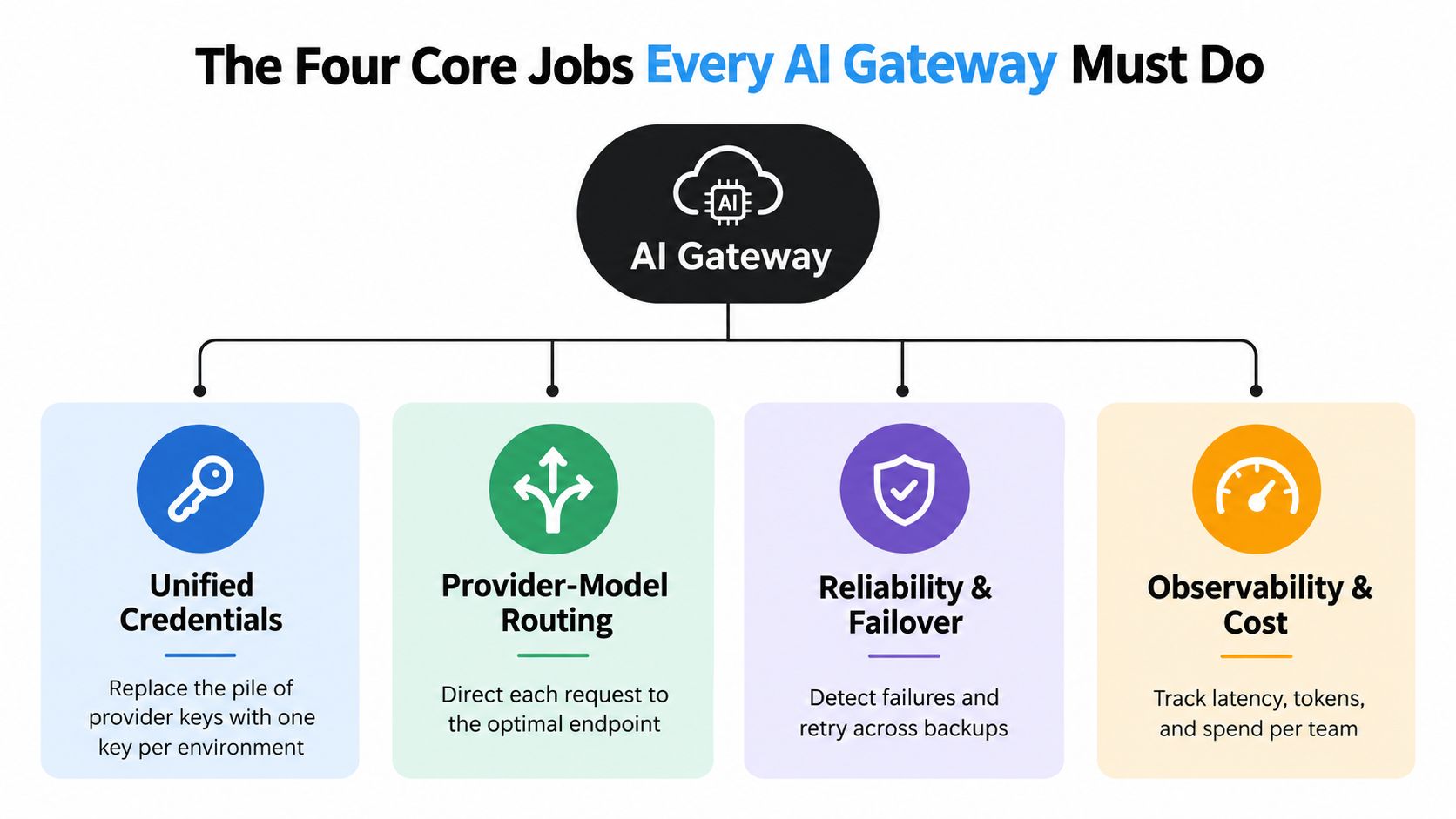
- The Four Core Jobs Every AI Gateway Must Do
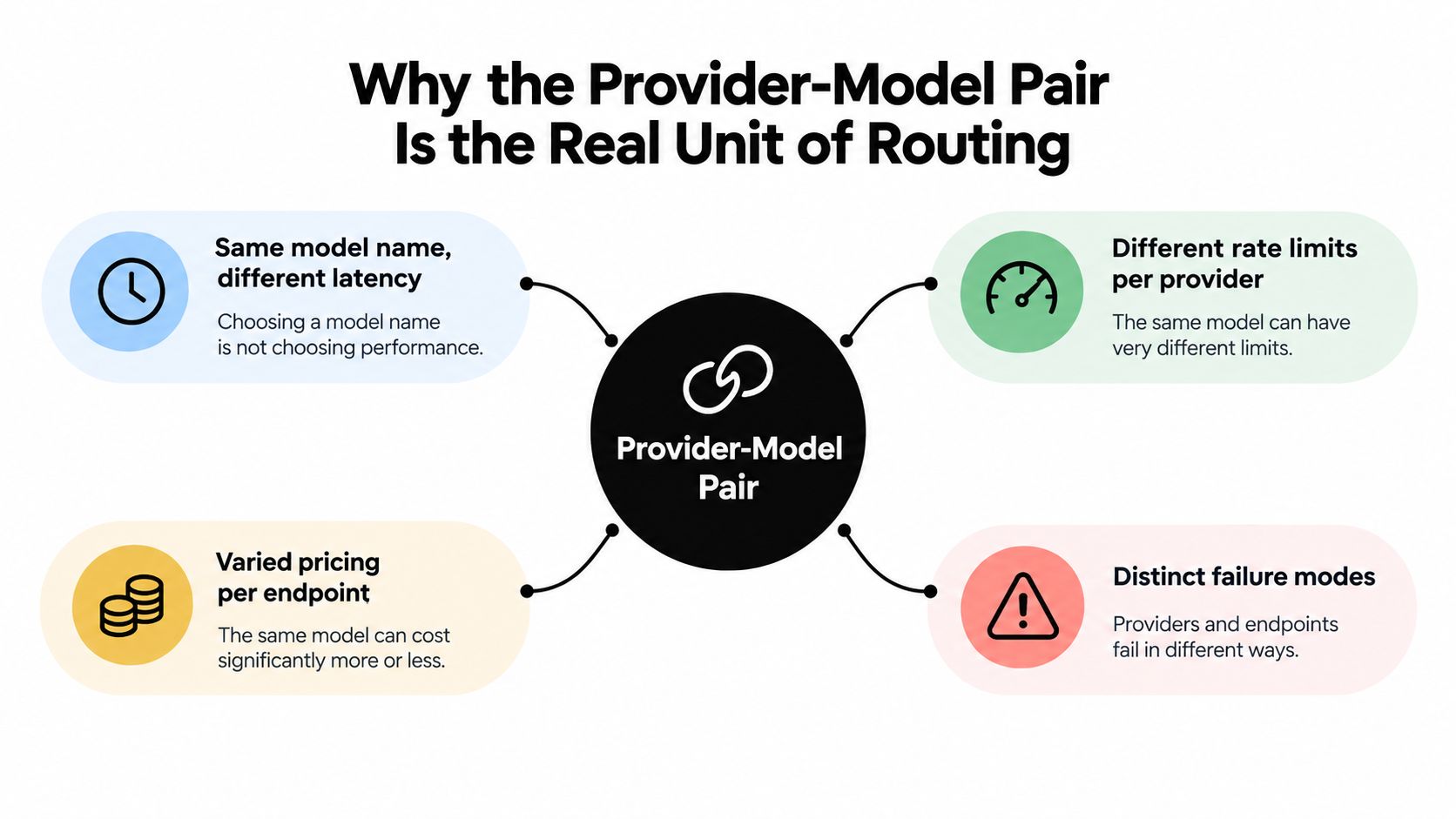
- Why Routing Decisions Belong to Provider-Model Pairs
- Designing Failover That Survives Real Outages
- Token-Aware Admission Control and Per-Request Metering
- Security and Governance When One Key Holds Everything
- Choosing and Operating an AI API Gateway
The Multi-Provider Reality Teams Hit First
A team usually doesn't start with a “multi-provider strategy.” It starts with one app, one model, and a single SDK call that ships fast. Then someone adds a second provider for fallback, a third for a region, and a fourth because a product team wants a different context window or tool-calling behavior.
Now the same service is juggling five keys, duplicated request code, and billing data scattered across multiple consoles. Engineers end up checking provider dashboards to answer questions that should be trivial, like whether a spike in latency came from one upstream, one tenant, or one prompt shape.
Fragmentation shows up in very practical ways
The first sign is usually not an outage. It's drift. One service uses one provider's client library, another service uses a different response shape, and a third has custom retry logic nobody wants to touch.
That creates hidden work:
- Duplicate SDK work because each provider exposes a slightly different interface.
- Scattered observability because latency and token usage live in separate dashboards.
- Billing surprises because cost data arrives at different times and in different formats.
- Operational blind spots because the team can't answer which provider handled which request without digging.
A centralized gateway is meant to replace that sprawl with one control point for model access. The architectural idea is simple, but the operational payoff is bigger than it first looks.
Practical rule: if your team can't trace one request from app to provider to invoice without opening several tabs, you're already operating like you need a gateway.
That's why this pattern gets adopted in production environments first, not as an optimization but as a cleanup move. Teams want one entry point that can normalize requests, isolate credentials, and keep provider changes from turning into application rewrites.
What an AI API Gateway Is
An AI API gateway is a control plane for model access, policy, and measurement. In production, it sits between your application and the upstream model providers, so each request is matched to a specific provider-model pair based on health, policy, and current conditions.
That role is different from a standard API gateway. A normal gateway already routes HTTP traffic and manages client auth. An AI gateway keeps those functions and adds model-specific decisions that are easy to miss if you treat it like a generic reverse proxy.
| Responsibility | General API gateway | AI API gateway |
|---|---|---|
| Routing | Sends HTTP requests to backend services | Chooses the right provider-model pair for each request |
| Authentication | Manages client auth and access control | Does that plus unified model credentials per environment |
| Metering | Tracks requests and usage | Tracks input tokens, output tokens, and sometimes reasoning tokens |
| Reliability | Handles retries and upstream health | Handles mid-flight failover across model providers |
| Observability | Logs requests and latency | Logs provider, model, tokens, time to first token, and cost |
Four jobs only an AI gateway performs
Provider abstraction keeps application code stable. Your service should not need to know whether a prompt goes to one upstream or another, as long as the request contract stays the same.
Token accounting is the next job. Model workloads consume capacity by more than request count, so the gateway has to treat tokens as a first-class unit, not an afterthought.
Latency-aware routing matters because a healthy upstream can still be too slow for the request. If a provider is up but misses your latency budget, the gateway still needs to choose differently.
AI-specific failover is the last piece. It means switching providers mid-flight while still respecting deadlines, retries, and cost limits.
Openbase is a useful example of how this shows up in practice. A unified key reduces credential sprawl, mid-flight retries keep requests moving when one upstream degrades, and token-aware metering gives the platform a billing and control layer that reflects real model usage.
The Four Core Jobs Every AI Gateway Must Do
Unified credentials
One gateway key per environment is easier to manage than a pile of provider-specific keys. That doesn't just reduce clutter, it changes how teams handle secrets, revocation, and blast radius.
If a staging service only needs access to approved models, the gateway can enforce that at the boundary instead of scattering access rules across each app. The key point is isolation, not convenience.
Provider-model routing
Routing is not “pick the cheapest model” or “pick the fastest provider.” It's choosing the best upstream for the current request, which can depend on health, rate-limit state, latency budget, or feature compatibility.
That's why the correct unit of analysis is the provider-model pair. The same model name can behave differently depending on where it's hosted, how it's rate-limited, and whether streaming or tool-calling works the way your app expects.
Token-aware metering
A gateway that only counts requests is blind to long prompts and heavy generations. LLM traffic burns capacity in tokens, not just calls, so request-based throttling can look healthy right up until token quotas get crushed.
The fix is to estimate input tokens before dispatch, reserve output capacity, then reconcile after completion. That gives you auditable cost control and makes per-key budgets meaningful instead of approximate.
Mid-flight failover
Failover isn't a static backup list. It's a live control decision. If a provider returns a transient failure, the gateway can retry or move the request to another eligible upstream, but only if the deadline still makes sense.
Openbase documents this as part of its model access flow, along with provider-prefixed slugs and per-request usage logging at its model documentation. The engineering takeaway is that failover belongs in the gateway, not in ad hoc app code.
Why Routing Decisions Belong to Provider-Model Pairs
The common mistake is treating the model name as enough. It isn't. Two providers can expose the same model and still differ in latency, availability, streaming behavior, and tool-call compatibility, so routing by model alone hides the decision you need to make.
The routing surface is wider than it looks. A 2025 OpenRouter endpoint census found an average of 12.2 providers per tested model among OpenAI-compatible endpoints, which means one model label can map to many live options. Another study found the cheapest quality-feasible endpoint had a median 7.8× higher p95 latency than the fastest feasible endpoint, which shows why price and operational speed do not move together.
What to optimize for depends on the workload
Interactive traffic and batch traffic need different policies. A chat experience depends on responsiveness and tail latency. A background generation job can accept slower paths if the result is cheaper or more available.
For production routing, the checks stay practical:
- Use p95, not averages. Mean latency hides bad tail behavior.
- Test streaming and tool calls per pair. Compatibility can differ even when the model label looks identical.
- Maintain health scores. Healthy is not the same as fast, and fast is not the same as reliable.
- Keep workload classes separate. Interactive requests need tighter latency budgets than batch jobs.
If a provider-model pair cannot meet the runtime behavior your app needs, it is not a valid route, no matter how attractive the nominal price looks.
Openbase's model docs show this idea in practice, with provider-prefixed slugs and per-request usage logging documented at its model documentation. That is the control-plane view: the gateway chooses among provider-model pairs, while unified keys, mid-flight retries, and metering decide how safely each request moves through that route.
Choose routes by workload objective, not by model name alone. The cheapest feasible path can still be the most expensive in user pain.
Designing Failover That Survives Real Outages
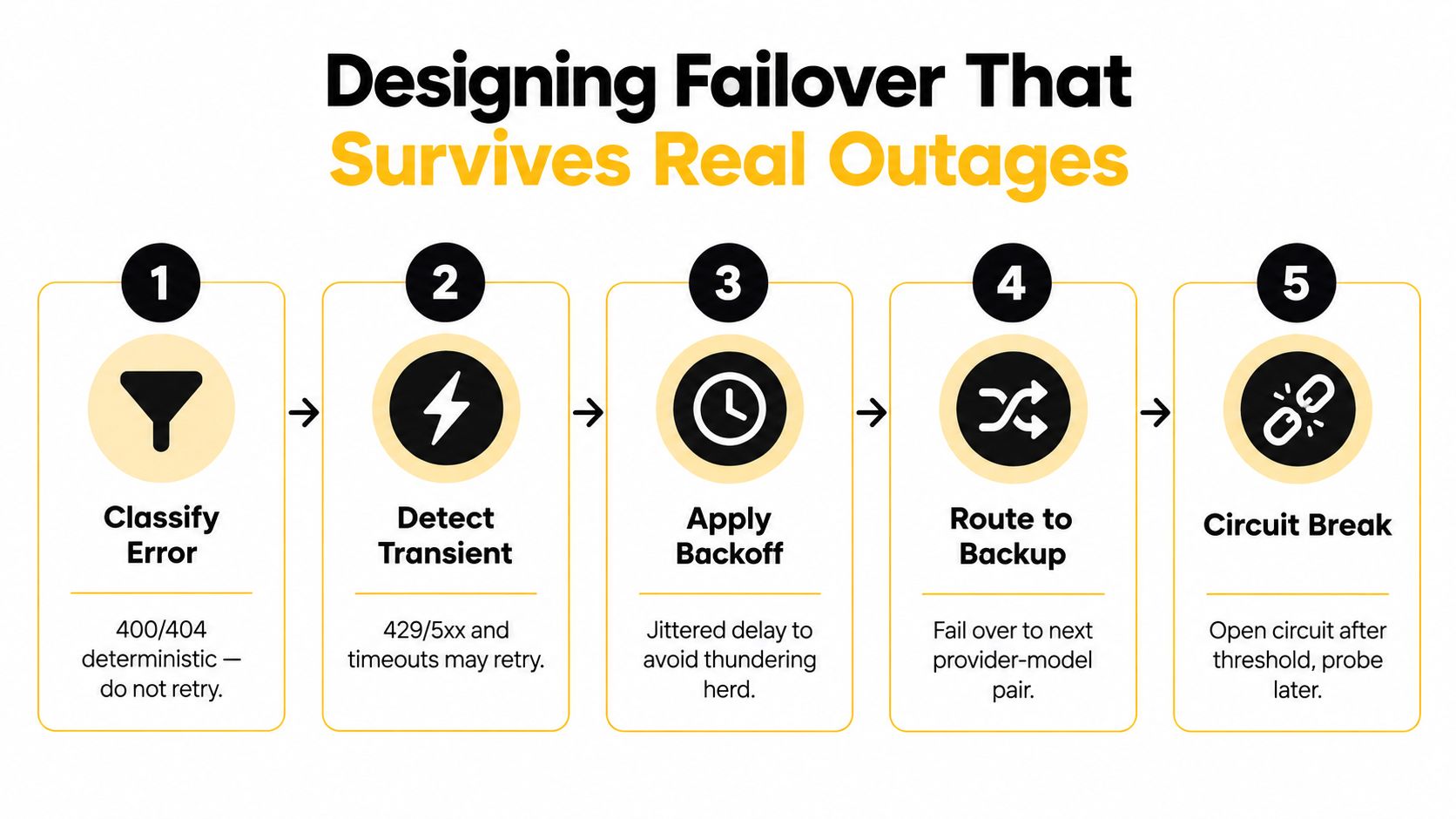
Failover fails when teams treat every error as retryable. A 400 or 404 is a client-side result, so sending it again only wastes time. A 429, 5xx, connection timeout, or other transient failure is different. The request may still succeed if the gateway backs off and sends it to another healthy provider-model pair.
Retry policy has to be bounded
Immediate retries are the common mistake. Many clients retry at once, their requests line up, and the upstream problem gets worse instead of better. The gateway needs bounded exponential backoff, random jitter, and a retry budget.
AWS's Architecture Blog, in its analysis of jitter and backoff, shows why that matters. Exponential backoff without jitter reached a P99 latency of 2,600 ms and a 17% error rate in one recovery scenario. With jitter, the same scenario dropped to 1,400 ms and 6%. Adding bounded retries with a circuit breaker brought it down further to 1,100 ms and 3%.
The gateway should protect deadlines
Mid-flight failover only helps if the original request still has time to finish. If the gateway keeps retrying after the useful deadline has passed, it ties up connections, consumes capacity, and makes the app feel slower even when availability looks better on paper.
That is why failover has to account for:
- Error classification so deterministic client errors do not retry.
- Remaining deadline so retries stop before the request goes stale.
- Retry budget so one bad upstream does not absorb the whole gateway.
- Provider health and rate limits so the backup path is actually usable.
- Downstream impact so the fallback does not start a second incident.
The useful SLOs are failover success rate, retry amplification, p95 and p99 latency, and downstream error rate. Those are gateway-level outcomes, not app-level afterthoughts.
Openbase's model docs show the control-plane view in practice, with provider-prefixed slugs and per-request usage logging documented at its model documentation. The gateway is choosing among provider-model pairs, while unified keys, mid-flight retries, and metering decide how safely each request moves through that route.
Token-Aware Admission Control and Per-Request Metering
A request counter is too blunt for LLM traffic. Providers often limit both requests per minute and tokens per minute, and some also enforce concurrency or spend-based caps. Openbase's rate-limits reference is the kind of doc a gateway team uses to map those limits before traffic starts flowing. That means a gateway can stay under request limits while still exhausting token capacity on long prompts.
Admission control needs two buckets
The gateway should reserve capacity before dispatch, the same way a ticket scanner checks both the ticket and the seat count before letting people into a venue. First it estimates input tokens. Then it reserves room for the expected output. After the call finishes, it reconciles the reservation against actual usage.
That gives you a cleaner control loop:
- Request bucket protects against bursty call volume.
- Token bucket protects against long prompts and expensive generations.
- Post-call reconciliation keeps accounting aligned with what happened.
If you only gate by request count, a single reasoning-heavy workload can consume more upstream capacity than a short burst of ordinary calls.
What to log per call
The minimum telemetry record should include model, provider, input tokens, output tokens, reasoning tokens where exposed, time to first token, total latency, status, retry count, and exact cost. That gives teams enough detail to reconcile invoices, debug slowdowns, and spot prompt changes that suddenly inflate token usage.
| Field | Why it matters |
|---|---|
| Model | Shows which model served the request |
| Provider | Separates upstream behavior from model behavior |
| Input tokens | Reveals prompt growth and capacity use |
| Output tokens | Tracks generation volume and billable usage |
| Reasoning tokens | Makes hidden cost visible when providers expose it |
| Time to first token | Captures perceived responsiveness for streamed calls |
| Total latency | Measures end-to-end service time |
| Status | Distinguishes success, retry, and failure paths |
| Retry count | Shows how often the gateway had to recover |
| Exact cost | Supports budget control and reconciliation |
A system like Openbase exposes this kind of per-call logging and pairs it with daily rollups and monthly invoices. For operational teams, that is the difference between “we think cost went up” and “we can prove where it went.”
Security and Governance When One Key Holds Everything
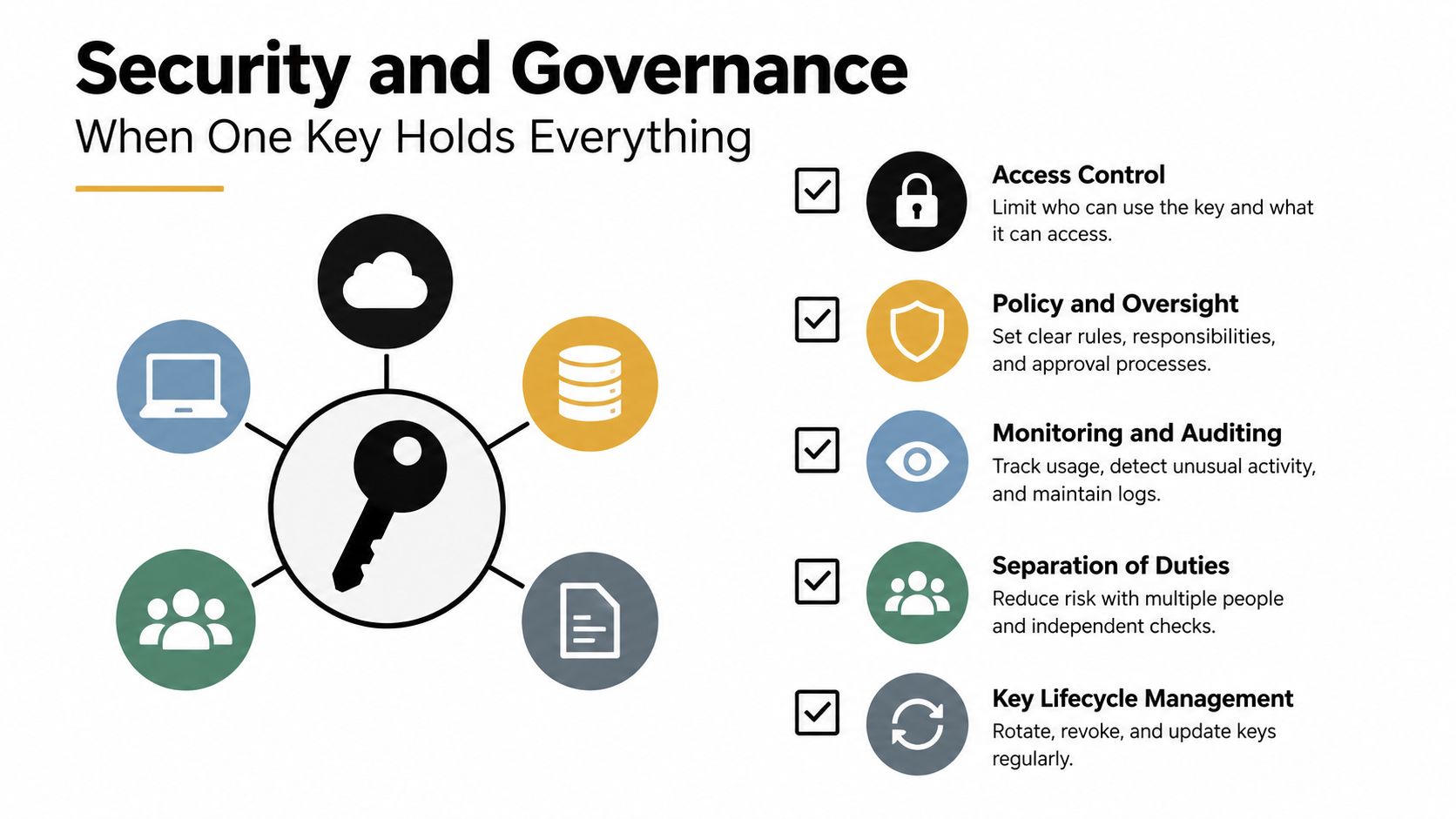
Consolidation is useful, but it increases blast radius. If one gateway key can reach many models and providers, then identity, policy, and observability become the boundary that keeps the setup safe.
Independent 2025 research reported that 31% of organizations planned to redirect their largest security investments toward AI supply-chain security, and 13% of surveyed organizations experienced a breach linked to the third-party AI supply chain, with 97% of those compromised through AI applications lacking access controls such as least-privilege restrictions (Proofpoint's 2025 AI security research).
Controls the gateway boundary should enforce
A security review should ask for more than a shared key and a dashboard.
- Per-key scoping: limit each key to approved models and environments.
- Full audit trail: record who called what, when, and through which provider.
- Rate limits and budget ceilings: stop abuse before it becomes an invoice surprise.
- Role-based access: separate admin, developer, and viewer access.
- Secret rotation: rotate credentials without downtime.
- Retention and residency decisions: make provider handling explicit before data leaves the boundary.
That list matters because the gateway is where usage, identity, and spend meet. If those three are handled separately, you get policy drift. If they're designed together, you get a single control plane that's much easier to trust.
For an example of how teams can centralize that governance, see Openbase security guidance, especially if you're mapping gateway access to environments and audit requirements.
Choosing and Operating an AI API Gateway
The easiest way to evaluate an AI API gateway is to map each feature to an engineering decision. Unified credentials answer, “How many secrets should apps hold?” Provider-model routing answers, “Which upstream serves this request?” Token-aware metering answers, “What did this call consume?” Mid-flight failover answers, “How do we recover without breaking deadlines?” Governance answers, “Who can do what, and how do we prove it later?”
A practical checklist
- Credentials: one key per environment, with clear revocation.
- Routing: provider-model pair selection based on health and workload type.
- Metering: per-call token and cost logs that finance can reconcile.
- Failover: bounded retries with jitter and deadline awareness.
- Governance: isolation, audit trails, and policy controls at the boundary.
If you're building this in-house or buying it, ask three questions. Can it route by provider-model pair instead of just model name? Can it meter tokens and exact cost per request? Can it fail over mid-flight without ignoring request deadlines?
Those are the questions that separate a convenience layer from production control-plane infrastructure. As the number of models and providers keeps growing, the gateway isn't just a nice-to-have front door anymore. It's the place where reliability, cost, and governance all have to agree.
The real mental model is simple, the gateway controls provider-model pairs, not just traffic, and every decision should be visible in keys, logs, tokens, and failover behavior.
Openbase gives teams a single OpenAI-compatible gateway for accessing multiple model providers through one key, one balance, and one invoice. If you're trying to reduce integration sprawl while keeping failover, token tracking, and environment-level control in one place, visit Openbase and compare how that model fits your stack.