
A lot of teams meet AI API integration the same way. Someone wires a model call into a product flow, the first demo works, and everyone assumes the hard part is done.
Then production starts acting like production. A support queue fills up because streamed responses stall. A provider returns rate limits during a traffic spike. Finance asks why one feature suddenly has an unpredictable usage bill. Security asks which agent called which internal tool. At that point, AI API integration stops being a code snippet and becomes an operating problem.
Table of Contents
- Why AI API Integration Is Now an Engineering Discipline
- Choosing Your Gateway and Authentication Model
- Shaping Requests, Tool Calls, and Structured Outputs
- Streaming Responses the Right Way
- Retry, Failover, and Error Handling Policy
- Observability Hooks for Cost and Performance
- Governing Agentic Traffic and Wrapping Up
Why AI API Integration Is Now an Engineering Discipline
On Tuesday, a product team adds a single LLM-backed feature. They use a provider SDK, paste an API key into a secret, and call a chat endpoint from a backend route. By Thursday afternoon, the same integration is sitting on a revenue path. Users are waiting on streamed answers, retry storms are amplifying rate limits, and nobody can tell whether the latency problem starts in the app, the gateway, or the model provider.
That pattern isn't unusual anymore. Enterprise adoption moved fast. Gartner-linked reporting projects that more than 80% of enterprises will have used generative AI APIs or models in production by 2026, up from less than 5% in 2023, and the same reporting says the market is projected to reach $246.87 billion by 2030 while expanding at a 31.3% CAGR (DreamFactory coverage of the Gartner-linked projections). The important part for engineers isn't just market size. It's that API-based AI is becoming normal production infrastructure.
The demo survives. The system doesn't.
A plain SDK call usually holds up in three situations:
- Prototype traffic: one developer, one key, one provider, low concurrency.
- Non-critical workflows: internal summaries, side tasks, delayed jobs.
- Short-lived experiments: no hard reliability target, no audit requirement.
It starts breaking down when the model call becomes part of search, support, onboarding, document handling, or any workflow where users wait synchronously.
Traditional service integration patterns still matter, but the failure modes are stranger here:
- Responses stream: you don't always get a neat request-then-response boundary.
- Costs vary by output: the same prompt can generate very different token spend.
- Failures are semantic: an HTTP 200 can still produce unusable output.
- Providers differ: request fields, limits, and tool-calling behavior don't line up perfectly.
Practical rule: If an LLM call affects user-visible latency or revenue, treat it like a dependency you operate, not a library you imported.
Usage changes after pilot stage
The other shift is intensity. OpenAI enterprise reporting says chat message volume grew 8x and API reasoning token consumption per organization increased 320x year-over-year. It also says more than 9,000 organizations have processed over 10 billion tokens and nearly 200 have exceeded 1 trillion tokens, while international API customer growth exceeded 70% over the last six months (DreamFactory summary of OpenAI enterprise reporting). Those numbers describe a real operational transition. Once teams deploy, usage becomes continuous, large-scale, and tightly tied to reliability and spend controls.
That changes the engineering surface. The hard parts aren't “how do I call the model?” The hard parts are gateway choice, authentication boundaries, retry policy, failover order, token-aware observability, and governance for agents that can call tools without a human in the loop.
Choosing Your Gateway and Authentication Model
Teams have three realistic routing patterns. The wrong choice creates pain later, especially when procurement, security review, and provider redundancy show up after launch.
Gateway Routing Patterns Compared
| Pattern | Best For | Trade-offs |
|---|---|---|
| Direct provider calls | Fast prototyping, single-model experiments, low-governance internal tools | Simple to start, but every new provider adds SDK and billing sprawl |
| Unified OpenAI-compatible gateway | Multi-provider access, faster model swaps, shared auth, centralized logging | Adds another hop and another control plane you need to trust and monitor |
| Self-hosted proxy | Strict governance, custom redaction, tenant isolation, enterprise policy enforcement | Highest control, highest operational burden |
Direct calls are fine until they aren't
Direct provider integration is still the cleanest path when you're validating whether a feature deserves to exist. You use the provider's bearer token, point an SDK at its base URL, and ship quickly.
The trouble arrives when you need two providers instead of one. Or when your app team wants one model and your internal assistant wants another. Or when finance wants one invoice and one chargeback export instead of several dashboards that don't agree on terminology.
A unified gateway is where many teams land. Tools in this category normalize around the OpenAI-compatible Chat Completions request shape, which means you can keep the same message array, streaming logic, and tool-call handling while changing the base URL and key. In practice, teams evaluate options like Portkey, OpenRouter, Cloudflare AI Gateway, LiteLLM, and Openbase depending on how much routing, failover, and usage visibility they need.
Authentication should reflect who is consuming the model
The easy mistake is to think “one secret in the backend” is enough. It usually isn't.
Use a model that separates concerns:
- Provider or gateway key for server-to-server access: never expose it in the browser.
- Scoped service accounts for internal services: don't let every workload share one production credential.
- Environment isolation: separate dev, staging, and production keys so revocation doesn't become a company-wide outage.
- Per-tenant keys when customers consume AI-heavy features: this makes quota control and emergency shutdown much cleaner.
If you want a reference for the basics of key handling and request authorization, Openbase documents its authentication model around the same server-side pattern most gateways use.
The auth design that feels “extra” during week one is usually the design that saves you during your first abuse incident.
Pick the client based on control, not convenience
The SDK question is less about taste and more about what you need to observe and intercept.
- Vendor SDKs work well when you want first-party support for provider-specific features.
- Framework SDKs like Vercel AI SDK help if you're optimizing developer speed and front-end streaming.
- Raw HTTP clients are often the right choice for platform teams that need full control over headers, retries, tracing, and cancellation.
A good default is simple. Use the OpenAI-compatible shape as the contract, keep auth server-side, and insert a gateway before you need one, not after an outage proves you do.
Shaping Requests, Tool Calls, and Structured Outputs
Most integration bugs don't come from authentication. They come from request shape drifting over time until nobody remembers which fields are load-bearing.
A solid request has four parts: a stable system instruction, a bounded conversation window, explicit generation controls, and an output contract your application can trust.
Prompt position and context boundaries
Put your system prompt at the top of the payload and keep it short enough that engineers will maintain it. Long governance novels don't survive versioning. Short rules do.
A practical payload usually looks like this:
- System message first: role, safety boundaries, formatting contract.
- Recent conversation next: include the turns that matter for the current answer.
- Summarized older context: compress history instead of replaying every message forever.
- Feature-specific metadata out of band: don't bury internal flags inside natural language if your application can pass structured fields separately.
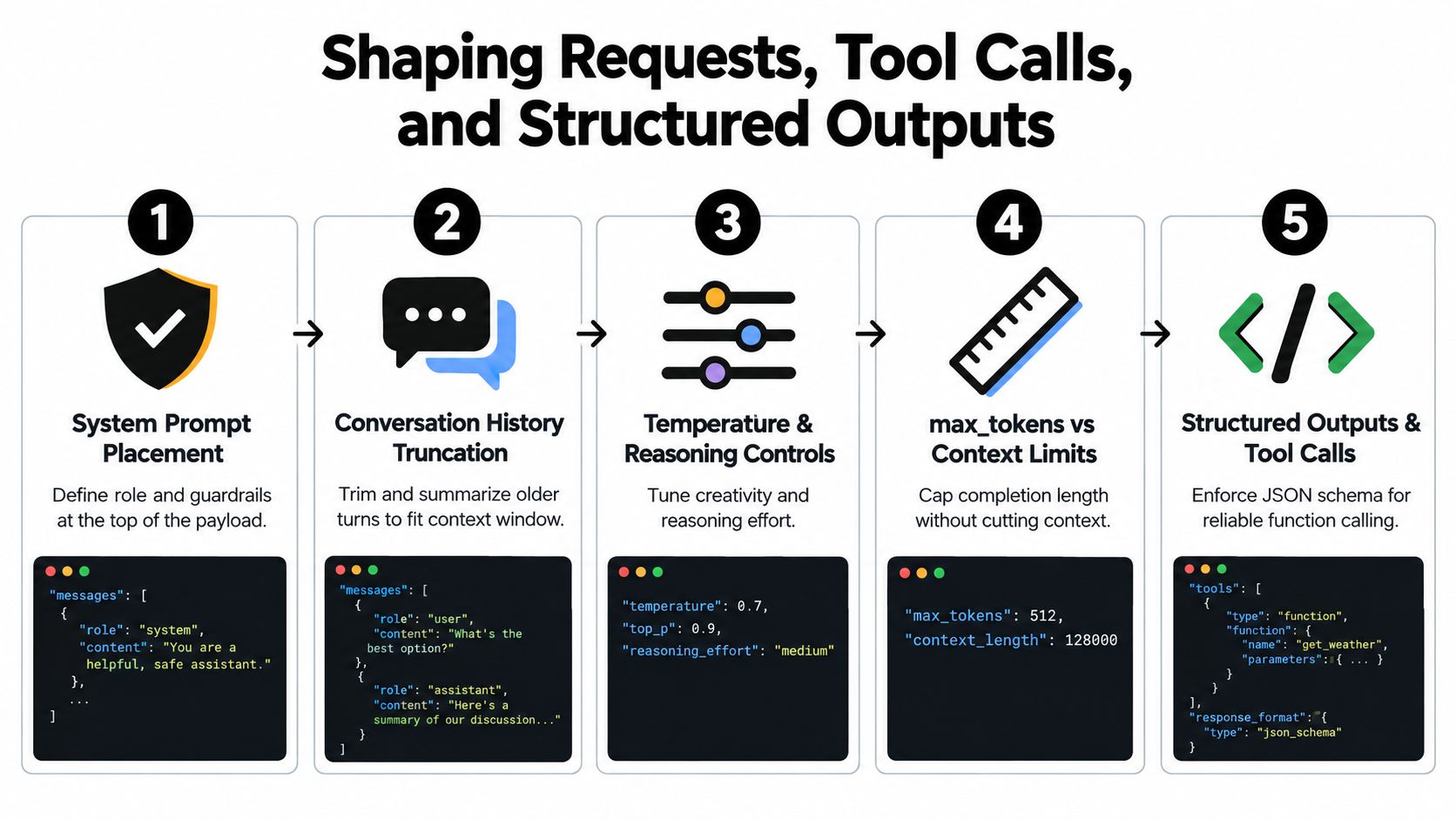
Context trimming matters because sloppy history handling hurts both latency and spend. Old turns should either be dropped or summarized. Re-sending everything is the fastest way to make a feature slower and harder to reason about.
Generation controls are cost controls
Temperature isn't just a style knob. It affects variance. So do provider-specific controls around reasoning depth and token limits.
Two details trip teams up:
max_tokensandmax_completion_tokensaren't always interchangeable. Different providers and gateways may prefer one field or support both with slightly different semantics.- Reasoning effort belongs in request shaping. If a model can spend extra reasoning tokens, that decision should be explicit at the feature level, not discovered later in billing logs.
The observability guidance from Calibre says latency should be broken into time to first token and per-token decode latency, with total latency approximated as TTFT + (ITL × output tokens). It also notes practical targets such as TTFT under about 800 ms for streaming chat and under about 300 ms for code completion (Calibre observability guidance). That formula is useful during request design because output length and reasoning depth directly change what users experience.
Structured outputs and tool calls need a hard contract
If your app needs a machine-readable result, ask for one directly. Use JSON Schema or a strict response format when malformed output would trigger expensive retries or broken downstream automation.
Loose parsing is sometimes cheaper when:
- the output is mostly for display,
- a lightweight validation pass can clean up small inconsistencies,
- or cross-provider schema enforcement isn't uniform enough for strict mode.
Tool calling follows the same principle. Register an explicit tools array with the tool name, description, and JSON Schema parameters. When the model returns tool_calls, your server should validate the chosen tool and arguments, invoke the allowed function, then feed the tool result back into the next model turn.
Don't let the loop run forever. Cap tool iterations.
Register the tools you support, validate every argument server-side, and reject any tool name the model wasn't explicitly given.
Versioning saves more incidents than prompting tricks
Prompt changes, schema changes, and model changes should all be versioned independently. That's because they fail differently.
Keep these rules in place:
- Pin model identifiers where stability matters: silent upgrades are not your friend in critical paths.
- Version system prompts: a support bot and a contract parser should not share one mutable instruction blob.
- Validate schemas on the server: never trust the model's confidence.
- Separate user-visible prose from machine outputs: if you need both, request both explicitly.
Teams often overfocus on prompt wording and underfocus on payload discipline. In production, payload discipline wins.
Streaming Responses the Right Way
Streaming is where AI features start feeling responsive. It's also where a lot of otherwise competent backends leak cost and connections.
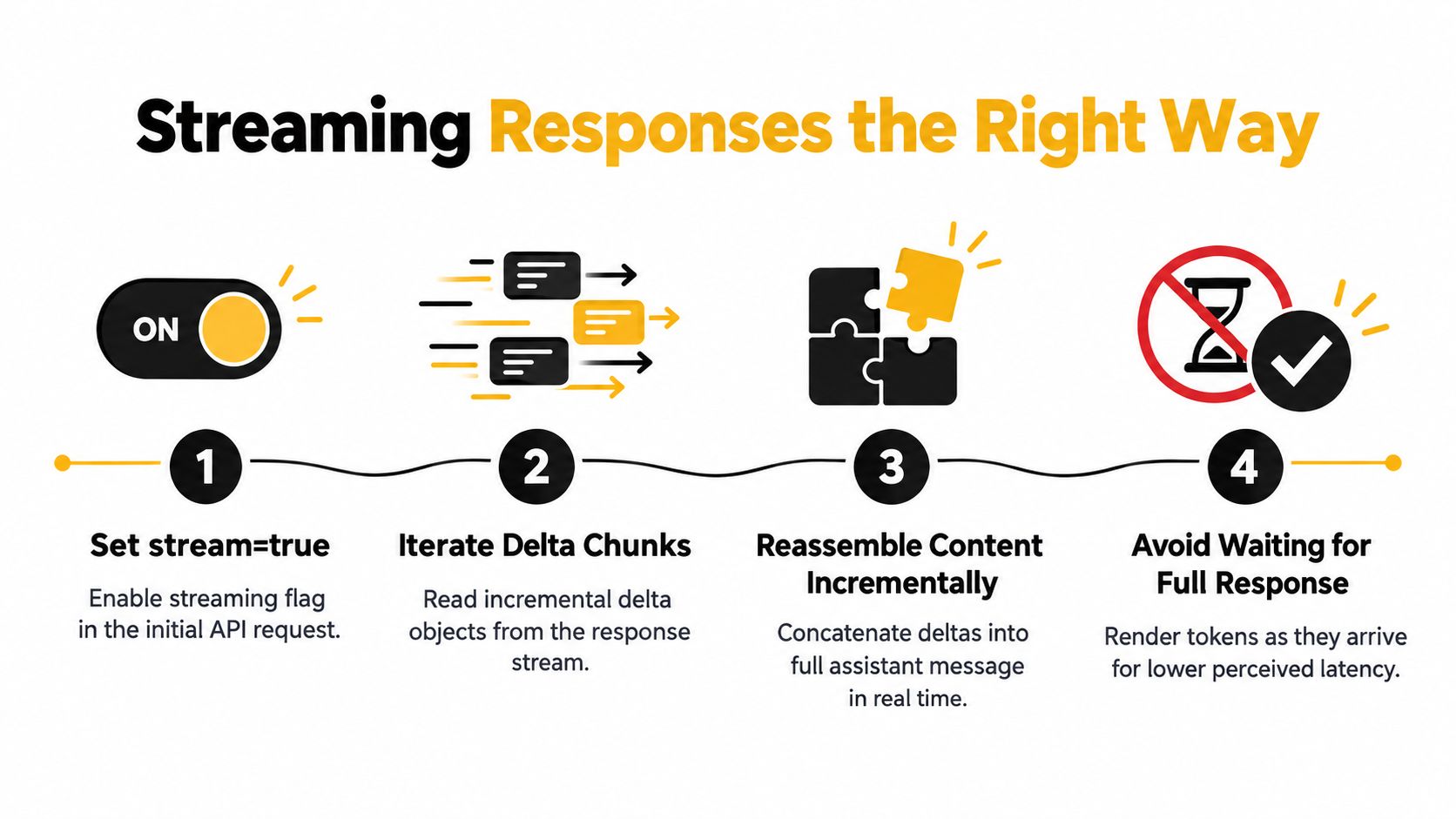
Set stream=true, consume the response as Server-Sent Events, and render tokens as they arrive instead of blocking on the final payload.
Measure the first useful moment
Users don't care much about full completion time if they can see the answer starting quickly. They care about the pause before anything appears.
Record time to first token when the first event chunk reaches your application boundary, not when the request object is created. Then keep total wall time separately. Those are different problems with different fixes.
If you need a reference implementation for client-side and server-side handling, Openbase's streaming documentation follows the same OpenAI-compatible pattern many gateways expose.
Reassemble content carefully
Streaming payloads often arrive as deltas. Your job is to iterate chunks, extract content-bearing fields, append them to a buffer, and flush them to the client incrementally.
Watch for these edge cases:
- Non-content deltas: some reasoning-oriented models may emit extra internal fields you shouldn't render directly.
- Chunk framing differences: SSE is not the same as newline-delimited JSON, even if both arrive progressively.
- Partial tool-call payloads: structured arguments may arrive over several events and need assembly before validation.
Here's a practical walkthrough of the streaming interaction pattern in action:
Cancellation hygiene matters
Streaming bugs usually show up under disconnect conditions, not happy paths. If the browser tab closes, abort the upstream request. If your server times out locally, close the stream instead of leaving the provider connection alive in the background.
That prevents orphaned generations from continuing to consume tokens after the user has already left.
A clean streaming implementation does three things well:
- Propagates abort signals upstream
- Stops buffering unbounded output when the downstream client is slow
- Finalizes logs even for cancelled requests
Teams often celebrate their first streamed demo. The more important milestone is the first time a dropped mobile connection doesn't leave five invisible model calls running.
Retry, Failover, and Error Handling Policy
A weak retry policy can double your costs and still fail the user. A good one is boring, explicit, and driven by status code and error type.
The core rule is simple. Retry transient failures. Don't retry caller or configuration errors.
Guidance from API7 for AI gateway routing recommends retrying 408, 429, 500, 502, 503, and 504, and not retrying 400, 401, 403, 404, or 422. It also recommends honoring Retry-After when present and setting request and total timeouts carefully so failover isn't cut off too early or allowed to hang too long (API7 guidance on proxy errors and retries).
Retry and Failover Decision Matrix
| Status / Error | Category | Action | Backoff | Failover? |
|---|---|---|---|---|
| 408 | Transient timeout | Retry same provider if deadline allows | Exponential with jitter | Yes, if repeated or near timeout budget |
| 429 | Rate limit | Respect provider signal, then retry | Use Retry-After when present | Yes, often the right next move |
| 500 | Transient server error | Retry cautiously | Exponential with jitter | Yes |
| 502 | Upstream gateway failure | Retry | Exponential with jitter | Yes |
| 503 | Temporary unavailability | Retry | Exponential with jitter | Yes |
| 504 | Gateway timeout | Retry if request budget remains | Exponential with jitter | Yes |
| 400 | Caller error | Do not retry | None | No |
| 401 | Auth error | Refresh or fix credentials, then stop | None | No |
| 403 | Permission error | Stop and alert | None | No |
| 404 | Wrong path or model identifier | Stop and correct config | None | No |
| 422 | Validation or semantic request error | Fix payload | None | No |
| Connection reset / network interruption | Usually transient | Retry if idempotent and within deadline | Exponential with jitter | Yes |
Keep retries scarce and intentional
In practice, two mistakes cause most pain:
- too many retries, which destroy tail latency;
- retries on bad requests, which multiply waste.
I prefer a small retry budget with jittered exponential backoff. That keeps p99 under control and prevents synchronized retry bursts when a provider is already under stress.
Your failover order should also be explicit:
- Primary model on primary provider
- Same or equivalent model on fallback provider
- Cached response or previously computed answer, if acceptable
- Graceful degraded path, such as summary unavailable, manual review required, or non-AI fallback copy
Streaming and idempotency need special care
For non-streaming requests, idempotency keys can help you dedupe duplicate completions after network failures. For streaming, the problem is messier because the user may have already seen part of the output before the connection died.
That means you need policy choices, not just transport logic:
- If a stream fails very early: retrying might be acceptable.
- If a stream fails after visible output: restarting may confuse users unless the UI can clearly indicate regeneration.
- If failover switches to a more expensive model: decide whether reliability or cost wins for that feature.
If your team needs a compact reference for common integration failures, Openbase keeps an error reference that fits the same OpenAI-compatible gateway workflow many teams implement.
A retry policy is part of product behavior, not just backend resilience. Users notice when the second answer contradicts the first.
Circuit breakers belong above individual requests. Trip them after a run of failures or higher provider instability, then route fresh traffic elsewhere for a cooldown period. Otherwise, every request rediscovers the outage independently.
Observability Hooks for Cost and Performance
If you can't answer “what happened, what did it cost, and which provider served it?” then your AI API integration isn't production-ready.
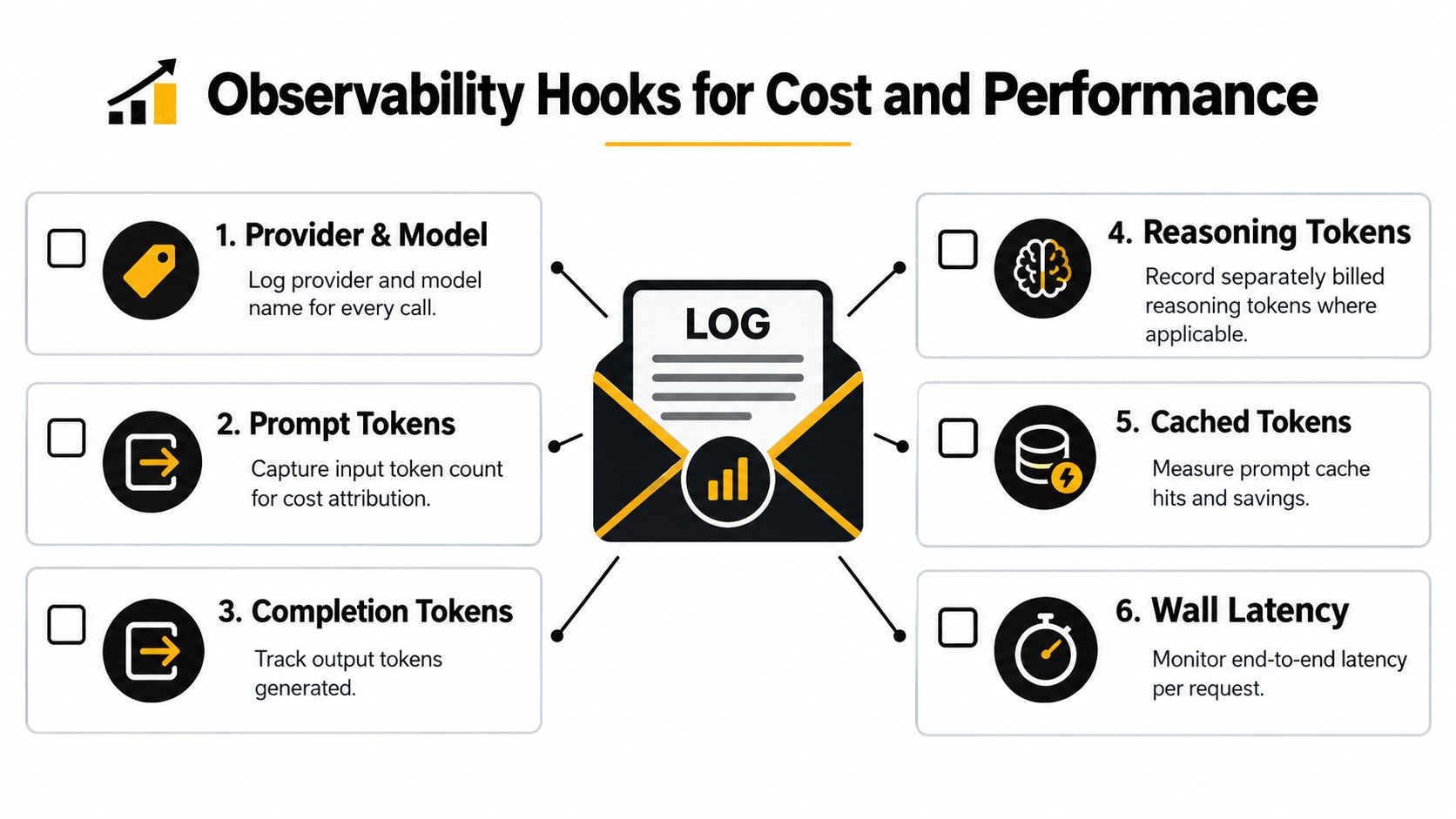
The minimum useful log envelope is structured, per request, and shared with the rest of your tracing pipeline. It should include provider, model, token usage fields, latency fields, whether the answer was streamed, whether a retry happened, and what final route served the request.
What to log every time
At minimum, capture:
- Provider and model: especially important when one logical model name can route to multiple upstreams.
- Input and output token counts: the foundation for cost attribution.
- Reasoning tokens where applicable: they change cost and sometimes explain latency.
- Wall latency and TTFT: one describes total duration, the other user-perceived responsiveness.
- Retry and failover markers: otherwise incident review turns into guesswork.
- Tenant, feature, and workflow identifiers: needed for chargeback and abuse control.
Observability itself has a cost
This gets skipped in too many guides. Instrumentation isn't free.
Broader observability research in 2025 found that spend can average about 17% of compute infrastructure spend, and the same source argues that agentic workloads can multiply telemetry and operational overhead (analysis of observability cost and complexity). That matters because AI requests already carry larger payloads, longer durations, and more branching behavior than many ordinary API calls.
The Calibre evaluation also notes overhead of about 12% and 15% for two monitoring tools in one 2026 evaluation, which is a useful reminder that tracing can affect throughput if you sample too aggressively, as cited in the earlier observability source.
Dashboards should answer operator questions
A dashboard that only shows request count isn't enough. Build views that map to actual decisions:
- Cost per feature: so product teams see which experiences are expensive.
- TTFT by model and provider: because “slow” usually means “slow to start.”
- Error rate by route: not just by application endpoint, but by upstream provider.
- Retry and failover frequency: a leading signal before users file tickets.
- Per-tenant usage: necessary for limits, billing, and support conversations.
OpenTelemetry is a good fit because it lets you correlate LLM spans with the parent application request. That makes it possible to answer whether the model was the bottleneck, or whether retrieval, serialization, or downstream tool calls were the delay.
The other operational habit that pays off is reconciliation. Compare your internal usage logs with provider or gateway billing exports on a regular cadence. Not because your system is necessarily wrong, but because AI metering has more moving parts than ordinary REST traffic.
Governing Agentic Traffic and Wrapping Up
A lot of teams still think AI API integration is about wiring prompts to models. That was true when the model only answered questions. It stops being true when the model can call tools, trigger workflows, or act across tenant boundaries.
The governance gap is real. Postman's 2025 API research found that 89% of developers use AI, but only 24% design APIs for AI agents. The same report says 51% cite unauthorized or excessive API calls from agents as a top security risk, 49% worry about sensitive-data exposure, and 46% worry about leaked credentials (Postman State of the API 2025). That should reset the conversation. The problem isn't just model quality. It's machine consumers operating with too much freedom.
Agents need policies, not trust
An agent that can call your tools is closer to an automated operator than a chatbot. Treat it that way.
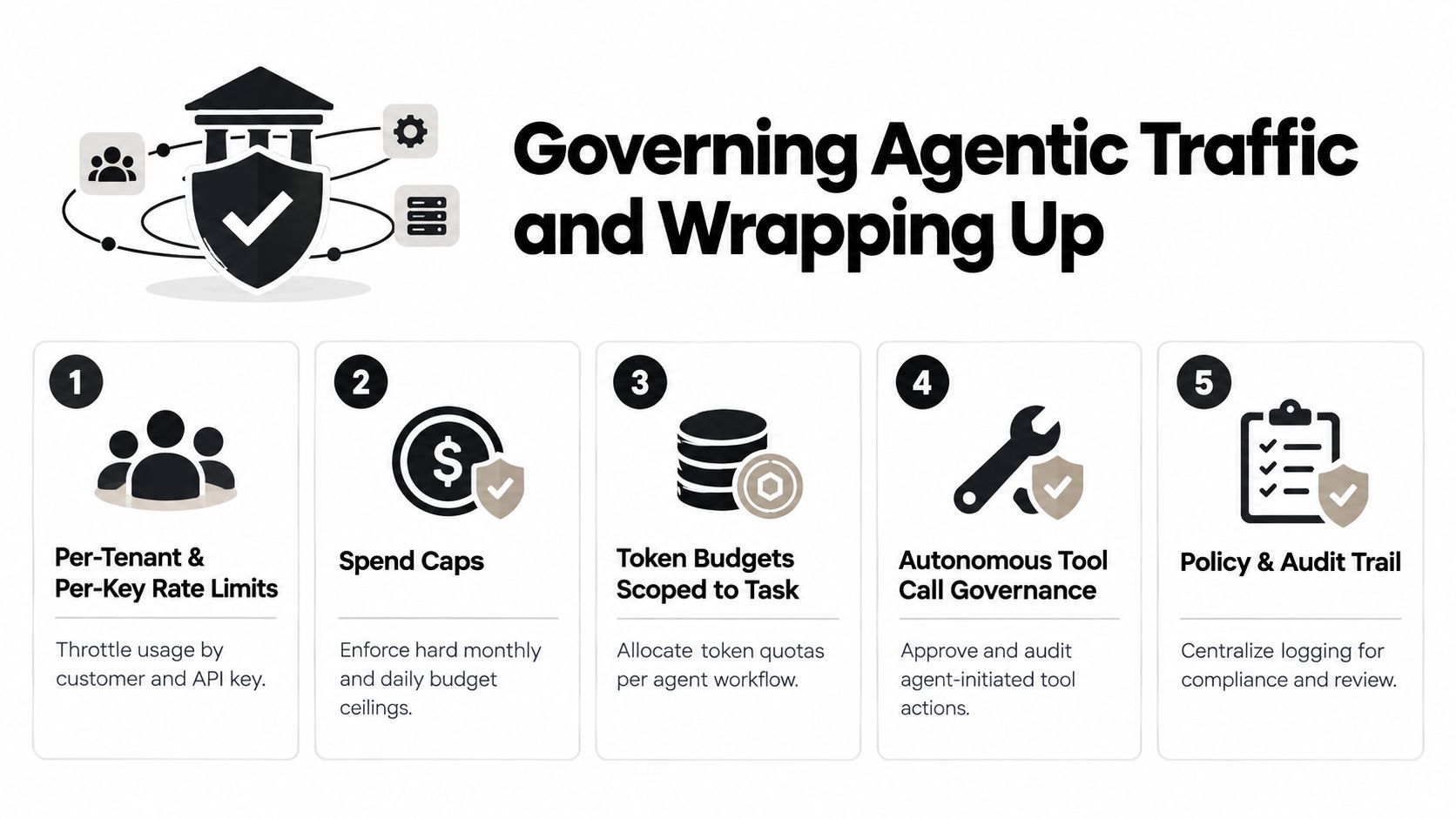
The controls that matter most are straightforward:
- Per-tenant and per-key rate limits: contain noisy behavior before it spreads.
- Spend caps and token budgets: enforce ceilings at the workflow level, not just the account level.
- Fast revocation: disable a key, tenant, or tool path immediately when policy is violated.
- Signed audit trails: record tool invocation, selected model, final provider, and outcome.
- Separation between user prompts and system actions: the model shouldn't turn a user request into a privileged action without a governed handoff.
The durable checklist
If a new AI feature can't pass this list, it isn't ready for production:
- A gateway plan exists: direct, unified, or self-hosted, with a reason for the choice.
- Auth boundaries are clear: no shared all-powerful secret sprayed across services.
- Requests are shaped intentionally: context, schema, tool definitions, and output caps are explicit.
- Streaming includes cancellation: disconnected clients don't keep spending.
- Retries follow status-code policy: transient errors are retried, caller errors are fixed.
- Observability is token-aware: cost, TTFT, and route data are queryable.
- Agent actions are governed: limits, revocation, and audit are built in.
One practical option for teams that want a unified layer is Openbase, which exposes an OpenAI-compatible endpoint across multiple providers, supports failover, and logs model, provider, token counts, latency, TTFT, and cost per call. That's useful when you want one integration surface without maintaining separate provider contracts yourself.
The common assumption is that model selection is the hard strategic choice. In day-to-day operations, governance usually matters more. Plenty of teams can swap one model for another. Fewer can explain, in detail, how an autonomous workflow was authorized, limited, billed, retried, and audited.
If you're building AI features that need one stable API surface, multi-provider routing, and per-call visibility into tokens, latency, and cost, Openbase is built for exactly that operating model. It gives teams an OpenAI-compatible gateway with failover and usage controls that fit the integration patterns covered here. Take a look at Openbase if you want to simplify the plumbing without giving up operational discipline.