
Your AI feature worked in the demo, then real traffic arrived. Responses slowed, retries multiplied, and the bill rose even though the model endpoint still reported itself as available. That's the moment teams discover that AI infrastructure isn't a single API call. It's the connected system that decides which model runs, where it runs, how long users wait, what each request costs, and what happens when something degrades.
Table of Contents
- Why AI Infrastructure Decisions Compound
- Build the AI Infrastructure Mental Model
- Compare AI Infrastructure Deployment Models
- Understand Compute and Serving Constraints
- Design Reliable Model Serving
- Orchestrate Models and Application Traffic
- Connect Observability With Cost Controls
- Verify a Production Reference Architecture
Why AI Infrastructure Decisions Compound
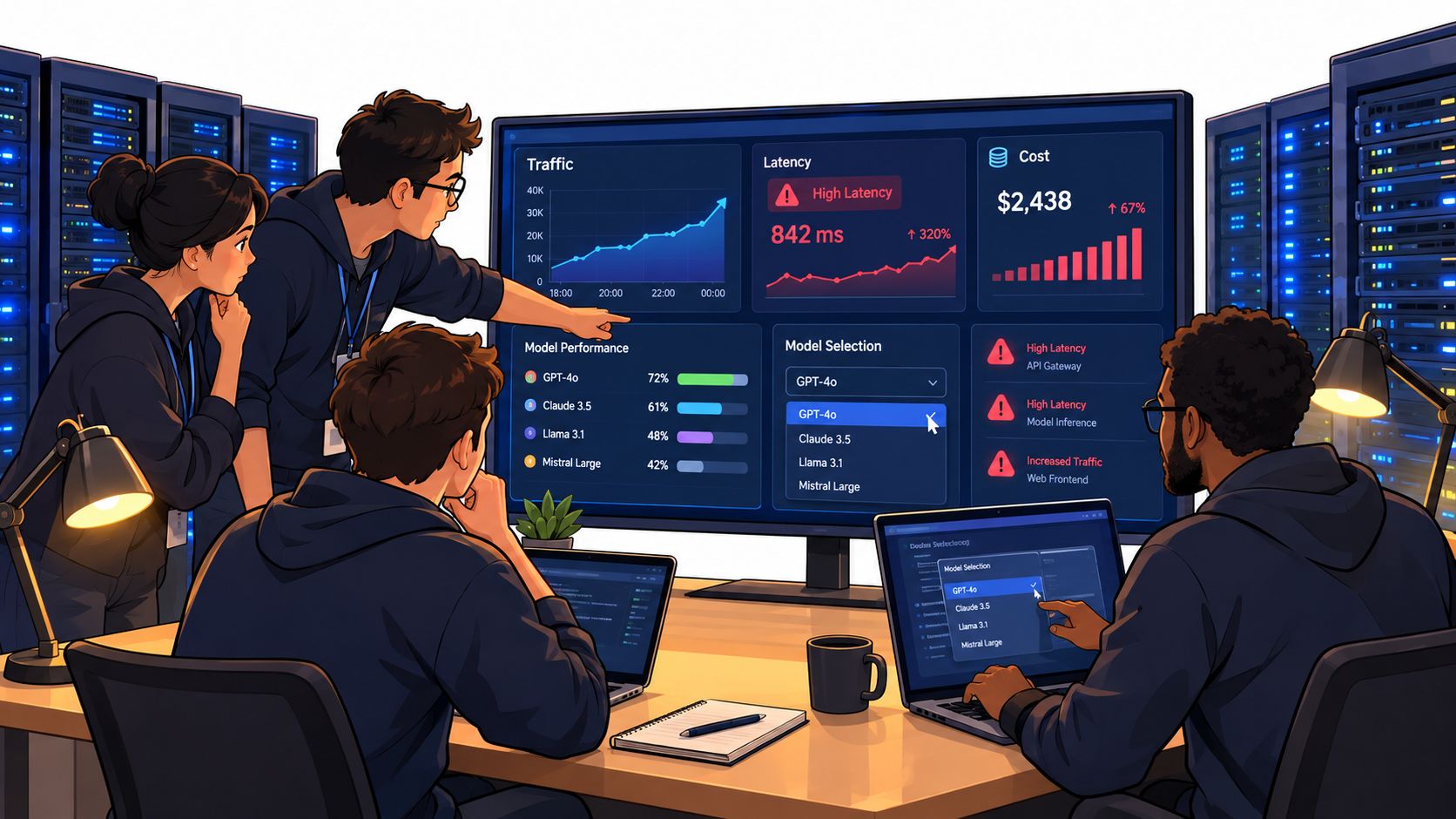
A support assistant launches on a Monday with light traffic and a generous context window. By Thursday, a product launch sends longer conversations, more concurrent users, and a new agent workflow that calls the model several times per task. The endpoint hasn't gone down, but time to first token climbs, timeouts trigger retries, and each retry sends the full context again.
The team first blames the model. Switching to a cheaper endpoint lowers the listed price per token, yet total spend keeps rising because nobody can see which workflow creates the retries, which prompts carry oversized context, or which calls produce long reasoning outputs. A faster accelerator wouldn't fix unclear usage attribution either.
What the incident actually reveals
AI infrastructure is the layer that turns a model request into dependable application behavior. It includes the compute that runs inference, the serving path that accepts and streams requests, the policies that route traffic, the logs that explain behavior, and the controls that keep usage inside a budget. Weakness in any one part puts pressure on the others.
Queueing looks like model slowness to a user. Unmeasured retries look like organic demand to a capacity planner. A missing data contract for prompts, tool results, and token limits lets one feature change the cost profile of every downstream call.
Treat early shortcuts as operating policy, because production traffic will repeat them at scale until you change them.
Four decisions compound fastest, and they're worth making deliberately before traffic forces your hand.
- Data contracts: Define what enters a prompt, how context is trimmed, and what output shape callers can expect.
- Routing policy: Decide how tasks map to models and what happens when a provider degrades.
- Usage attribution: Record model, provider, tokens, latency, retries, and cost for every call.
- Capacity headroom: Keep room for bursts and failures instead of sizing only for average load.
You'll get more leverage from those choices than from chasing a single cheaper endpoint. They determine whether you can explain an incident, prove a cost change worked, and add a new model without rewriting application code. Good infrastructure doesn't remove constraints, but it makes them visible early enough to manage.
Build the AI Infrastructure Mental Model
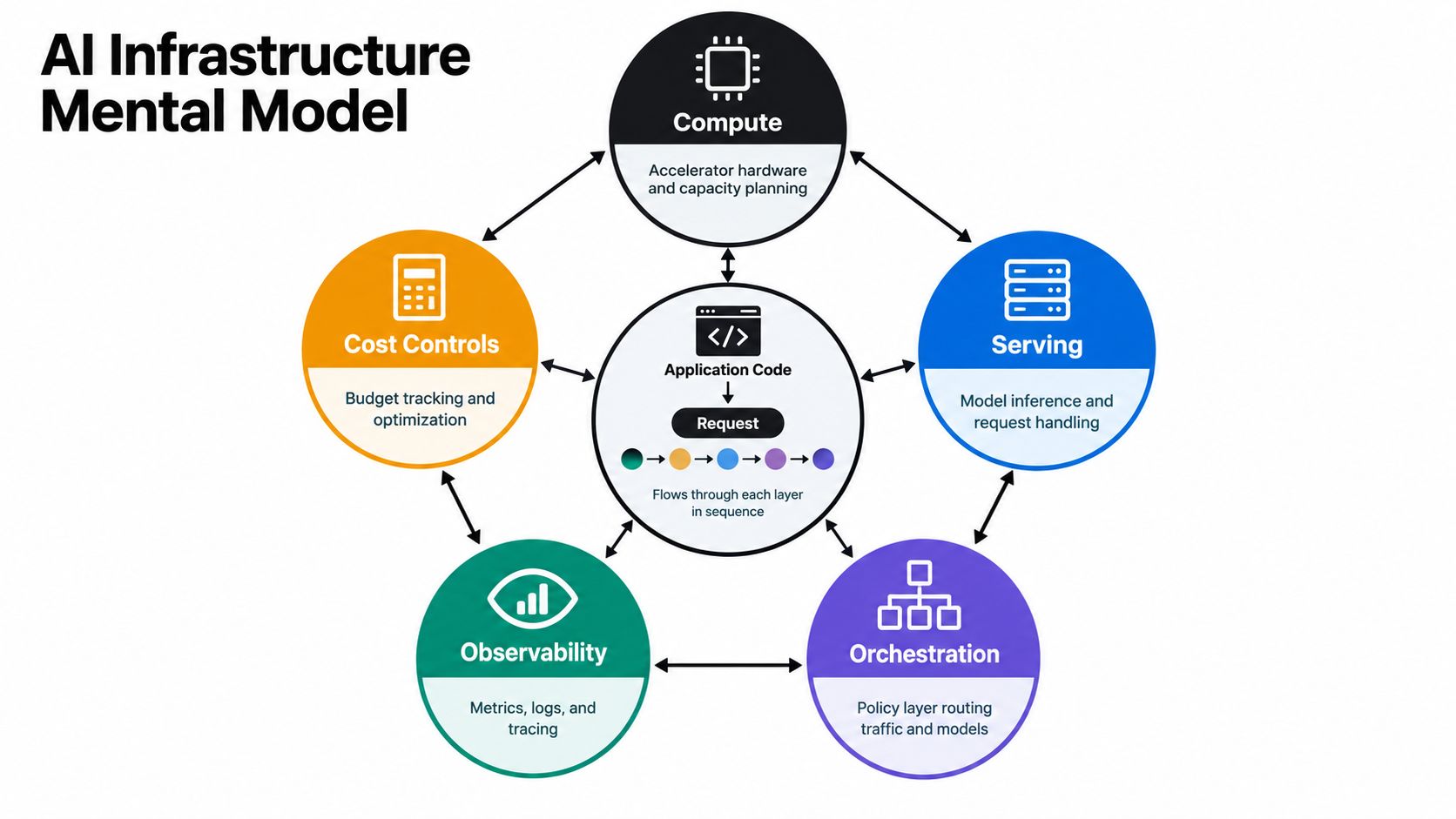
Follow one request. A user asks your application to summarize a long document, and your code sends a prompt, a model name, and output limits into the system. Something has to supply compute, run the model, enforce policy, record what happened, and charge the usage to the right budget.
Those jobs form five connected responsibilities. Keeping them separate in your head helps you assign each failure, metric, and owner to the right layer instead of blaming the model for every symptom.
Five responsibilities on one request path
Compute supplies the physical or hosted capacity, mainly accelerators, memory, storage, and networking. Serving exposes the inference interface, loads the model, accepts requests, generates tokens, and streams the response back. If compute is the kitchen equipment, serving is the pass where orders are accepted, cooked, and handed out in order.
Orchestration sits between application code and serving. It picks the model for the task, applies provider priority, enforces rate limits, and decides when a failure should trigger failover. Observability records tokens, latency, errors, retries, and provider choice so you can reconstruct the request later.
Cost controls close the loop. They turn observations into limits on context size, output length, concurrency, retries, and spend per key, team, or workflow. Without that loop, dashboards only describe problems after the invoice arrives.
A short walkthrough of this flow can make the handoffs easier to picture before you map them to your own stack.
Training is not inference
Training builds model weights by processing large datasets in long, planned runs where throughput matters more than a single user's wait. Inference answers live requests, so latency, concurrency, and unpredictable prompt sizes dominate. The Stanford AI Index notes that training compute has been doubling approximately every five months, datasets every eight months, and AI power use annually, which explains why training capacity planning follows a different curve from serving demand in Stanford's 2025 AI Index report.
Most application teams don't operate training, but they inherit its consequences. Larger models need more memory at serving time, and new model releases change the cost and latency profile of existing features. Your mental model should treat model choice as an infrastructure input, not a fixed constant.
When a request misbehaves, walk the five layers in order. Was capacity saturated, did serving queue the request, did orchestration pick a poor route, did observability miss the signal, or did a missing cost control let the workflow run unbounded? That sequence turns a vague complaint into a testable diagnosis.
Compare AI Infrastructure Deployment Models
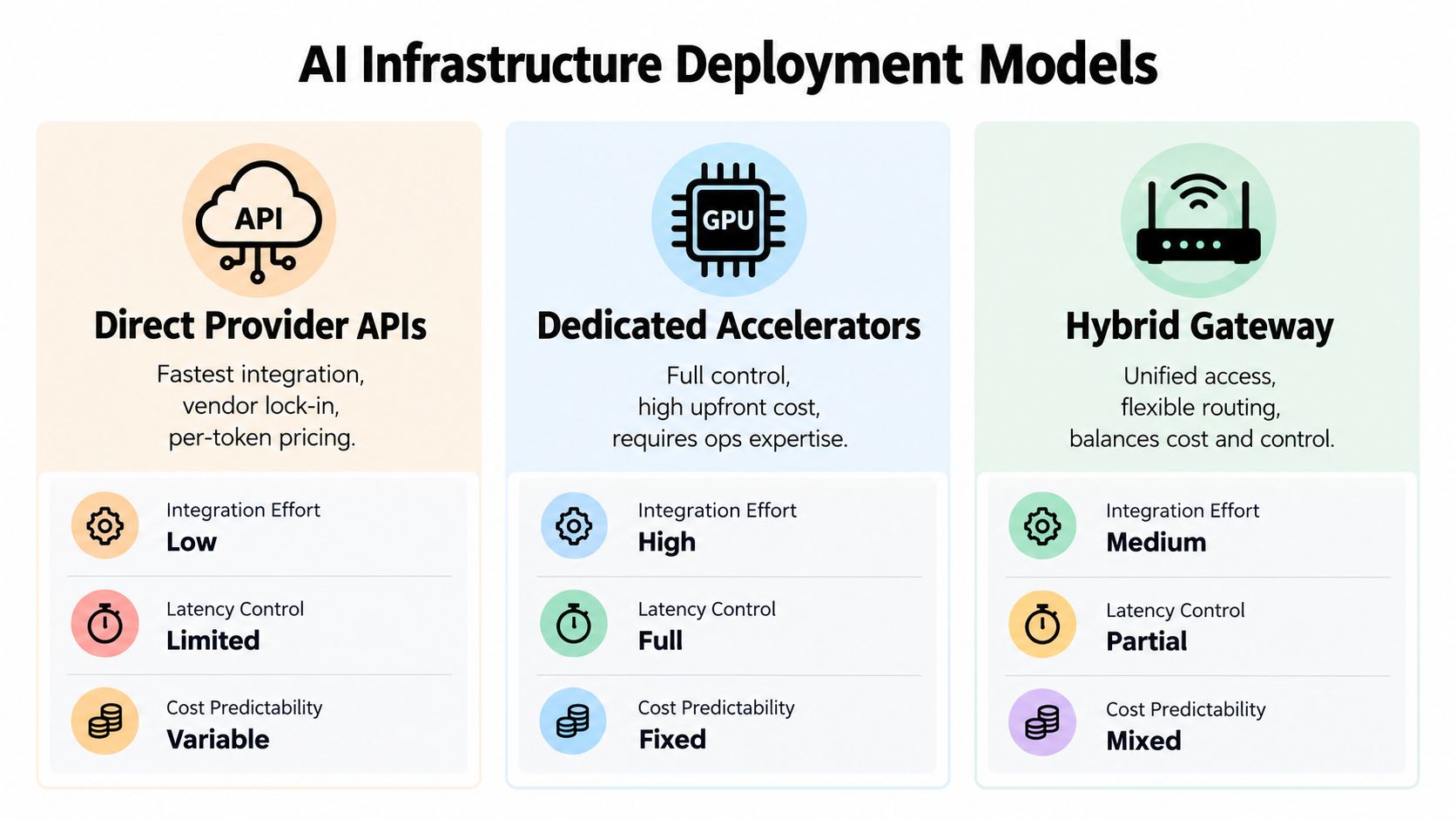
Three deployment paths cover most production needs, and none wins on every dimension. Your choice depends on workload shape, how much operations work your team can absorb, and how much control you need over capacity. Comparing them carefully prevents both underbuilding and expensive overbuilding.
Direct provider APIs
Calling a hosted provider directly gives you the fastest path to a working feature. You skip hardware procurement, model hosting, and capacity operations, and you pay per token as demand varies. That fit suits experimentation, spiky traffic, and teams that can't justify running accelerators.
The tradeoffs appear as you add providers. Each new vendor can mean another key, invoice, rate limit, request shape, and failure mode, and your application absorbs the differences. You also depend on the provider's capacity and incident response, so redundancy becomes your integration problem.
Dedicated or locally operated accelerators
Running your own accelerators gives you direct control over model versions, data locality, batching, and capacity. Teams with steady, predictable volume or strict governance needs can justify that investment. Cost becomes more fixed, but only if utilization stays high enough to spread the hardware and operations expense.
Ownership is the price. Your team handles procurement, drivers, model updates, scaling, monitoring, and hardware failure, and idle capacity still costs money. Dedicated infrastructure also moves slowly when a better model needs different memory or accelerator characteristics than the fleet you bought.
Hybrid gateway led design
A gateway keeps application code behind one interface while traffic reaches multiple providers or your own serving capacity. Openbase is one example of this pattern, offering unified model access through an OpenAI-compatible endpoint, consolidated billing, provider routing with automatic failover, and per-request usage logging. That reduces integration friction, but it doesn't remove upstream capacity limits or make a poor routing policy safe.
- Integration effort: Direct APIs start fastest, dedicated capacity takes longest, and a gateway adds one integration that can serve many models.
- Operational ownership: Providers own hosted capacity, your team owns dedicated fleets, and hybrid designs split responsibility at the gateway boundary.
- Redundancy: Direct calls need application-level fallback, dedicated fleets need spare capacity, and gateways can route around a degraded upstream.
- Cost attribution: Per-token invoices vary by provider, dedicated costs need internal allocation, and gateway logs can attribute spend per request and key.
Start from your constraints, not from fashion. If demand is uncertain, hosted access preserves flexibility while you learn the workload. If volume is stable and control requirements are strict, dedicated capacity may earn its operational cost. Many teams land in the hybrid middle because they need provider choice and consistent measurement more than they need to own hardware.
Understand Compute and Serving Constraints
A model doesn't run on an API abstraction. It runs on accelerators that must hold weights in memory, move data between components, and generate tokens while other requests compete for the same resources. Deployment labels hide those limits, but latency exposes them.
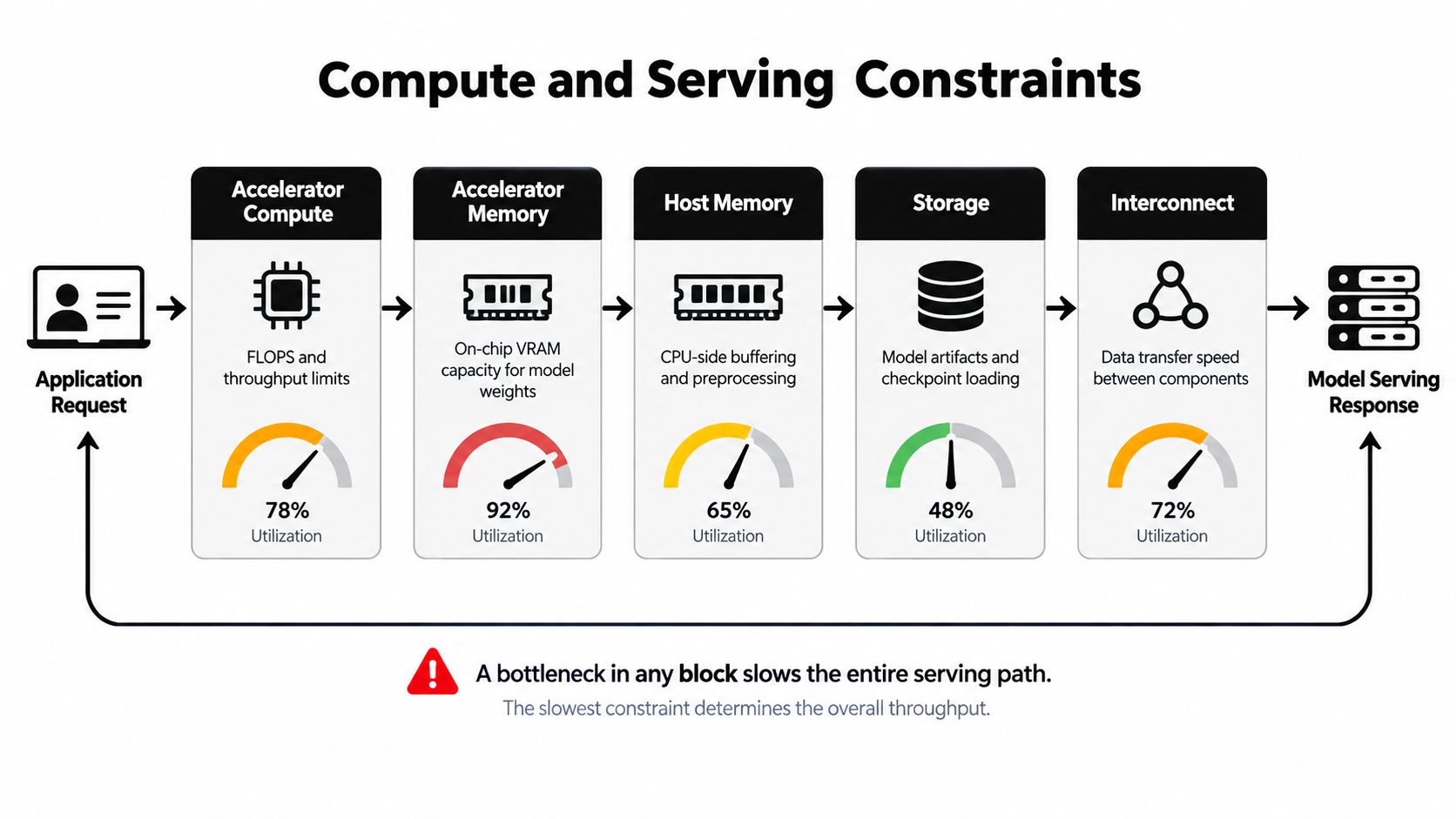
Five resources that can bottleneck a request
Accelerator compute performs the matrix operations behind inference, usually described in FLOPS. Accelerator memory holds model weights and the key-value cache that grows with context length and concurrency. When memory fills, requests queue or fail even if raw compute sits idle.
Host memory buffers inputs and handles preprocessing on the CPU side. Storage affects how fast model artifacts and checkpoints load, which matters during scaling and recovery. Interconnect moves data between accelerators, hosts, and storage, and slow movement starves otherwise capable hardware.
Think of a warehouse with fast forklifts but narrow aisles. Adding forklifts doesn't raise throughput when workers can't reach the shelves, and adding FLOPS doesn't help when memory bandwidth can't feed the accelerator. A Micron workload study found DDR5-4800 provides a theoretical maximum bandwidth of 614 GB/s versus 410 GB/s for DDR4-3200, while measured gains varied sharply by workload, reaching 7x for ResNet inference, 4.9x for BERT inference, and 4.3x for a deep learning recommendation model in Micron's DDR5 AI inference workload study.
Workload shape picks the bottleneck
Model size, context length, batch size, quantization, and concurrency decide which resource saturates first. Long contexts expand memory pressure, large batches raise throughput but can delay individual responses, and quantization reduces memory demand while changing the compute profile. The same hardware can look excellent for short chat prompts and poor for long document analysis.
Measure the request, not just the machine. When you compare options in a catalog of available models, pair each candidate with workload signals from your own traffic.
- Time to first token: Shows queueing, model loading, and prompt processing delay before output starts.
- Inter-token latency: Shows how steadily tokens arrive once generation begins.
- Output tokens per second: Summarizes generation speed for a request or workload.
- Concurrency and tokens per GPU-second: Reveal whether added load produces useful throughput or only longer waits.
Benchmark with representative prompts and realistic concurrency, not single isolated calls. A lone request can't expose queueing, cache pressure, or upstream throttling. Your goal is a diagnosis you can act on, whether the system is compute-saturated, memory-constrained, queue-bound, or throttled before it reaches the accelerator.
Design Reliable Model Serving
Reliable serving starts with the caller's experience, then works backward into capacity. A user doesn't care whether delay came from admission control or generation, but your design has to separate those stages. Each stage needs a limit, a signal, and a defined behavior when pressure rises.
Follow the request in order
Request admission decides whether the system accepts work now, queues it, or rejects it with a clear error. Queueing protects the serving tier from overload, but an unbounded queue only converts failure into long, useless waits. Set queue behavior from your latency objective, because work that finishes after the user leaves still consumes capacity.
Model loading comes next when capacity scales or recovers. Cold capacity that must load large weights can't serve immediately, so scaling decisions need lead time and warm headroom. Preprocessing then validates input, applies context limits, and prepares tool definitions before generation starts.
During generation, streaming returns tokens as they're produced, which improves perceived responsiveness and exposes stalls early. Response handling must preserve that stream correctly, record final token counts, and make tool calls behave consistently for the caller. A response that streams well but loses usage data still breaks your control loop.
Design rule: Every serving stage should either complete quickly, wait visibly, or fail clearly. Silent accumulation is what turns pressure into an outage.
Separate the two latency questions
Time to first token answers how long the system took to start responding. It reflects admission, queueing, prompt processing, and model readiness. Inter-token latency answers whether generation stays steady after it starts, which points more toward compute, memory, and batching pressure.
A request can look healthy at the API while pressure builds behind it. Early tokens may stream from a lightly loaded replica while the queue grows for everyone behind. Watch both measures together, segmented by model and concurrency, instead of trusting a single average latency number.
Batching and concurrency are tradeoffs
Batching groups requests so accelerators do more useful work per pass, raising throughput. The cost is responsiveness, because a request may wait for a batch to form or share generation with heavier neighbors. Interactive chat usually tolerates less batching delay than offline summarization, so one global setting rarely fits both.
Treat concurrency as a control knob, not a score to maximize. Past a workload-specific point, more simultaneous requests mainly add queueing and memory pressure. Find that point with representative load testing using your real prompt mix, output lengths, and streaming behavior.
For resilience, define detection and containment before an incident. Your team should know which signals mark capacity as unhealthy, how traffic routes away, how retries stay bounded, and how you'll verify streaming and tool calls after recovery. Write those behaviors down and test them, because an untested fallback path is a hope, not a design.
Orchestrate Models and Application Traffic
Orchestration is the policy layer between your applications and the systems that serve models. Serving answers whether a request can run, while orchestration answers where it should run, under which limits, and what happens when the first choice fails. That's where reliability and cost concentrate.
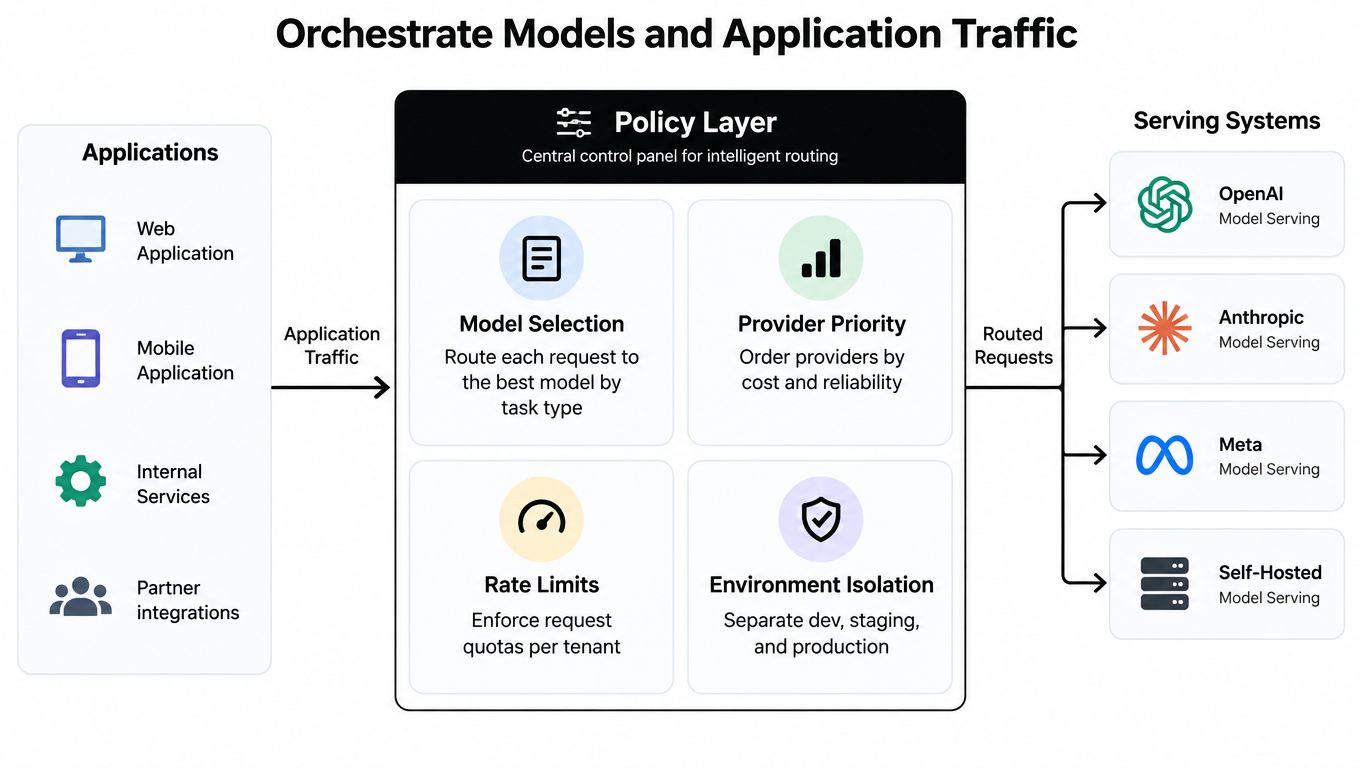
Route by task and provider health
Not every task needs the same model. Classification, extraction, drafting, and deep reasoning differ in context size, output length, and quality needs, so routing by task prevents your most expensive model from becoming the default for everything. Provider priority then orders acceptable upstreams by reliability, latency, and cost for that workload.
Health has to be current. A provider that was fastest yesterday may be throttling today, and static routing keeps sending traffic into the problem. Combine recent latency, error, and throttling signals with workload context, because a route that's fine for short prompts may struggle with long-context jobs.
Control limits, keys, and retries
Rate limits protect shared capacity and keep one tenant or feature from crowding out the rest. Environment-specific API keys isolate development, staging, and production traffic, and per-key limits let you revoke or constrain one integration without disturbing others. Pooled limits across providers serving the same model can reduce exposure to a single provider's ceiling, a pattern described in the documentation on rate limits and pooled capacity.
Retries need the most discipline. Automatic failover and mid-flight retries help when an upstream returns a transient error, times out, or degrades during a request. Indiscriminate retries do the opposite, multiplying load and token spend against an already struggling provider.
- Retryable conditions: Transient server errors, timeouts, and throttling may justify a bounded retry or failover to a healthy provider.
- Non-retryable conditions: Malformed requests and unknown model names won't succeed on repetition, so fail fast and surface the error.
- Retry boundaries: Cap attempts, preserve request context, and log every attempt so cost attribution stays honest.
A consistent request shape makes these policies portable. Provider-prefixed model slugs behind an OpenAI-compatible interface let application code change the model identifier without adopting a new SDK for each upstream. Streaming and tool calling should travel through the same shape so failover doesn't change application behavior.
Settle policy questions before traffic arrives. Which tasks may fall back to a smaller model, which errors trigger failover, which keys get priority during contention, and who owns changing a route during an incident? Answering those questions in advance converts orchestration from scattered application code into an operating system for your AI traffic.
Connect Observability With Cost Controls
A dashboard that only shows total spend can't tell you what to change. Observability becomes useful when each request joins model, provider, input and output token counts, reasoning tokens, latency, time to first token, retries, and exact cost per call. That record lets you connect a user-visible slowdown to a routing decision and a dollar amount.
AI Infrastructure Measurement Layers
| Measurement Layer | Representative Signals | Decision Supported |
|---|---|---|
| Per-request operations | Model, provider, latency, time to first token, errors, retries | Detect degradation, route away from unhealthy capacity |
| Workload efficiency | Tokens per GPU-second, batch utilization, joules per generated token, output tokens per second | Compare models and serving settings for a given workload |
| Financial controls | Exact cost per call, reasoning tokens, daily rollups, spend per key | Set budgets, attribute cost, reconcile invoices |
| Application constraints | Context size, output length, agent steps, cache hits | Limit runaway workflows before they consume capacity |
Cheap tokens can still produce expensive workflows
Price per token is just one input. A workflow with long contexts, oversized outputs, repeated retries, and low accelerator utilization can cost more on a cheap model than a tight workflow costs on a pricier one. Compare total cost per completed task using the rates structure shown on the pricing page for per-token model rates, then multiply by the retries and reasoning tokens your logs record.
Controls should act on the causes your measurements expose. Route simple tasks to smaller models, cache repeated prompts, batch delay-tolerant work, cap context and output length, limit retries, and give agents a step budget. Each control trades something, usually freshness, responsiveness, or reasoning depth, so tie it to a workload requirement instead of applying it globally.
Watch the rebound effect and the facility layer
Lower unit cost often invites more usage. Cheaper inference encourages more calls, longer agent loops, higher reasoning budgets, and multimodal features, so total consumption can rise even as each request gets more efficient. Data-centre electricity demand rose 17% in 2025, and total consumption is projected to roughly double from 485 TWh in 2025 to 950 TWh in 2030 while AI-focused demand triples, according to the IEA update on data-centre electricity use in 2025. Report marginal workload impact alongside unit economics, or efficiency gains will hide growth in total footprint.
Keep facility efficiency separate from application efficiency. The U.S. Department of Energy estimates facilities serving AI equipment averaged a power usage effectiveness of 1.145 in 2024, meaning total facility electricity ran 14.5% above IT equipment consumption, with only a modest projected improvement to 1.136 by 2030 in the Department of Energy 2025 data center energy report. PUE describes building overhead, not whether your software converts electricity into useful tokens.
Report cost per completed task, tokens per successful outcome, and total workload volume together. Any one of them alone will mislead you.
Correlate provider, model, tokens, latency, and retry behavior in one log stream. That correlation is what lets routing optimize reliability and total resource efficiency instead of chasing the lowest listed price. It also gives finance, product, and engineering the same facts during a dispute.
Verify a Production Reference Architecture
A reference architecture earns its place by surviving failure questions, not by looking tidy. Use the design below as an illustrative topology, then test each choice against your latency, governance, and cost constraints. The labels describe responsibilities, and your implementation can merge or split them as long as ownership stays clear.
An illustrative production path
Application code sends a request with a task type, context limits, and an environment-specific key. A model-access gateway authenticates the key, applies routing and orchestration policy, and selects a provider or dedicated serving pool. Serving capacity admits or queues the request, generates tokens with streaming, and returns the response through the same path.
Observability wraps every hop. The gateway logs model, provider, token counts, reasoning tokens, latency, time to first token, retries, and cost, while serving emits queue depth, concurrency, and utilization. Cost controls read those signals and enforce budgets, context limits, and agent-step ceilings before the next request repeats an expensive pattern.
Energy sits beneath the whole path whether you operate the facility or rent capacity. Data centres consumed approximately 415 TWh in 2024, about 1.5% of global electricity consumption, and the IEA projects approximately 945 TWh by 2030, just under 3% of projected global electricity demand, in the IEA report on energy demand from AI. The same source estimates grid constraints could delay around 20% of planned global data-centre capacity through 2030, so geographic redundancy and capacity flexibility belong in architecture reviews.
Walk the failure scenarios
Test provider degradation by asking which signal triggers failover and whether streaming and tool calls still behave after the switch. Test a memory bottleneck by loading long contexts at realistic concurrency and watching whether time to first token or inter-token latency moves first. Each scenario should end with a named owner and a measurable exit condition.
Test a retry storm by simulating transient errors and confirming attempt caps, backoff, and non-retryable handling hold. Test queue growth by exceeding comfortable concurrency and checking that admission rejects or sheds work before waits become useless. Test unexpected token growth by sending the longest context and output your contracts allow, then verifying budget alerts fire before spend runs away.
- Classify workloads: Separate interactive, batch, and agent traffic with distinct latency and cost expectations.
- Test representatively: Use real prompt mixes, context lengths, and concurrency in load tests.
- Correlate metrics: Join provider, model, tokens, latency, retries, and cost in every usage record.
- Attribute usage: Give each environment and feature its own key and budget.
- Bound retries: Define retryable conditions, attempt caps, and failover triggers in writing.
- Protect headroom: Size for bursts and the loss of one route, not only for average demand.
- Set review triggers: Revisit routing and capacity when traffic shape, model pricing, or error patterns change materially.
Capital concentration shapes your options too. U.S. private AI investment reached $109.1 billion in 2024, nearly 12 times China's $9.3 billion and 24 times the United Kingdom's $4.5 billion, while generative AI attracted $33.9 billion globally, figures reported earlier from Stanford's AI Index. Organizations rarely replicate frontier infrastructure at that scale, which makes flexible access and pooled capacity practical rather than compromised choices.
Apply one decision rule at the end of the review. Choose the simplest deployment that satisfies your reliability, latency, governance, and cost constraints, and add dedicated capacity or gateway complexity only when you understand and can measure the tradeoff. If you can't explain how a layer fails, what it costs per completed task, and which signal proves it's healthy, that layer isn't verified yet.
If you're ready to put this architecture into practice without stitching together separate provider accounts, Openbase gives your team one OpenAI-compatible endpoint with automatic failover, provider routing, and per-request logs for tokens, latency, and cost. Start with a single key, route a representative workload through it, and use the usage records to verify your routing, retry, and budget decisions against real traffic.