
Your team ships an LLM feature through one provider. It works in staging, then launch week arrives. Requests hit rate limits, streaming responses slow down, and a larger-than-expected invoice appears before anyone has attributed spend to a product or environment. The model wasn't necessarily the problem. The stack around it was too narrow.
The right AI infrastructure tool depends on the failure you need to prevent. A gateway addresses fragmented provider access and upstream outages. A serving platform addresses model deployment and GPU capacity. A serverless GPU runtime addresses bursty custom workloads. A managed cloud platform addresses governance, networking, and procurement.
The tools below are assessed by the infrastructure job they perform, not by popularity or a generic feature checklist. For each one, the practical questions are simple. What breaks when demand rises? Which part of the system does the product control? What does it hide? Before adopting any platform, settle the details that affect production: compatibility with your SDK, retry behavior, rate limits, cold starts, regional availability, observability, and the way usage reaches your finance team.
Table of Contents
- 1. Openbase
- 2. Together AI
- 3. Fireworks.ai
- 4. Anyscale Endpoints
- 5. Replicate
- 6. Modal
- 7. Baseten
- 8. Amazon Bedrock
- 9. Google Vertex AI
- 10. Groq
- Top 10 AI Infrastructure Tools, Feature Comparison
- Matching Your Stack to the Failure You Fear Most
1. Openbase
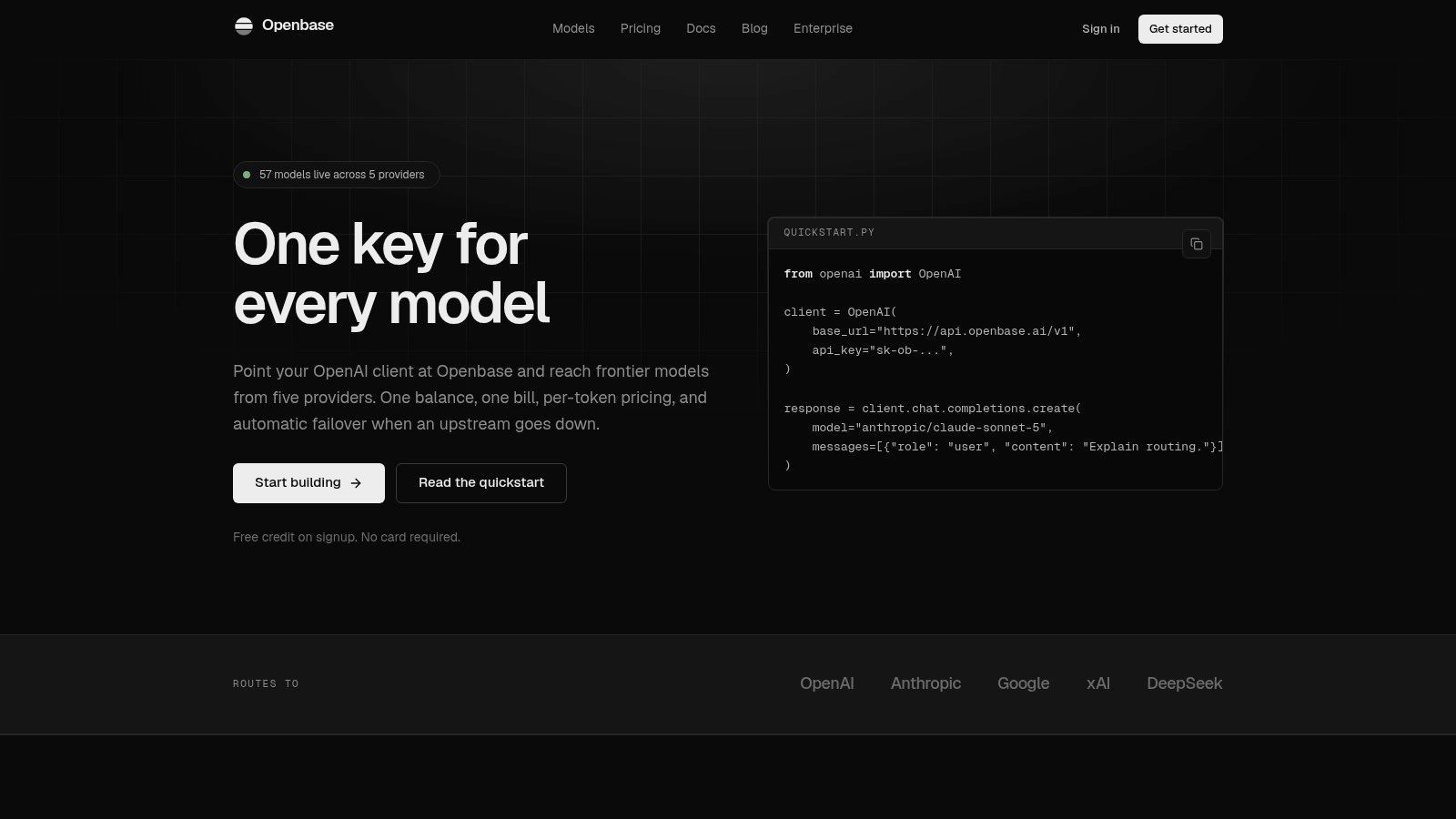
A production LLM service can fail even when its model code is unchanged. One provider may throttle requests, return transient server errors, or become unavailable during a release. Openbase addresses that gateway problem by exposing one OpenAI-compatible endpoint and API key for models from OpenAI, Anthropic, Google, xAI, and DeepSeek. Existing OpenAI clients, streaming code, and tool calls can usually remain in place. The main integration changes are the base URL and API key.
That compatibility reduces duplicated provider logic. Without a gateway, authentication, request formatting, error handling, and billing rules often spread across application code. Openbase keeps the request shape consistent and uses provider-prefixed model names, so adding another upstream does not require a separate client implementation.
The platform advertises access to 57+ live models across five providers, with prepaid per-token billing at published per-million rates. Exact pricing still depends on the selected provider and model, so teams should check the catalog before estimating spend. Usage records include the model, provider, input and output tokens, reasoning tokens, latency, time to first token, and exact request cost.
The failure it addresses
Openbase's strongest infrastructure function is mid-flight failover. It retries eligible failures, including 429, 408, 5xx responses, and connection timeouts, against healthy upstreams. It does not retry 400 or 404 errors, which avoids replaying malformed requests or requests for missing resources.
Provider routing and pooled rate limits can reduce dependence on one provider's throttling ceiling. Consolidated billing provides one balance and invoice, while unlimited API keys and per-key limits help separate development, staging, and production usage. According to the platform's product description, failed attempts that produce no tokens are not charged.
Practical rule: Keep an explicit fallback policy in the application, even when the gateway retries requests. Define which models are interchangeable, which failures are safe to replay, and whether the alternate provider meets your quality and compliance requirements.
The trade-off is another dependency and network hop. Openbase sits in the request path, so monitor its latency and availability alongside the upstream providers. Review reasoning-token usage as well. A lower visible prompt rate does not guarantee a lower total request cost.
For teams using several model providers, Openbase targets three concrete problems: duplicated integration code, fragmented billing, and provider-specific outages. Review the Openbase platform for its endpoint, catalog, documentation, and enterprise information.
2. Together AI
Together AI is a managed inference layer for teams that want open and partner models without operating GPU fleets. Its OpenAI-compatible API makes migration straightforward for applications already built around chat and completion patterns. The more important choice comes after migration: serverless inference is convenient, while Provisioned Throughput is designed for committed capacity and service guarantees.
That split addresses a common failure. A serverless endpoint can be easy to adopt but may expose variable rate limits or capacity behavior during a launch. Provisioned Throughput gives platform teams a way to plan around a known token capacity rather than hoping best-effort infrastructure will absorb every burst.
Together AI also focuses on inference performance, so it suits teams that need a hosted model endpoint rather than a general-purpose GPU runtime. You don't manage containers, drivers, or scheduling, but you also don't get the same low-level control you'd have on a platform where you package and operate the model yourself.
What to verify before production
Check the exact model menu, pricing, supported regions, and rate limits. Rates vary by model, and serverless behavior can differ from provisioned capacity. Run a workload that includes realistic concurrency, long prompts, streaming, retries, and your expected output length. Peak tokens per second alone won't reveal queueing or tail latency.
Together AI is a good fit when fast adoption and managed open-model serving matter more than multi-provider failover. It isn't a complete answer to fragmented billing across unrelated providers, and it won't remove the need for application-level observability.
Use the Openbase model catalog when comparing Together AI's available models with alternative providers. The useful comparison is not just model quality. It is the total operating path, from SDK compatibility through capacity guarantees and cost attribution.
3. Fireworks.ai
Fireworks.ai targets teams that want open-model inference and a managed route from a base model to a production fine-tune. It provides serverless, pay-per-token inference and an OpenAI-compatible client experience, which makes the first deployment familiar to engineers who already use OpenAI-style requests.
The platform's useful distinction is its fine-tuning path. Managed production fine-tunes can be served at the base-model price described in the product plan. That simplifies the handoff from experimentation to serving, though it doesn't eliminate the need to evaluate whether the fine-tuned model improves the application under realistic traffic.
Where it earns its place
Fireworks.ai exposes a public model catalog with context windows, recommended uses, and per-model pricing. That is more useful than a vague “fast inference” claim because engineers can inspect the serving assumptions before writing an integration. The catalog also helps teams compare models by context and cost rather than selecting a model from a marketing page.
Compatibility still needs testing. OpenAI-style endpoints don't guarantee identical behavior across every parameter, endpoint, streaming mode, or tool-calling path. Check the compatibility notes, then test malformed requests and provider errors. Model-specific throughput and latency can vary, so don't infer a production SLO from a short development request.
Measure the model you'll operate, not the model shown in the demo.
Fireworks.ai is strongest when your team wants managed open-model serving with a smooth fine-tuning route. It is less suitable as a redundancy layer across unrelated commercial providers. Confirm the exact model, price, context behavior, and service expectations before committing a critical path.
4. Anyscale Endpoints
Anyscale Endpoints is aimed at teams that want managed access to open-source LLMs with Ray expertise behind the serving layer. Its OpenAI SDK compatibility keeps endpoint integration simple, while the broader Anyscale platform provides a path toward custom models, private networking, and more controlled deployments.
The practical failure mode here is a mismatch between a quick endpoint and a later need for private infrastructure. Teams often start with a hosted model, then discover that network placement, custom serving logic, or internal data access matters more than the initial API integration. Anyscale's value is the upgrade path from a simple endpoint to a more controlled Ray-powered environment.
The cost of that flexibility
Public, granular token pricing is less transparent than on platforms that expose a simple model catalog with rates. Some commercial details may require documentation review or a sales conversation. That makes forecasting harder during an early bake-off, especially when you need to compare several models under the same traffic pattern.
The model menu may also be narrower than a broad aggregator. Verify that the exact model, context length, region, and endpoint type meet your requirements. Test private networking and authentication before production, not after your security review has already approved the architecture.
Anyscale works best for teams that see open-model serving as the beginning of a broader Ray-based platform. If all you need is a large catalog and transparent per-request pricing, a simpler serverless provider may be easier to operate.
5. Replicate
Replicate addresses a different problem from an LLM gateway. It gives teams a managed way to run public, private, and custom models without building a GPU scheduler or Kubernetes deployment first. Its public model ecosystem makes experimentation quick, while dedicated Deployments provide a route to private production APIs with autoscaling and rollout controls.
The useful failure mode is deployment friction. A team may have a model packaged locally but no practical path to expose it safely, update it, or scale it. Replicate's Cog packaging helps make builds reproducible, and dedicated deployments support zero-downtime rollouts and autoscaling.
Prototype speed versus request consistency
Public models are convenient for testing ideas, but production behavior depends heavily on the specific model and serving path. Serverless calls can experience cold-start latency. If your application has a strict response objective, use warm capacity or a pinned deployment instead of assuming that a public prediction endpoint will behave like a permanently running service.
Pricing also varies by model. Private models can use per-second hardware pricing, while many public models use per-prediction pricing. Read the individual model page, then estimate the full request pattern, including failed calls, preprocessing, postprocessing, and idle or warm capacity where relevant.
Replicate is a strong choice for image, audio, experimental, and custom model workloads that don't fit a standard chat endpoint. It is less attractive if your only need is interchangeable access to commercial language-model providers.
6. Modal
Modal is a serverless GPU platform for engineers who want infrastructure primitives rather than a model marketplace. You package Python code, define the compute environment, and run inference, batch jobs, agents, or custom pipelines with per-second GPU billing. The platform is particularly well suited to workloads that arrive in bursts and can scale to zero between jobs.
That design addresses idle capacity. A dedicated GPU deployment can waste money when traffic is uneven, while a fully managed model API may not support the custom preprocessing, batching, or agent loop your application needs. Modal gives you fine-grained runtime control, but it also makes you responsible for more of the serving code.
What you still own
Modal isn't a pick-a-model API. Your team must manage model containers, dependencies, startup behavior, memory use, and application-level reliability. GPU availability and queue time can also vary at busy periods, so test the actual hardware and concurrency pattern you plan to use.
Cold starts may be acceptable for asynchronous batch work but painful for interactive requests. Keep separate performance tests for warm calls, scale-out events, model loading, and queueing. A per-second price doesn't tell you the cost of a request unless you include initialization and concurrency.
Before choosing a runtime, compare the Openbase pricing information with your expected hosted-model and gateway costs. Modal is compelling when customization and burst economics matter. It isn't the simplest option for a team that wants a stable chat API with no container ownership.
7. Baseten
Baseten sits between managed model APIs and self-operated serving. It supports open, fine-tuned, and custom models, with serverless Model APIs for quick access and dedicated deployments for teams that need more predictable control. Dedicated capacity uses minute-level GPU billing and autoscaling, while hybrid, VPC, and self-host options address stricter network and data requirements.
Its core failure mode is an architecture that works in a public endpoint but cannot pass enterprise security or performance requirements. Baseten gives teams a path to move from hosted access toward VPC or hybrid deployment without discarding the serving workflow.
Choosing the serving mode
Serverless Model APIs are useful for initial validation. Dedicated deployments make more sense when traffic is steady, latency matters, or the team needs control over capacity. The platform also presents token-based rates for several popular models and granular GPU pricing for dedicated infrastructure, but a full enterprise configuration may require a custom quote.
That pricing split deserves attention. Token billing is easy to attach to requests. GPU billing requires a capacity model that includes autoscaling, idle time, concurrency, and deployment count. Compare both paths using the same workload and include failure retries in the estimate.
Baseten's model catalog is narrower than a large aggregator, so verify model availability before designing around it. For teams that need security controls, private networking, and an upgrade path from managed inference to dedicated serving, it offers a practical middle ground.
8. Amazon Bedrock
Amazon Bedrock addresses the failure that occurs when model access needs to fit an existing AWS operating model. It puts multiple foundation-model providers behind an AWS-managed service and connects them to IAM, VPC controls, monitoring, procurement, guardrails, knowledge bases, and agent tooling.
The advantage isn't merely model choice. It is ownership. If your platform team already manages AWS accounts, policies, logging, and spend controls, Bedrock can keep AI infrastructure inside familiar governance boundaries. Batch inference and reserved or provisioned capacity options also give teams more ways to separate interactive traffic from scheduled work.
Why forecasting takes work
Bedrock pricing depends on the model, tier, region, and usage mode. Some models or tiers may require approval or differ by region. Build a cost model from the exact model IDs and endpoints you intend to use, then validate it with a small production-shaped workload. Don't rely on a general “per token” estimate when batch, priority, flex, and reserved options can change the operating profile.
Bedrock is a strong managed-cloud choice for organizations that prioritize AWS integration and enterprise controls. It may feel heavy for a small team that only needs a compatible endpoint and simple failover. It also doesn't automatically solve provider portability at the application layer, because model-specific behavior and request formats still require testing.
9. Google Vertex AI
Google Vertex AI is a natural fit for teams standardizing on Google Cloud and Gemini. It combines managed model access with enterprise governance, tuning, grounding, and agent tooling. Teams can use global or non-global endpoints, batch and flex options, cached-input pricing, and grounding integrations with Google Search, Maps, or internal data.
The failure mode it addresses is fragmented deployment inside a GCP estate. A team can keep authentication, billing, network policy, and operational controls within Google Cloud instead of creating a separate serving boundary for generative AI.
Treat the pricing page as configuration
Vertex AI's pricing is detailed, but that detail creates work. Model, endpoint, region, cached input, batch mode, and promotional treatment can all affect the result. The product documentation states that only successful 200 responses are billed for inputs and outputs, which is useful when modeling application retries and failure behavior.
Non-global endpoints can differ from global endpoints in price and availability. Test the endpoint you will deploy against, especially if data residency or regional reliability matters. Measure time to first token, sustained throughput, tail latency, and retry behavior rather than accepting a headline benchmark.
Vertex AI makes sense when Google Cloud integration and grounding capabilities are central to the product. It is less compelling as a neutral routing layer across every provider. Teams that need cross-provider failover should add an explicit gateway or routing strategy instead of assuming a cloud model catalog provides application portability.
10. Groq
GroqCloud targets the low-latency end of inference. Its LPU hardware and OpenAI-style APIs appeal to applications where streaming speed and consistent token throughput matter more than access to every possible model. The developer experience is familiar, so teams can test a latency-sensitive path without adopting a completely different request pattern.
The failure mode is slow interactive inference. Voice interfaces, live assistants, and streaming applications expose delay immediately. Groq's focused hardware approach can make it useful for those paths, but the trade-off is a model menu centered on open-weight models rather than universal provider coverage.
Test the path users actually feel
Don't benchmark only completed responses. Measure time to first token, tokens during the stream, interruption behavior, retries, and concurrency. A fast model call can still produce a poor user experience if your application buffers the response, waits for a long tool call, or retries without a deadline.
Public per-model price information can move between documentation pages and the console, so confirm current rates before forecasting spend. Paid plans can provide higher rate limits, but the exact limit and model availability should be checked for the account and region you plan to use.
Use the Openbase rate-limits documentation as a reference point when designing application-level throttling and fallback behavior. Groq is a focused serving option for speed-sensitive open-model workloads. It isn't a substitute for a multi-provider gateway when provider redundancy and consolidated billing are the main requirements.
Top 10 AI Infrastructure Tools, Feature Comparison
| Platform | Core features | UX & Reliability (★) | Pricing & Value (💰) | Target Audience (👥) | Unique Strengths (✨ / 🏆) |
|---|---|---|---|---|---|
| Openbase 🏆 | Single OpenAI-compatible endpoint; 57+ models across 5 providers; automatic mid‑flight failover; per-request metering; streaming & function calls | ★★★★☆, drop‑in SDK, automatic retries, pooled rate limits, detailed logs | 💰 Prepaid per‑token (per‑M rates); consolidated balance & invoices; per‑call cost visibility | 👥 Engineers, infra/platform teams, ML teams, enterprises | ✨ Drop‑in OpenAI compatibility; provider‑prefixed slugs; explicit reasoning‑token billing; consolidated billing 🏆 |
| Together AI | OpenAI-compatible API; serverless pay‑per‑token; Provisioned Throughput for SLAs; latency‑optimized engine | ★★★★☆, low latency, high throughput; optional SLAs | 💰 Pay‑per‑token; Provisioned tier (committed capacity); model/region dependent | 👥 Teams needing high‑performance inference and predictable capacity | ✨ Provisioned Throughput for guaranteed capacity; inference engine tuned for latency |
| Fireworks.ai | OpenAI-like API; serverless pay‑per‑token; public catalog; managed production fine‑tunes at base price | ★★★☆☆, good docs; small compat differences possible | 💰 Clear per‑model pricing; fine‑tunes served at base‑model rates | 👥 Teams wanting hosted fine‑tunes + open‑model serving | ✨ Managed fine‑tunes at base model price; clear model catalog |
| Anyscale Endpoints | OpenAI-compatible endpoints for open models; private endpoints & enterprise networking; upgrade path to Anyscale platform | ★★★★☆, Ray-powered performance; enterprise deployment options | 💰 Pricing less transparent; details via sales/docs | 👥 Teams seeking Ray performance, private networking, enterprise control | ✨ Ray expertise; path to full AI app platform and VPC/private deployments |
| Replicate | Managed deployments with autoscaling; cog packaging; large public model library; private deploys | ★★★☆☆, great for prototyping; possible cold starts on some paths | 💰 Per‑second hardware for private models; per‑prediction for many public models | 👥 Researchers, prototypers, teams shipping custom models | ✨ Huge community model ecosystem; reproducible builds (Cog); private deployments |
| Modal | Serverless GPU (per‑second); Python-native developer workflow; fast cold‑starts; scale‑to‑zero | ★★★★☆, code-centric infra; fast for bursty workloads | 💰 Per‑second GPU billing; cost‑effective for spiky jobs; GPU availability varies | 👥 Teams needing bursty GPU compute and custom pipelines | ✨ Python-native sandboxes/notebooks; fine‑grained GPU billing and rapid scale |
| Baseten | Model APIs (token pricing) + dedicated GPU deployments; hybrid/VPC; enterprise security/compliance | ★★★★☆, autoscale + enterprise controls | 💰 Token & minute-level GPU pricing; enterprise quotes for advanced features | 👥 Enterprises needing compliance, hybrid or VPC deployments | ✨ Hybrid/VPC + SOC2/HIPAA-ready controls; mix of serverless + dedicated deployments |
| Amazon Bedrock | AWS-managed multi‑vendor model catalog; guardrails, knowledge bases, agent tooling; multiple tiers | ★★★★☆, enterprise IAM/VPC integration; varied service tiers | 💰 Multi-tier, model/tier/region pricing; reserved & priority options, requires planning | 👥 AWS-centric enterprises and teams needing governance | ✨ Deep AWS integration; agent tooling, guardrails, reserved capacity options |
| Google Vertex AI | Gemini models & agent platform; grounding integrations (Search/Maps); endpoint/batch/flex options | ★★★★☆, strong GCP integration; detailed model & endpoint controls | 💰 Detailed model/endpoint pricing; promo windows; billed on successful 200s | 👥 GCP customers needing grounding and enterprise billing constructs | ✨ Gemini + grounding integrations; Flexible Savings Plans and Google ecosystem tie‑ins |
| Groq (GroqCloud) | LPU-accelerated inference for open weights; OpenAI-style API; high throughput & low latency | ★★★★☆, deterministic token throughput; ideal for streaming | 💰 Pay-as-you-go with predictable throughput tiers; check docs for rates | 👥 Real‑time/streaming token workloads and latency‑sensitive apps | ✨ LPU hardware for deterministic tokens-per-second and low latency |
Matching Your Stack to the Failure You Fear Most
Start with the failure that would cost your team the most. If a provider outage or rate-limit spike would take down a customer-facing feature, use a gateway and test mid-flight retries, fallback eligibility, provider selection, and request replay. Openbase is designed for that role because it keeps an OpenAI-compatible surface while consolidating providers, routing, metering, and billing.
If GPU capacity is the problem, decide whether you need a managed model endpoint or a runtime for your own containers. Together AI, Fireworks.ai, Anyscale Endpoints, Baseten, and Groq reduce the amount of serving infrastructure you operate. Replicate is useful when you need to package and expose custom or community models quickly. Modal is better when your team wants Python-native control over inference, batch jobs, and GPU lifecycles.
Latency requires a workload-specific test. Measure time to first token, sustained throughput, queue time, cold starts, tail latency, and behavior under concurrency. A provider that looks fast in an isolated request may degrade when traffic arrives in bursts. Keep interactive, batch, and agent workloads separate in your benchmark because they have different tolerance for startup time and retries.
Unpredictable spend needs request-level attribution, not just a monthly cloud bill. Record model, provider, input tokens, output tokens, reasoning tokens where applicable, latency, retries, and environment. Then connect those records to a product, team, or API key. A platform that exposes a published rate but hides the full request cost still leaves finance and engineering to reconstruct the invoice.
Deployment constraints also change the shortlist. Hybrid and cloud infrastructure are now common patterns for AI workloads. A 2025 industry survey reported that 42% of organizations used hybrid cloud for AI, while 79% planned to modernize infrastructure within 18 months and only 53% were somewhat confident that existing infrastructure could meet AI requirements, according to A10 Networks' State of AI Infrastructure report. Treat portability, regional controls, consistent telemetry, and authentication as architecture requirements, not optional features.
The scale of the market makes operational discipline more important, not less. IDC reported $89.9 billion in worldwide AI infrastructure spending in the fourth quarter of 2025, up 62% year over year, with full-year spending reaching $318 billion. IDC projects the market will exceed $1 trillion by 2029, as described in its AI infrastructure spending analysis. Your team doesn't need every tool in this list. It needs a clear owner for routing, serving, capacity, observability, and cost.
Choose one gateway or serving layer that addresses the failure you fear most. Confirm exact model rates, regions, quotas, retry semantics, and data-handling terms in current vendor documentation. Add observability before launch, so the first invoice confirms what your dashboards already show instead of revealing an architecture nobody can explain.
Openbase gives teams one OpenAI-compatible endpoint for models across major providers, with routing, automatic failover, consolidated billing, and per-request visibility into tokens, latency, provider, and cost. Visit Openbase to evaluate it as the gateway layer for a more resilient and measurable AI infrastructure stack.