
In a market estimated at USD 48 billion in 2025 and USD 85 billion in 2026, an AI model aggregator is a unified gateway that replaces fragmented provider integrations with one OpenAI-compatible endpoint, consolidated billing, automatic failover, and token-level observability. Foundation model API revenue was separately estimated at USD 12.5 billion in 2025, showing why unified access has become an infrastructure concern rather than a minor developer convenience.
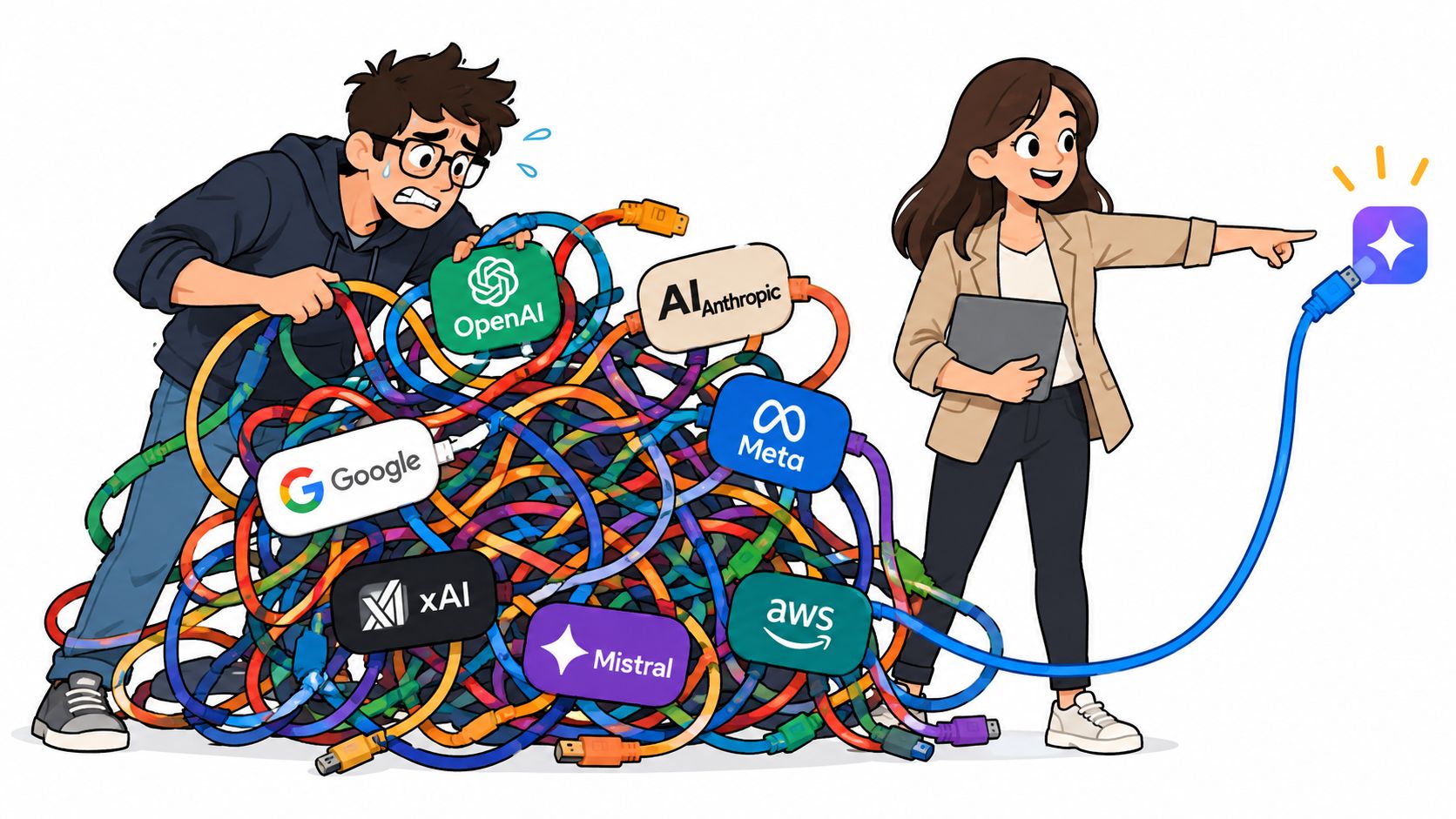
Your team probably started with one provider because the first integration was straightforward. Then a product manager asked to test Anthropic, a customer requested a Google model, and an infrastructure engineer added another provider after the first one experienced a degraded service. Suddenly, five API keys sit in different secret stores, each provider has a separate dashboard, and every SDK returns errors in its own style.
That setup works during a prototype. It becomes expensive to operate when traffic grows, models change, and an outage arrives at the same time as a rate-limit spike. A production-grade aggregator turns those separate connections into a controlled routing layer, but only if it handles more than model names and billing. The difficult work is health-aware routing, stateful failover, cost attribution, and an audit trail for every decision.
Table of Contents
- The Problem with Fragmented AI Integrations
- Defining the AI Model Aggregator Architecture
- Aggregator Versus Direct Provider APIs
- Core Problems Solved by Model Aggregation
- Enterprise Requirements for Observability and Audit
- Real-World Implementation with Openbase
- Building a Unified AI Strategy with Aggregators
The Problem with Fragmented AI Integrations
The trouble starts innocently. Your application calls OpenAI through a familiar SDK, the response shape is understood, and deployment is uneventful. A few weeks later, the product team wants to compare Claude for long-form reasoning and Gemini for another workflow. You add another SDK, another authentication path, another model-specific configuration, and another set of tests.
The codebase now has provider branches scattered through application services. One integration handles streaming one way, another uses a different event format, and a third reports rate limits through headers your existing retry middleware doesn't understand. Engineers spend time maintaining plumbing instead of improving the AI feature itself.
The operational debt appears in small failures
Direct provider integrations create several recurring problems:
- Duplicated implementation: Each new provider can require its own client, authentication setup, request mapping, streaming parser, and error policy.
- Unclear limits: A request may work in staging and fail in production when a provider-specific quota is reached.
- Scattered spend: Finance reconciles separate usage dashboards, while engineering tries to connect invoices to applications and tenants.
- Weak incident context: A failed generation may be caused by a model response, a timeout, a rate limit, or an application bug. Without common telemetry, those causes look similar.
- Tight vendor coupling: Changing a model can force changes to application code, tests, and deployment configuration.
The market context makes this coupling harder to ignore. A 2026 estimate put hosted model access at roughly 78% of foundation model revenue, with North America representing approximately 44% of that market, according to the foundation model market estimate. As organizations consume more models through hosted APIs, the cost of managing separate integrations rises with usage.
The aggregator is the structural response. It puts one gateway between your application and upstream providers, giving the platform team one place to normalize requests, enforce limits, select routes, retry transient failures, and record usage.
When a provider returns a hard failure, the gateway should also know whether retrying is sensible. Retrying a malformed request won't fix the problem. Retrying a timeout or temporary upstream failure may preserve the user experience, provided the gateway understands idempotency, token generation, and conversation state.
This short video provides a visual introduction to the unified gateway concept:
The key distinction is that aggregation isn't just putting multiple model names in a dropdown. It moves provider-specific operational decisions out of product code and into an infrastructure component that can be tested, monitored, and governed.
Defining the AI Model Aggregator Architecture
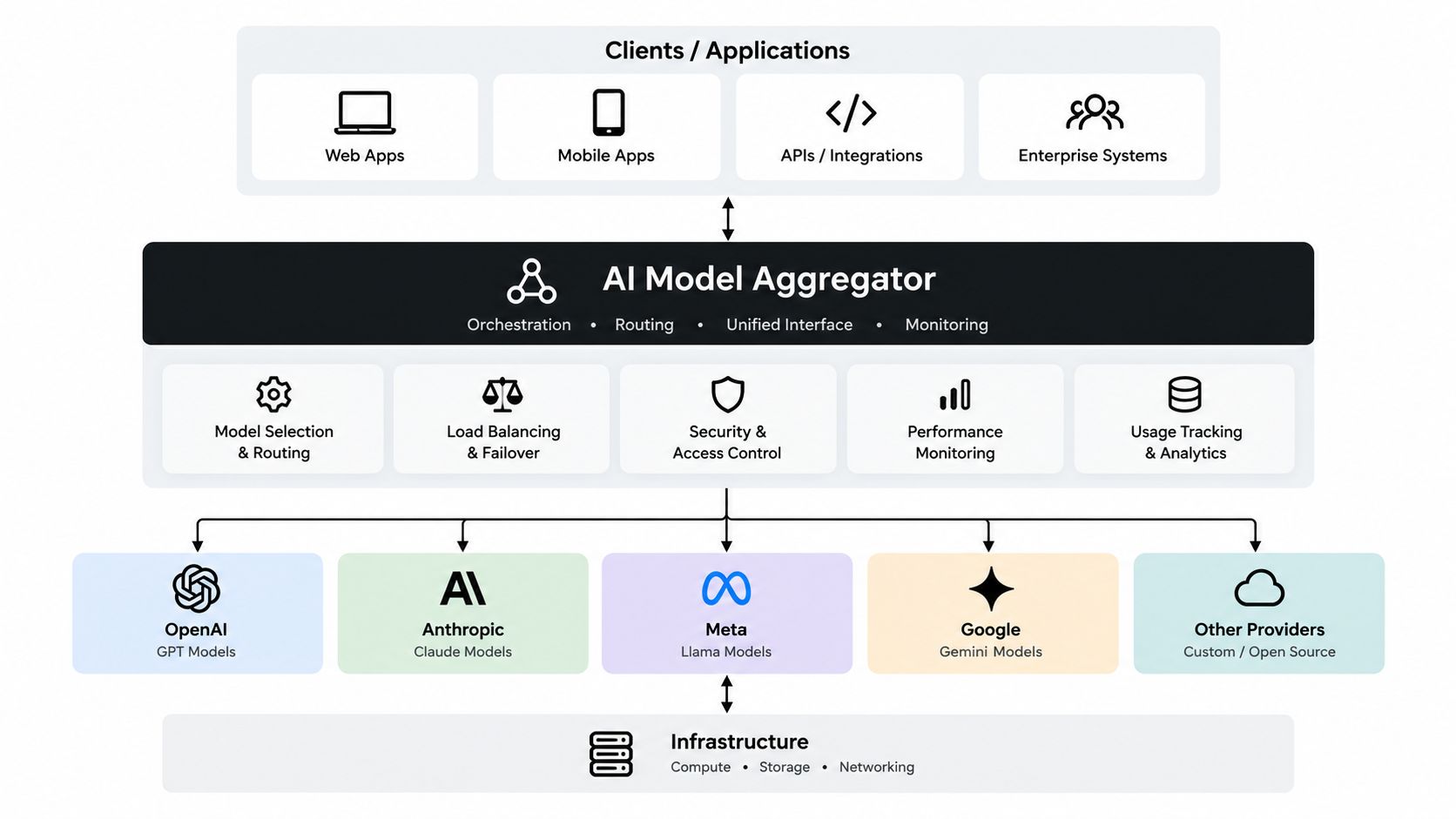
An AI model aggregator is a centralized gateway that receives requests from an application, chooses or accepts a target model, forwards the request to an upstream provider, and returns a normalized response. The application talks to one endpoint. The gateway handles provider-specific credentials, routing rules, retries, usage records, and response translation.
A practical architecture usually has four layers:
- Client interface: An OpenAI-compatible endpoint accepts familiar chat completion requests, streaming responses, and tool or function calls.
- Model address: A provider-prefixed slug identifies the requested model and, where relevant, the provider path that can serve it.
- Routing engine: Priority, health, remaining capacity, latency, policy, and cost influence the upstream selection.
- Normalization and telemetry: The gateway returns a consistent response while recording provider, model, tokens, latency, errors, and fallback behavior.
One request shape, several upstream paths
The application might request a model using a provider-prefixed identifier such as anthropic/claude-3-opus. The exact catalog changes over time, but the important design principle remains stable. The request body and client integration stay consistent while configuration determines which upstream model receives the call.
That abstraction is valuable only when it has clear boundaries. The gateway must document which capabilities are portable and which are provider-specific. Tool calling, structured output, image inputs, context limits, streaming events, and reasoning behavior may not map perfectly across model families. Hiding those differences completely creates surprises later.
Teams should use a model catalog and API reference to verify supported identifiers, capabilities, and request behavior before switching a production workflow. A normalized API reduces integration work, but it doesn't eliminate the need to evaluate model quality and feature compatibility.
Routing is a policy decision
A basic router sends every request to the selected provider. A production router evaluates current conditions. It may prefer a primary provider, fall back to an ordered alternative after a transient error, and avoid a provider whose rate-limit headers show little remaining capacity.
This is more reliable than assuming one API key represents the provider's available capacity. Gateway guidance recommends using real remaining capacity from provider rate-limit headers, because static assumptions can produce uneven load and avoidable throttling. The LLM gateway routing guidance also describes failover for 429, 408, 5xx, and timeout conditions while avoiding retries for hard client errors such as 400 and 404.
The gateway should preserve enough request context to make a safe decision. A retry isn't just another HTTP call when the request includes tools, streaming, or a long conversation. The system must know whether output was already delivered, whether a tool call has side effects, and whether the fallback model can accept the same context.
Aggregator Versus Direct Provider APIs
Direct provider APIs give teams maximum proximity to the upstream service. You get the provider's newest features, its native controls, and a direct support relationship. That simplicity can be attractive when one model serves one narrow workload and the team is willing to own the integration.
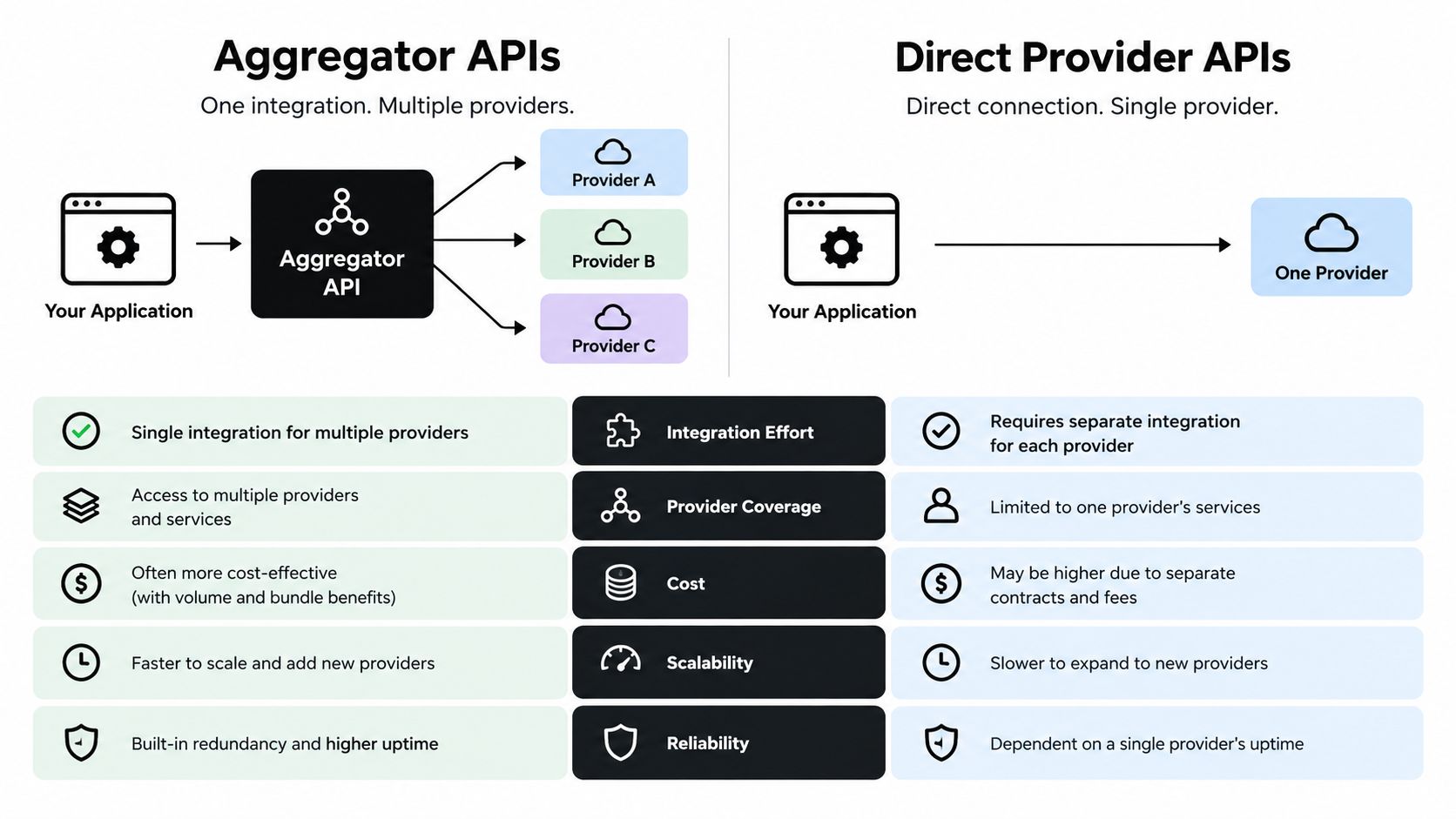
An aggregator trades some directness for a common control plane. The application uses one endpoint, while the gateway manages multiple upstream connections. This usually makes the biggest difference in three areas: integration effort, reliability operations, and financial administration.
Integration effort
With direct APIs, adding a provider commonly means adding credentials, an SDK or HTTP adapter, model-specific request mapping, response parsing, error handling, and test coverage. You may also need separate code for streaming and tool calls.
With an aggregator, the application can retain one request shape and change the model identifier or routing policy. That doesn't mean every model is interchangeable. It means the common path lives in one place, while incompatibilities are exposed as documented capability differences instead of scattered conditional logic.
| Concern | Direct provider APIs | Aggregator gateway |
|---|---|---|
| Authentication | Separate credentials and secret rotation | One gateway credential model |
| Request format | Provider-specific adapters may be required | One normalized interface |
| New model | Application changes may be needed | Usually a catalog or configuration change |
| Error handling | Each provider needs separate treatment | Centralized retry and fallback policy |
| Streaming | Provider-specific event behavior | Common integration with gateway-defined limits |
Reliability operations
A direct connection has a simple failure boundary. If that provider is unavailable or your account is throttled, the application must either fail, queue, or implement its own fallback. Teams often add retries first, but fixed retries can amplify an incident by sending more traffic to the same unhealthy service.
An aggregator can route to an ordered fallback provider when the primary returns a transient failure. It can also use health signals and remaining capacity to spread requests before the primary becomes unusable. The trade-off is operational complexity inside the gateway. Poorly designed routing can cause retry storms, switch between models unexpectedly, or create inconsistent user experiences.
Practical rule: Fail over on infrastructure conditions, not on every error. A malformed request should reach the developer, while a timeout may justify a controlled alternate route.
Financial administration
Direct connections separate balances, invoices, usage exports, and provider-specific token terminology. Finance teams may reconcile those sources manually, while engineering builds its own internal estimates to understand which product or tenant generated the spend.
An aggregator can consolidate usage into one balance and invoice, then attribute cost at the request level. That makes chargeback and budget enforcement easier, but it introduces a dependency on the aggregator's pricing transparency and accounting accuracy. Buyers should verify whether input, output, cached, and reasoning tokens are represented clearly, and whether failed attempts can generate charges.
The right choice depends on the workload. A regulated system that requires a provider-native feature may keep a direct connection. A team operating several model families, multiple environments, or bursty traffic will usually gain more from a shared gateway than from maintaining another custom adapter.
Core Problems Solved by Model Aggregation
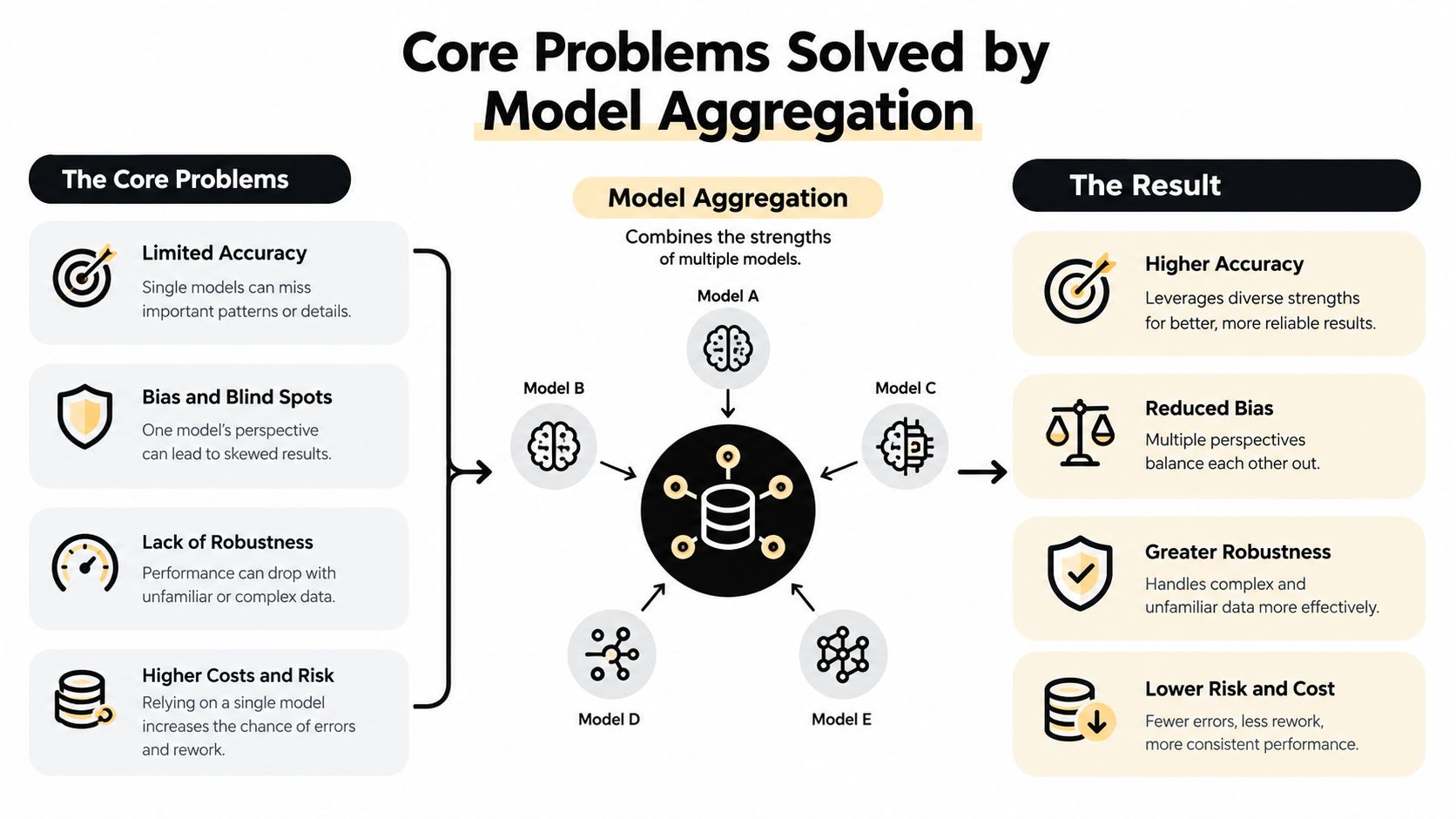
Aggregation earns its place in production when it removes recurring operational work from application teams. The main gains come from consolidating integrations, handling provider instability, controlling fragmented spend, and making every route decision inspectable.
Duplicated integration work
Start at the application boundary. Replace provider-specific clients with one OpenAI-compatible gateway, then keep model selection in configuration or an explicit routing policy. Existing SDK-based services can often use that gateway by changing the base URL and credential while preserving their request and response handling.
Centralize the shared controls:
- Credentials: Store and rotate gateway access centrally, then issue scoped keys for services or environments.
- Request normalization: Handle chat, streaming, and tool calls through one integration.
- Model selection: Reference models through a catalog instead of embedding provider logic in business services.
- Testing: Run the same contract tests against every supported route and record capability differences.
Compatibility still needs testing. Models can differ in tool behavior, context limits, structured output, and streaming details even when they expose a similar API. The gateway contract should declare those differences and reject unsupported combinations clearly. That prevents a routing change from becoming an application defect.
Outages and rate-limit spikes
A provider may return a 429 when capacity is exhausted, a 5xx during an incident, or a timeout when the network path degrades. The application needs a controlled response that protects the user without repeating a side-effecting tool call.
A health-aware gateway can retry selected transient failures on an ordered fallback route. Gateway telemetry should record retry and fallback frequency, because a successful response after repeated attempts may still indicate an unhealthy route.
Use separate policies for different failure types:
- Transient failures: 408, 429, 5xx, and connection timeouts may justify a controlled fallback.
- Client failures: 400 and 404 generally require a corrected request, not another provider.
- Partial streams: Once content has been emitted, switching models can produce an incomplete or inconsistent result.
- Tool calls: A fallback must not repeat an external side effect without an idempotency strategy.
Routing also needs state. Health signals, cooldowns, provider capacity, and recent failures determine whether a route should receive traffic. Without that state, retries can create a storm or move requests between models unpredictably.
Billing fragmentation and blind spots
Request volume alone cannot explain spend. Input and output sizes vary, and reasoning tokens may affect cost without appearing as ordinary visible output. A central gateway can associate token counts, model, provider, tenant, environment, and route outcome with each request.
That record supports practical controls:
- Set limits per key or tenant.
- Review cost by model and workflow.
- Find requests that repeatedly fall back.
- Compare latency and cost before changing a route.
- Investigate unexpected spend through request-level records instead of a monthly total.
An aggregator does not reduce cost automatically. It gives the team common accounting and router controls for choosing a cheaper or better-fitting route without rewriting application code.
Enterprise Requirements for Observability and Audit
An enterprise request can succeed while remaining impossible to explain later. A traffic count will not show why the router selected a provider, why latency increased, or why the call cost more than expected. Observability must connect the request, routing decision, provider response, and charge in one record.
Capture the selected model, upstream provider, route decision, input and output tokens, reasoning-token accounting where available, time to first token, total latency, response status, retry count, fallback trigger, tenant, and environment. Apply the organization's data policy to prompt and response content, but avoid removing metadata needed for incident analysis and cost review.
Metrics that separate quality from infrastructure
A poor result may reflect model quality or a delivery failure. Per-provider errors and latency help isolate upstream problems. Time to first token can reveal queueing or capacity pressure even when total generation time remains acceptable. Fallback frequency shows whether a route is reliable or succeeds only after repeated failures.
The AI gateway observability recommendations identify per-provider errors, latency, retries, fallback frequency, time to first token, and token-aware quotas as useful signals. Slice these metrics by model, provider, workload, and tenant. A platform-wide average can hide a failing route used by one customer or workflow.
Operational standard: Every successful response should be explainable after the fact. The team should know which model was selected, which provider served it, whether a fallback occurred, and what the request cost.
Audit records also need the router's reasoning. A route may be selected because of priority, health, capacity, policy, or cost. Store that basis with the request so engineers can reproduce a decision and verify that tenant rules were applied. Routing research recommends recording the selected model, router confidence, fallback triggers, request cost, and downstream quality signals in an auditability-focused model routing analysis.
Stateful failover is the difficult part
A mid-session fallback requires more than sending the latest prompt to another model. The gateway may need to preserve system instructions, message history, tool definitions, tool results, response-format requirements, and available context. Provider changes can also alter tokenization, supported capabilities, and handling of partially generated output.
Agentic workloads make these state issues more visible. A 2026 systems study on multi-provider routing examines conversational state preservation across heterogeneous models as a harder problem than basic uptime. Test stateful failover directly. A successful HTTP retry does not prove that the conversation continued safely.
Enterprise buyers should require retention controls, tenant isolation, key management, exportable logs, routing explanations, and defined behavior for failed streams or tool calls. For retention controls, tenant isolation, and audit exports, review the Openbase enterprise capabilities. These requirements turn a provider switch into an auditable operational process rather than an opaque retry.
Real-World Implementation with Openbase
Openbase shows how a gateway can fit into an existing application without forcing a provider-specific rewrite. It exposes an OpenAI-compatible interface for models from OpenAI, Anthropic, Google, xAI, and DeepSeek. Provider-prefixed model slugs, one balance, and one invoice reduce the operational work of managing several upstream accounts, while the gateway handles provider selection.
Failover needs testing beyond a successful retry. For transient upstream failures, including problems during generation, verify how the gateway classifies transport and provider errors, tracks produced tokens, and prevents a repeated tool side effect. A retry that preserves connectivity can still corrupt an agent workflow if an external action runs twice.
Billing records should support both engineering investigation and financial reconciliation. Openbase uses prepaid per-token billing, reports reasoning tokens explicitly, and records the model, provider, input and output tokens, latency, time to first token, and exact cost for each call. Those fields make it possible to compare routes, identify slow providers, and reconcile usage without estimating from request counts.
What to verify before production
A proof of concept should exercise failure paths that a quickstart usually leaves untouched:
- Streaming interruption: Confirm what the client receives when the primary provider fails after output has started.
- Tool-call safety: Verify that fallback handling cannot repeat an external action.
- Capability mismatch: Test structured output, tools, long context, and provider-specific options.
- Key isolation: Create separate keys and limits for development, staging, production, and internal services.
- Cost records: Compare logged input, output, and reasoning tokens with expected accounting.
- Fallback visibility: Confirm that route changes appear in logs and dashboards.
Use the Openbase quickstart documentation to validate the endpoint and SDK integration, then test the gateway under provider errors and partial streams. Treat the product as infrastructure with routing, accounting, and operational controls, rather than as a model directory.
Agent workflows add another verification layer. The aggregator must carry state across steps, preserve tool context, and enforce per-trajectory budgets when routing changes provider. Systems research on stateful multi-provider routing notes that continuity across heterogeneous models is harder to guarantee than basic uptime. Test conversation state, tool results, response formats, and partially generated output during an actual provider switch.
Building a Unified AI Strategy with Aggregators
A unified gateway changes the responsibility map. Developers get one integration surface. Platform engineers gain centralized routing, failover, limits, and incident telemetry. Finance teams receive a consistent view of token usage and cost. Security and compliance teams get evidence of which model served which request and why a fallback occurred.
The market is also becoming more concentrated while spending expands. An enterprise survey reported foundation model API spending rising from USD 3.5 billion in late 2024 to USD 8.4 billion by mid-2025, with Anthropic at 32%, OpenAI at 25%, and Google at 20% of reported enterprise usage. The same enterprise foundation model market analysis reported that 11% of teams switched their primary vendor while 66% upgraded within their existing provider. That combination creates a practical need for portability without pretending vendor changes are frictionless.
The aggregator layer isn't automatically the right answer. Direct APIs remain sensible when a workload depends on a provider-specific feature, requires a direct contractual relationship, or has a narrow reliability profile. For multi-provider applications, though, a gateway provides the control surface needed to manage redundancy, cost, and auditability in one place.
Start with one workflow rather than moving every call at once. Define the model contract, test streaming and tools, set fallback boundaries, capture token-level telemetry, and review stateful failure behavior before expanding the route to more tenants.
Openbase offers a unified OpenAI-compatible gateway, provider routing, automatic failover, per-token usage accounting, and request-level performance logs for teams managing multiple model providers. Review the implementation details and connect your first workload through Openbase.