
An AI Model API is a hosted HTTP endpoint that lets software call a remote language or generative model behind a consistent request and response shape, with usage-based per-token billing. That simple contract is why GPT-3's private beta in June 2020 mattered, because it turned large language models into something developers could program against instead of something they had to host themselves (OpenAI growth timeline).
Table of Contents
- Why an AI Model API Is the New Plumbing for Software
- Anatomy of a Model API Request and Response
- Chat Completions, Embeddings, and the Two Endpoints That Run Most Products
- Streaming, Tool Calling, and the Latency Behaviors That Shape UX
- How Providers Differ at a High Level
- Why Teams Layer a Unified Gateway on Top of Provider APIs
- Reliability, Observability, and the Real Cost of a Token
- A Practical Mental Model for Choosing Your First Integration
Why an AI Model API Is the New Plumbing for Software
OpenAI reported that GPT-3's API reached more than 300 applications while tens of thousands of developers had access, and those applications were generating about 4.5 billion words per day. That detail matters because it shows how quickly a model API moved from a novelty to a shared dependency in real products.
A model API is the contract layer between software and a remote model. Your application sends text, context, or tool instructions, and the service returns structured output in a form your code can consume. The team building the feature does not need to care where the weights run, which cluster serves the request, or whether the provider swaps the underlying model later.
That separation is the actual shift. Product teams care about outputs such as summaries, classifications, embeddings, or tool calls. Platform teams care about billing, retries, latency, and whether a provider change forces a rewrite. A well-designed API keeps those concerns apart.
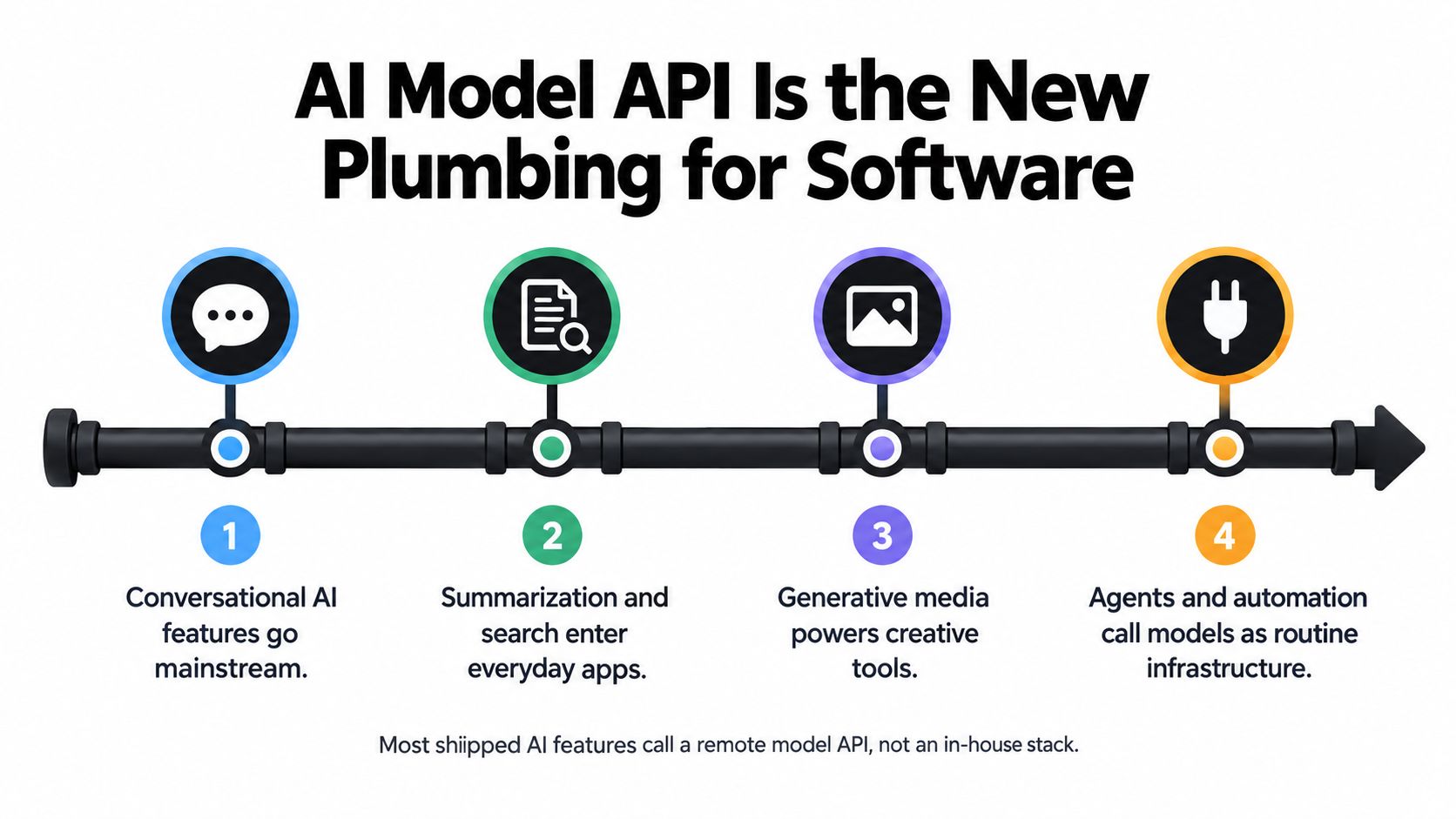
The useful analogy is plumbing. Local model files make your team operate the machinery. A hosted model API lets your team route requests through a defined interface, just as payments flow through a payment processor without every app handling card networks directly. Once that interface exists, model choice becomes a routing decision.
That is also why OpenAI-compatible unified gateways matter. They let a team point one integration at several providers, then switch or retry at the gateway layer instead of rewriting every call site. The abstraction is not perfect, because providers still differ in model behavior, token accounting, and feature support. But it gives software teams a stable contract, and in this field, a stable contract is often the difference between a prototype and something you can keep in production.
Anatomy of a Model API Request and Response
A chat-style model call usually starts with a JSON envelope that carries the conversation history. The most important fields are the messages array, the role of each message, and the endpoint itself. A system message sets behavior, a user message carries the actual request, and the model replies in the same structured shape.
A minimal request looks like this in practice:
POST /chat/completionsmessages: an ordered list of role-tagged messagessystem: instructions that shape the answeruser: the prompt or task- optional generation controls such as temperature or tool definitions
The response comes back with the model's message, a finish reason, and a usage block. That usage data is what makes per-call observability possible, because it tells you how much text went in and how much came out. For models that reason internally before answering, the provider may also expose reasoning token accounting separately from visible output.
Here's the compact shape to keep in your head:
| Field | What it tells you | Why it matters |
|---|---|---|
messages |
The conversation input | Preserves role and order |
assistant response |
The generated answer | Lets the client render or route output |
finish_reason |
Why generation stopped | Helps detect truncation or tool handoff |
usage |
Input and output token counts | Powers cost and monitoring |
| reasoning tokens | Internal thinking cost where billed | Changes the real economics of a call |
Older completion APIs returned a single text block. Chat APIs exchange structured, role-based messages, which is why they fit assistants, agents, and tool use so much better.
If you can read raw request and response bodies, you can debug most integration issues before they become product bugs. You can also see why a gateway can stay compatible with existing SDKs, because the contract is the point, not the vendor name on the bill.
Chat Completions, Embeddings, and the Two Endpoints That Run Most Products
Most production stacks lean on two endpoint families. One generates text or structured instructions. The other turns text into vectors for search, clustering, and retrieval. They solve different problems, and teams get into trouble when they treat them as interchangeable.
| Endpoint | Returns | Typical use | Billing unit |
|---|---|---|---|
| Chat completions | Generated text or tool intent | Chat, drafting, agents, extraction | Tokens |
| Embeddings | Fixed-length vectors | Semantic search, retrieval, similarity | Tokens |
An embedding is not an answer. It's a numeric representation of meaning that downstream code can compare with other vectors. That's why retrieval-augmented generation often uses both endpoints in one flow, first embedding the query and documents, then passing the retrieved context into chat completions for the final answer.
Token thinking helps here. A token is not a word, and it isn't always a character either. For planning, it's safest to assume the model counts text in chunks smaller than words, so a long prompt, a long answer, or repeated retries all affect cost.
A quick intuition table:
| Workload shape | What usually happens |
|---|---|
| Short Q&A | Chat completion only |
| Search over docs | Embeddings first, then chat |
| Agent with actions | Chat completion plus tool calling |
| Semantic deduplication | Embeddings only |
Tool calling sits between generation and retrieval. The model can propose a structured action, but your application still decides whether to execute it. That split is what keeps the endpoint contract honest.
For request and response design, the base shape stays consistent even when the underlying feature changes. If you want a reference point for model lists and compatibility patterns, the OpenBase model documentation shows the kind of stable endpoint surface teams usually build around.
Streaming, Tool Calling, and the Latency Behaviors That Shape UX
A non-streaming response can feel sluggish even when the final answer arrives within an acceptable window. Users don't experience total latency first, they experience the delay before anything appears. That's why time to first token matters as much as end-to-end response time.
The simplest way to think about streaming is a waiter carrying plates as the kitchen finishes them. The diner doesn't wait for the full meal to leave the pass. The application shouldn't wait for the full completion to start rendering, parsing, or routing either.
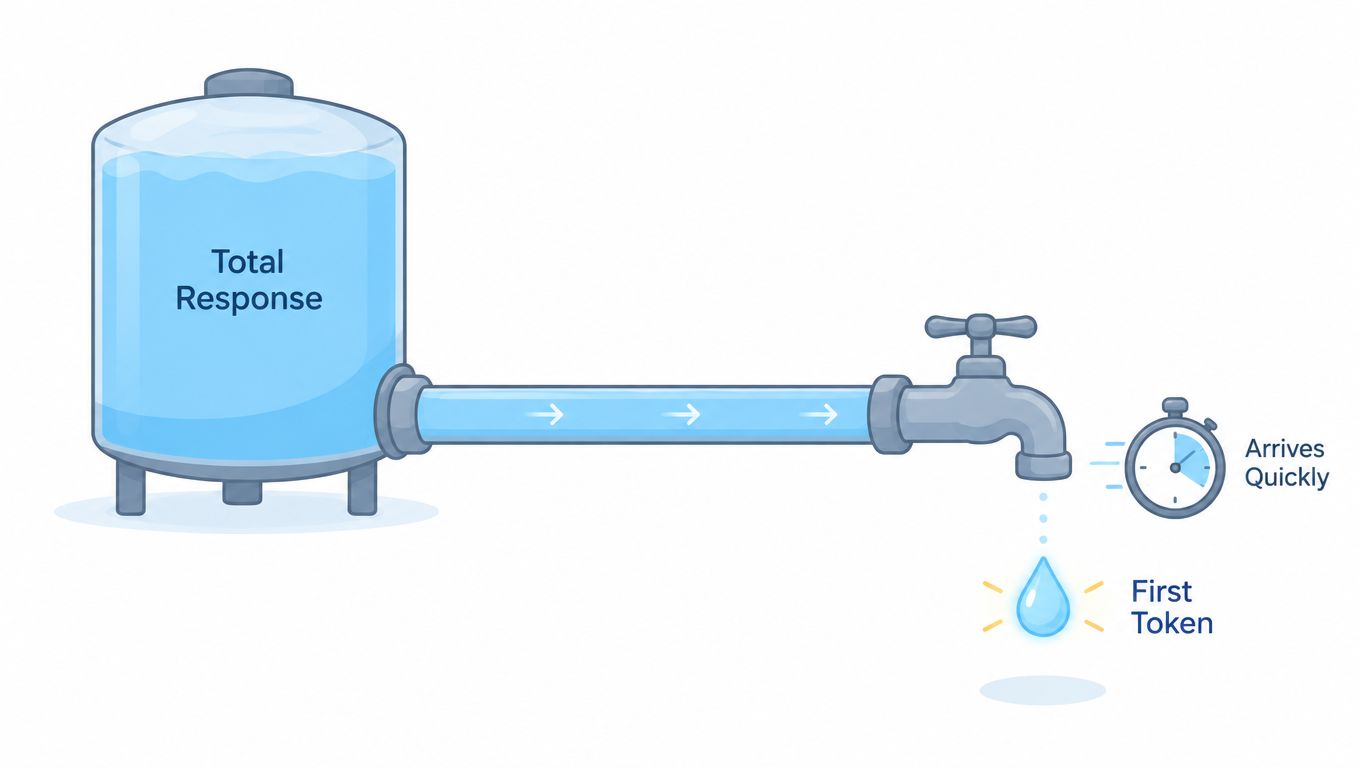
With SSE streaming, the client receives a sequence of data-only events instead of one final payload. The early chunks carry deltas, partial content, or tool-call fragments. The terminal event closes the stream and may include final usage data. Observability needs to record both the first token and the final completion, because those are different failure modes.
Operational note: measure TTFT separately from full response time, or you'll miss UX regressions that users feel immediately.
Tool calling makes the boundary even more important. The model can emit a tool_calls structure, but the application owns validation, authorization, execution, and the next turn. If streamed arguments are incomplete, treat them as incomplete until the final event lands. Partial JSON is not permission to run an external action.
Later, when retries or failover enter the picture, the same flow keeps working because the request and response shapes remain stable. That's the reason streaming code and agent loops survive provider changes with less rewiring than teams expect.
A useful reference for this event-driven shape is the OpenBase streaming guide, especially if your client already expects OpenAI-style chunks.
How Providers Differ at a High Level
Provider choice looks complicated until you reduce it to the few axes that matter in production. The first is capability, because some models are better at code, others at reasoning, and some are stronger in multimodal flows. The second is operational fit, including where data can live, how requests are routed, and what failure modes you're willing to absorb.
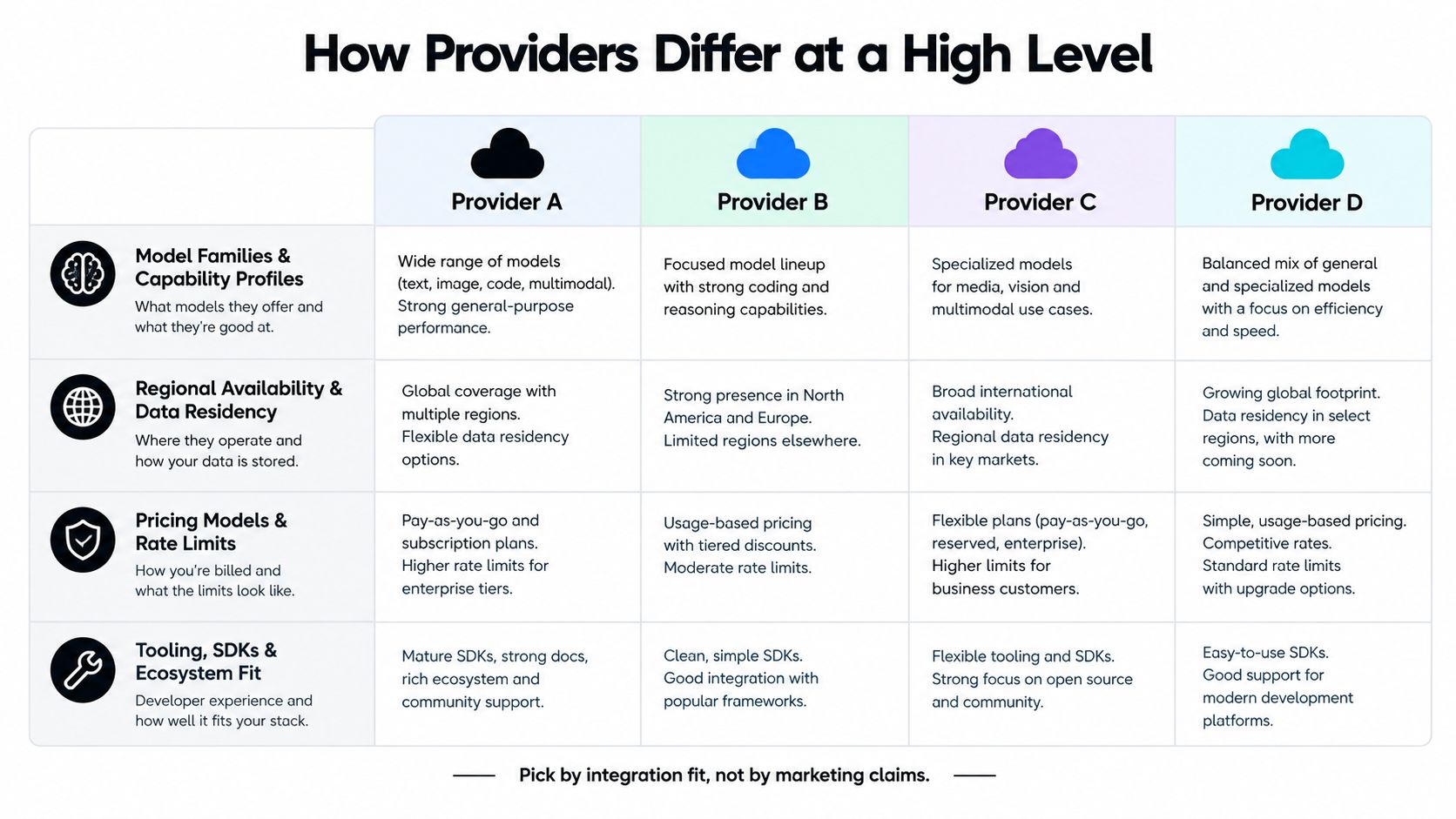
A third axis is pricing and rate limits. Teams often start by comparing token prices, but that only tells part of the story. Context window, multimodal support, and rate-limit tiers decide whether the model can carry the workload without constant retries or prompt trimming.
Provider-prefixed model addressing is the cleanest abstraction for this mess. Instead of rewriting request bodies for each vendor, the application can ask for a model through a stable slug and let the gateway route it to the right upstream. That turns provider selection into a routing decision, not a code fork.
Useful heuristic: if the request and response shapes stay stable, provider changes become deployment choices instead of integration projects.
This is also why the ecosystem is converging around OpenAI-compatible endpoints. The shape is easy to recognize, SDKs already know it, and gateways can preserve it while switching upstream providers behind the scenes. A team doesn't have to love every provider. It just has to know which one is the right fit for a given request.
Why Teams Layer a Unified Gateway on Top of Provider APIs
Once a team uses more than one provider, the operational friction shows up fast. Credentials multiply. Usage dashboards stop agreeing with each other. Billing arrives in separate invoices. Error semantics drift, and engineers end up writing provider-specific branches just to keep features alive.
A unified gateway removes most of that overhead by holding one account surface in front of many upstreams. The application keeps talking to an OpenAI-shaped interface, while the gateway consolidates keys, balance, invoicing, and request logging. That means existing SDKs and streaming code can keep working without a multi-vendor rewrite.
Routing matters more than retry spam. If one upstream is degraded, the gateway can fail over mid-flight to another deployment of the same model family. That's different from naive client-side retries, which often just repeat the same failure path and can amplify load on an already stressed provider.
When the gateway mirrors the request and response contract, it can also pool rate limits across providers serving the same model. That gives teams a buffer against single-provider throttling without forcing them to rewrite tool calls, streaming handlers, or response parsers.
Openbase is one example of this pattern. It provides a single OpenAI-compatible endpoint, provider-prefixed model access, and automatic failover while keeping the request body consistent across upstreams.
The part it doesn't solve is equally important. A gateway doesn't make a bad prompt better, and it doesn't remove the need to validate tool arguments, inspect usage, or design idempotent operations. It just gives your team one place to control how those requests move across providers.
Reliability, Observability, and the Real Cost of a Token
Reliability for an AI model API is bigger than uptime. A provider can be technically up while one model, one region, or one latency tier is broken for the workload you care about. That's why aggregate SLA numbers can hide the failures that matter most.
A healthier scorecard separates per-model success rate, streamed-response completion, timeout rate, and recovery behavior. It also needs to track whether the model can return the first token quickly, because a service that stays up but stalls at generation time still feels broken to users.
Retry policy should be precise. Safe retries usually include rate limits, connection timeouts, and transient server errors. Unsafe retries include client mistakes and bad routes, because those errors won't fix themselves and can create duplicate side effects if the request triggers external tools.
Practical rule: retry transport and transient failures, not malformed requests or missing resources.
Cost needs the same discipline. Token price alone doesn't tell you what a workflow really costs once retries, reasoning tokens, cache hits, failed attempts, and downstream review are included. Recent infrastructure analysis shows the price needed to hit a given benchmark-performance level has fallen roughly 5x to 10x per year across several task types, and Stanford AI Index figures cited in that analysis show inference cost for comparable capability dropping from about $20 to $0.07 per million tokens (price-performance and inference-cost analysis). Those shifts are real, but they don't mean the cheapest token wins.
The better metric is cost per accepted outcome. If a cheaper model creates more rework, more tool-call failures, or more validation work, it can cost more overall. The operational dashboard should therefore track incident frequency by capability, TTFT, streamed-completion rate, reasoning-token share, and cost per accepted result.
If you need billing and reconciliation details at the platform layer, the OpenBase billing guide is the kind of place teams usually document how usage, invoices, and failover accounting line up.
A Practical Mental Model for Choosing Your First Integration
Pick the endpoint first, not the provider. If the feature needs generated language or tool intent, start with chat completions. If it needs semantic search or retrieval, start with embeddings. If it needs both, design the handoff between them before you tune prompts.
Then ask what reliability the workload needs. A customer-facing chat flow needs a better view of TTFT, streamed completion, and failover behavior than an offline tagging job does. A tool-using agent needs idempotency, retry discipline, and strong argument validation because the model is only proposing actions, not authorizing them.
Finally, decide whether you need a gateway on day one. If you're only using one provider, direct integration is fine. If you already know you'll add another provider, or you want one usage ledger across teams, a unified gateway saves the rewrite later.
The first call should be boring on purpose. Send one chat completion through an OpenAI-shaped endpoint, log usage and latency, and confirm that the response shape matches your client expectations. If that works, you've validated the abstraction before you scale the stack around it.
If you're building around an AI Model API and want one place to evaluate models, routing, and usage, Openbase gives you a unified OpenAI-compatible entry point with provider selection, failover, and per-call logging. Visit Openbase to compare how that gateway pattern fits your integration plan.