
A team has already built its first AI feature around an OpenAI client. Then product asks for a second model, infrastructure asks for failover, finance asks why the invoice changed, and users expect the response to stream without interruption. Rewriting SDK adapters, tool-call handlers, billing logic, and reliability controls isn't a small change.
The right AI platform for developers should fit the workflow you already operate. This roundup compares seven platforms by API compatibility, quickstart quality, streaming behavior, tool support, model access, deployment control, and cost-management implications, rather than by model count alone. The practical question is how quickly an existing client can connect, how faithfully the platform preserves your request shape, and what trade-offs appear after launch.
Start with the bottleneck in your workflow. Then test the exact models, prompts, streaming patterns, and tool calls you plan to ship. Openbase is a strong unified-gateway option when multi-provider access and operational controls matter, but a direct inference platform may be a better fit for teams that prioritize dedicated capacity, custom model hosting, or the lowest possible latency.
Table of Contents
- 1. Openbase
- 2. OpenRouter
- 3. Together AI
- 4. Fireworks.ai
- 5. DeepInfra
- 6. Replicate
- 7. Groq
- Top 7 AI Developer Platforms Comparison
- Match the Platform to the Bottleneck
1. Openbase
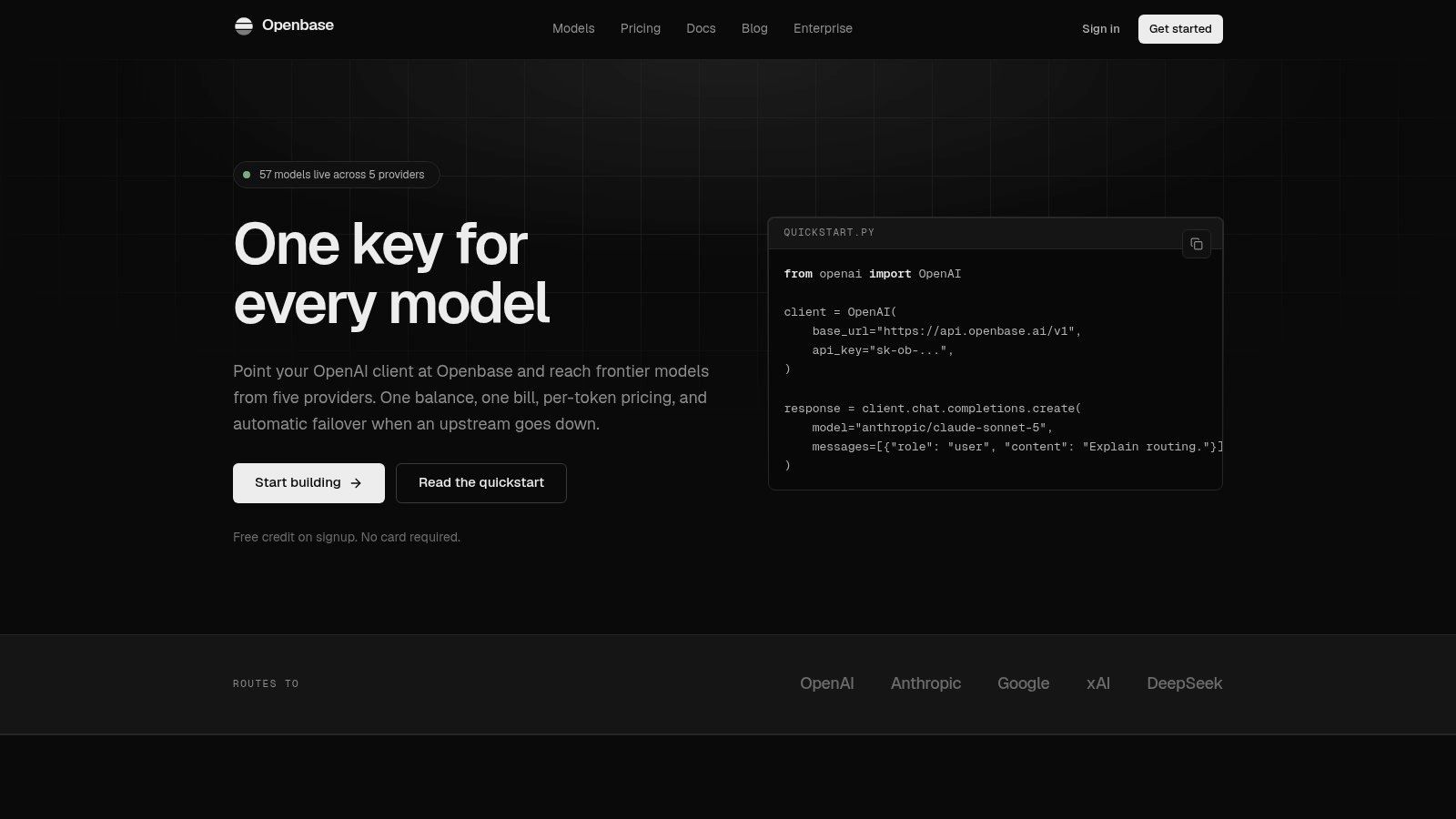
Openbase is the strongest fit for teams that want to add or change frontier models without rebuilding their application's AI integration layer. It provides a single OpenAI-compatible API across providers including OpenAI, Anthropic, Google, xAI, and DeepSeek. If your application already uses an OpenAI client, the migration path is deliberately narrow: change the base URL and API key, then keep the SDK, streaming implementation, and tool-call shape.
That matters most when reliability work is already part of your application. Openbase can retry eligible failures, including rate limits, timeouts, and upstream server errors, and route the request through another available provider. It avoids treating invalid requests as transient failures, so malformed parameters and missing resources don't disappear into a confusing retry loop. Pooled rate limits also reduce the risk of binding your entire workload to one provider's capacity.
What changes after deployment
The main advantage isn't only model access. Openbase gives developers a centralized usage record containing the model, provider, input and output tokens, latency, time to first token, and exact request cost. Reasoning tokens are accounted for explicitly, which helps teams explain why an apparently small request consumed more budget than expected.
A single balance and invoice simplify reconciliation across providers, while separate API keys and per-key limits support development, staging, production, and team-level isolation. Quickstarts for curl, Python, and Node reduce first-deployment friction, and streaming and function calling use the same request shape as the compatible Chat Completions interface.
Practical rule: Treat the gateway as a control plane, not just a model switcher. Use its logs to compare latency, retries, token usage, and cost by workflow before changing routing policy.
The trade-off is additional platform dependency and a gateway cost layer. Teams with a negotiated direct-provider contract may achieve lower unit economics through bespoke integrations. Provider-native features outside the shared OpenAI-compatible surface may also require a direct connection. For teams that value vendor redundancy, billing simplicity, and per-call observability, Openbase is the most complete workflow fit in this list.
2. OpenRouter
OpenRouter works well when the immediate requirement is broad model discovery through one OpenAI-compatible endpoint. Existing OpenAI SDK users can generally preserve their client structure while selecting models from a large catalog of third-party providers. That makes it practical for experimentation, benchmarking, and applications where the best model may change frequently.
The platform supports streaming and tool use, and its routing and fallback controls help developers avoid writing every provider adapter themselves. Provider selection can still matter, though. A model name alone doesn't tell you everything about response behavior, availability, data handling, or billing. Teams should test the selected provider path rather than assuming that every route behaves identically.
Where it fits
OpenRouter is a good choice for a prototype that needs fast access to many models, or for a product team running comparative evaluations without opening separate accounts everywhere. Its model pages and provider controls make discovery easier than maintaining a private spreadsheet of endpoints and capabilities.
Streaming deserves a real integration test. Confirm that partial content arrives in the format your frontend expects, that tool-call deltas are assembled correctly, and that your cancellation and timeout logic handles a provider change. Openbase's streaming implementation guidance is also useful as a reference when comparing compatible gateway behavior.
The operational trade-off is complexity hidden behind convenience. Pricing, routing behavior, and token accounting can be harder for newcomers to reason about than a direct provider relationship. Enterprise teams also need to evaluate the selected underlying provider for contractual, regional, and security requirements. Choose OpenRouter when model breadth and discovery lead the decision. Choose a more control-oriented gateway when consolidated governance and predictable operational reporting matter more than catalog size.
3. Together AI
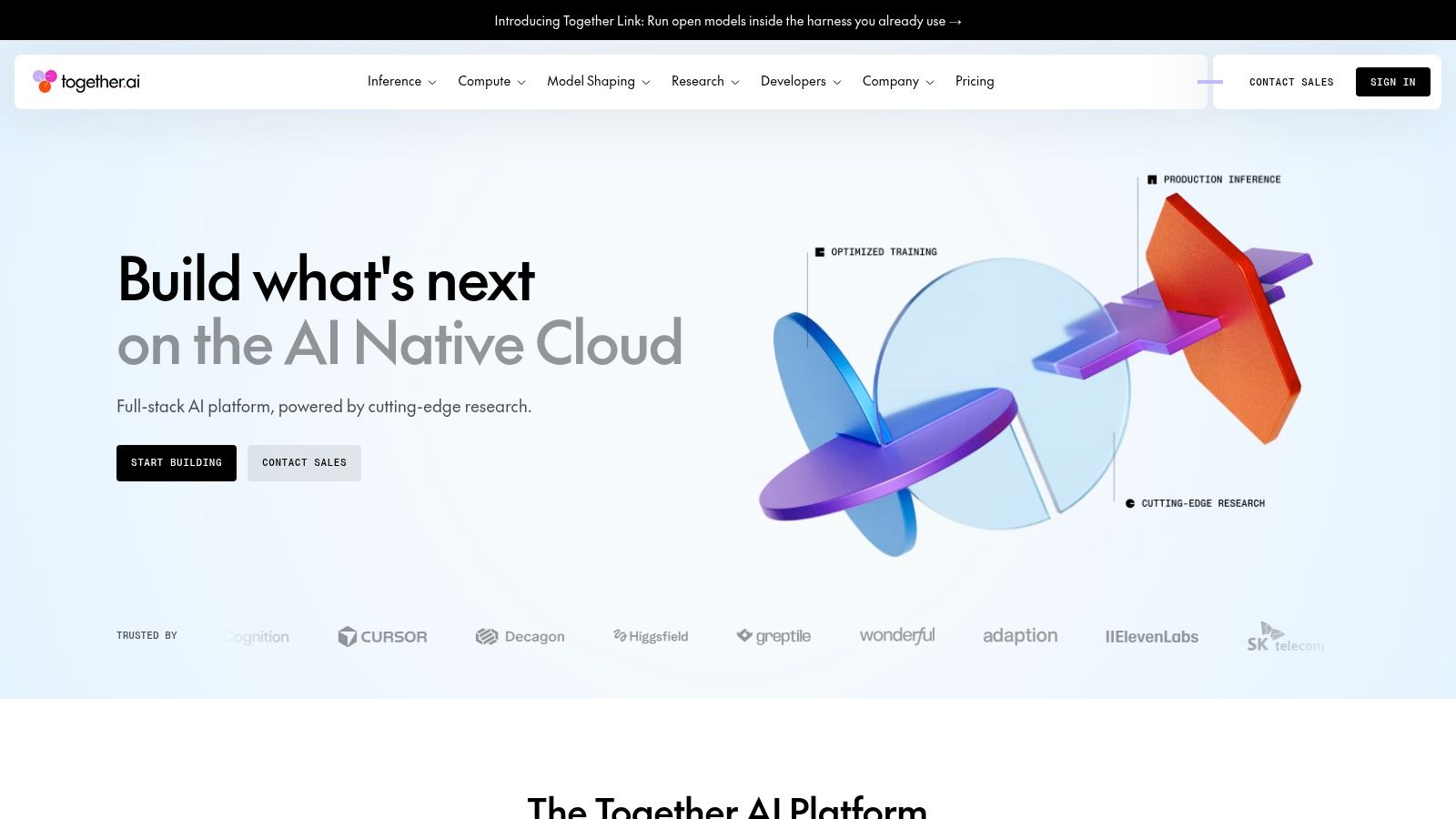
Together AI is built for teams that want an inference platform with a strong emphasis on open models, performance, and capacity planning. Its OpenAI-compatible chat-completions interface lowers migration effort, while serverless endpoints let developers begin without managing model infrastructure directly.
The more important distinction appears when an application moves beyond a trial. Together AI offers Provisioned Throughput for teams that need reserved capacity and a more deliberate reliability model. That can make sense for a production workload with known traffic patterns, strict latency expectations, or a requirement to avoid competing for purely on-demand capacity.
Capacity and customization
Together AI also supports fine-tuning workflows, so the platform can cover more than inference. This is useful when a team wants to evaluate an open-weight model, adapt it to a domain, and serve the resulting model through a related platform rather than splitting training and serving across unrelated vendors.
The cost model is easier to understand when you map it to workload behavior. Serverless usage may be a sensible starting point for irregular traffic. Provisioned capacity can become more attractive when demand is steady, but the commitment changes the economics and reduces the value of treating the platform as an occasional model playground.
A compatible endpoint accelerates the first deployment. It doesn't remove the need to benchmark queueing, streaming time to first token, output quality, and capacity utilization under your own traffic.
Together AI is the best fit when provisioned throughput or fine-tuning is central to the architecture. It is less compelling if your primary need is automatic cross-provider failover or a single ledger spanning unrelated model vendors. Confirm current model availability, API behavior, and pricing before migrating a production workload, because the best platform choice depends on the exact model and serving mode.
4. Fireworks.ai
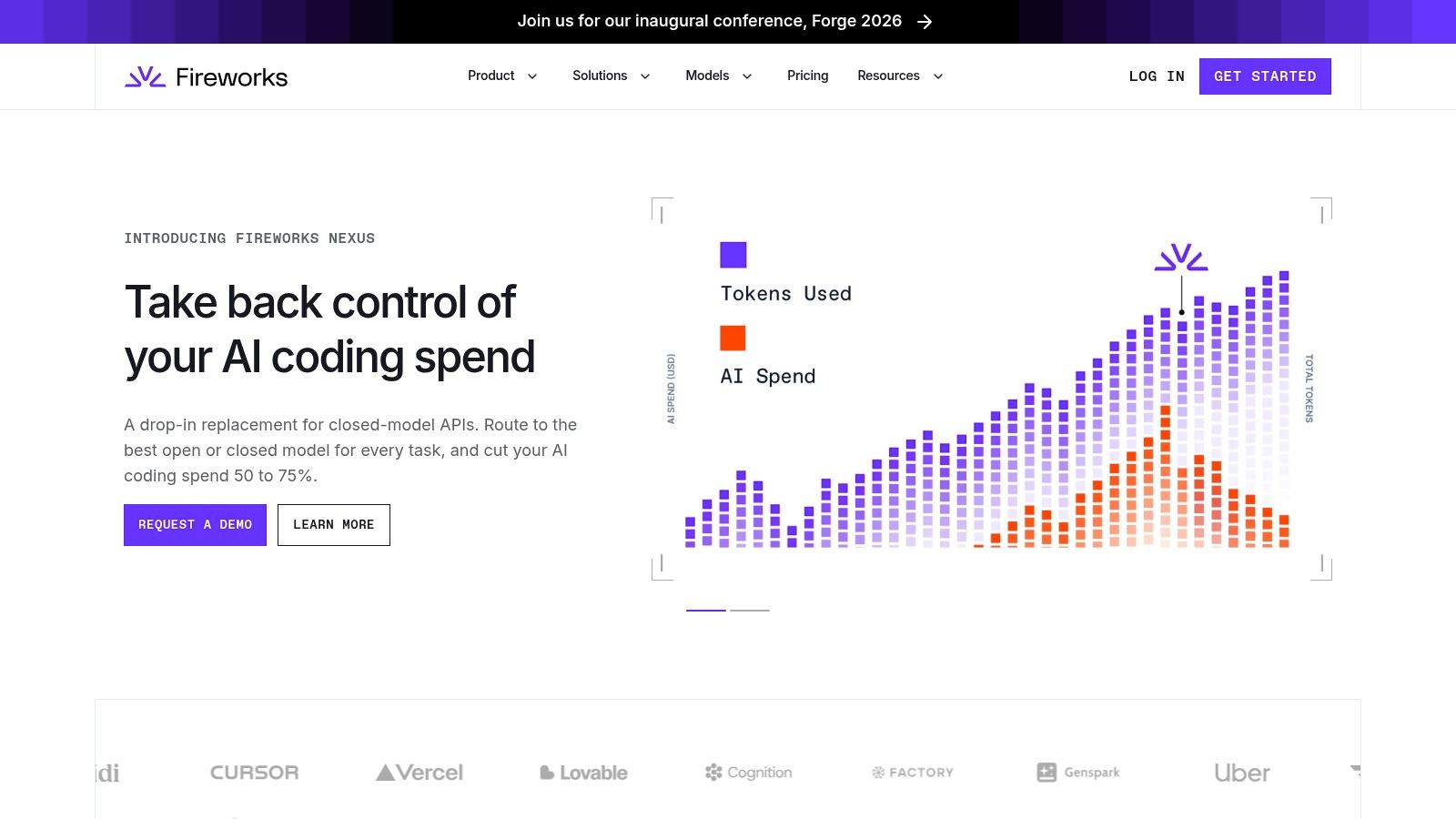
Fireworks.ai suits developers who want a fast path from model selection to a working inference endpoint. Its OpenAI-style chat-completions interface, function calling, and model library make the initial integration familiar. Teams can use hosted models, explore open-weight options, and move toward fine-tuned serving without building a separate deployment layer.
The developer experience is strongest when the application already follows conventional OpenAI request patterns. A base URL and client configuration change can get a proof of concept running quickly, while the model library gives engineers a practical starting point for text, embedding, and image workloads.
Test the edges, not just the quickstart
API parity helps with migration, but compatible syntax doesn't guarantee identical semantics. Test structured outputs, tool-call arguments, streaming termination, usage fields, refusal behavior, and error payloads with the exact model you intend to use. Small differences in these areas can break an agent loop even when the basic chat request works.
Fireworks.ai is attractive when engineers need convenient fine-tune and serve workflows alongside a developer-friendly API. Its pricing presentation can also make comparisons easier when a base model and a tuned model are available through related serving paths. The trade-off is that model availability and behavior vary, and undocumented edge cases deserve explicit regression tests.
Use Fireworks.ai when your bottleneck is deploying a chosen model quickly while preserving familiar API patterns. Don't select it solely because the endpoint looks like OpenAI. Validate the model's context behavior, function calling, streaming chunks, and failure responses in a staging environment before connecting it to a production agent.
5. DeepInfra
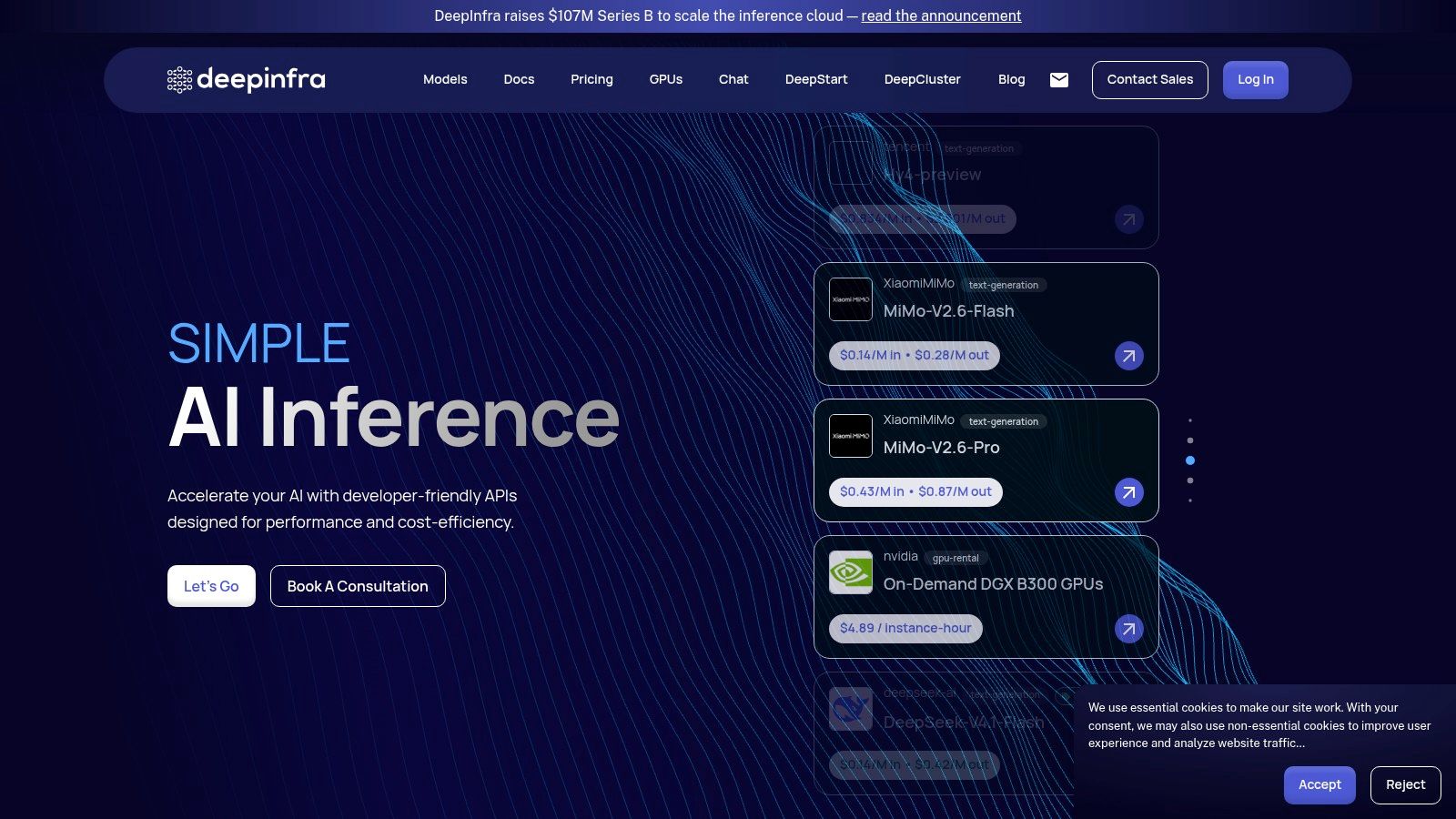
DeepInfra is a practical option for teams whose first question is, “Can this workload run at a lower inference cost?” It provides OpenAI-compatible endpoints for chat, embeddings, and image requests, including an /v1/openai path that can reduce the code change for an existing client.
The platform's model pages expose input, output, and cache-read pricing, which is useful for workloads with repeated context. Cached-token discounts can matter for applications that send stable system instructions or long recurring prefixes, but the benefit depends on the provider, model, and cache behavior rather than on the platform label alone.
Model the real request
A low token rate doesn't automatically produce a low application cost. Long contexts, retries, multi-step agents, and poor output quality can increase total consumption. Some models may also use execution time rather than tokens as the billing unit, so the team must record the unit for each selected model instead of applying one cost formula to the whole catalog.
For implementation details, compare the provider's endpoint behavior with your current client using a small test harness. The SDK integration documentation provides a useful compatibility checklist for teams comparing base-URL swaps, authentication, streaming, and response parsing across platforms.
DeepInfra's feature surface is leaner than a full routing gateway. That's a benefit when you want a straightforward inference endpoint and don't need extensive orchestration. It can become a limitation when you need centralized failover, detailed provider-level audit trails, or richer environment controls.
Choose DeepInfra when token economics and open-model access drive the decision. Before committing, calculate cost from successful calls, failed calls, retries, cache hits, latency, and the actual billing unit. A price page is a starting point, not a production forecast.
6. Replicate
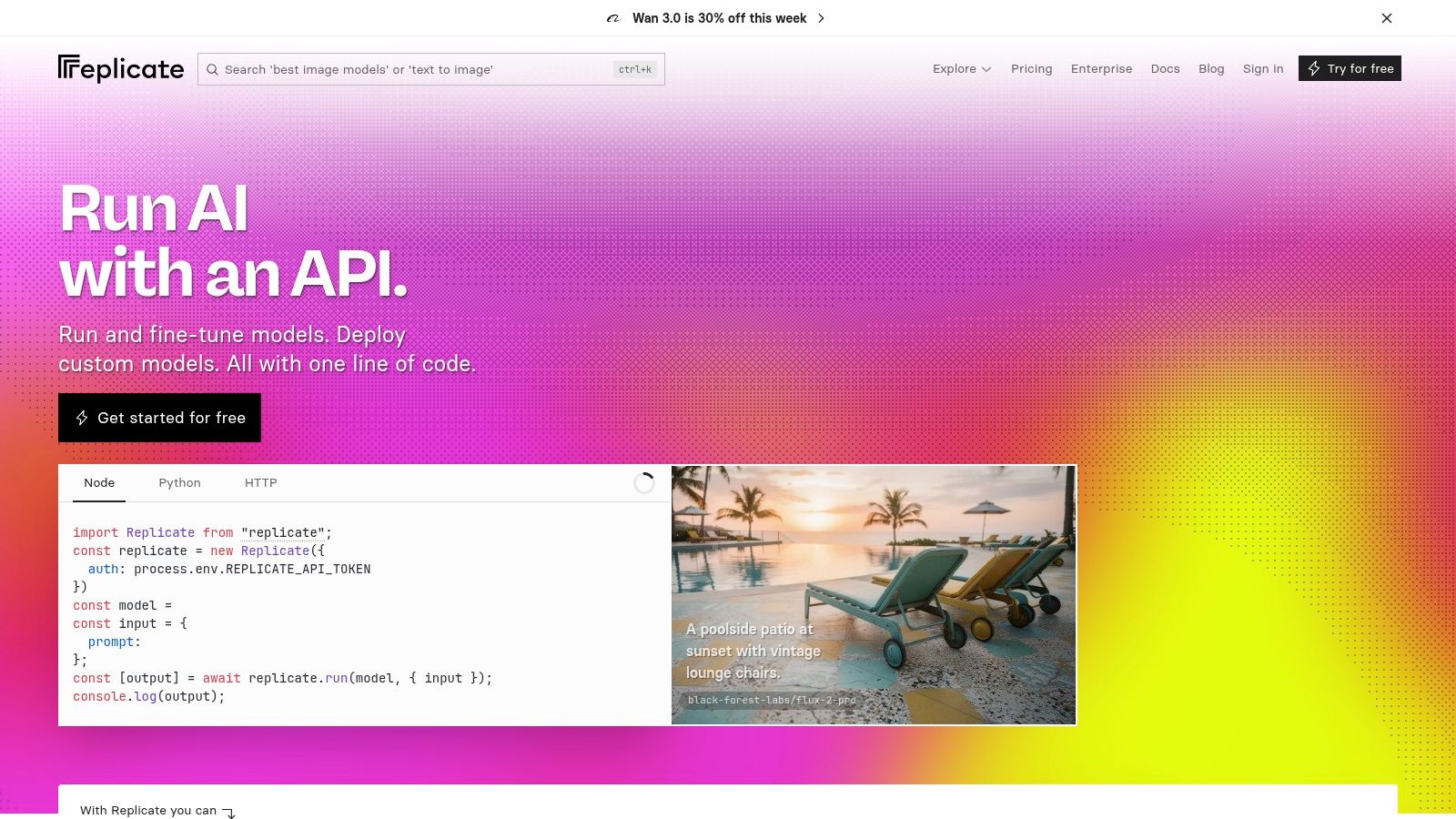
Replicate is the most natural fit for teams that need more than text generation. Its HTTP API exposes a broad collection of community and official models across text, vision, and audio, while Cog gives developers a path to package and deploy their own models. That combination is valuable when a product mixes conventional language features with image processing, speech, or specialized machine-learning code.
The integration model is simple: submit a prediction, track its status, and consume the result. Streaming over server-sent events supports interfaces where users need progress or incremental output. For a custom model, the engineering work moves toward packaging and serving the model rather than adapting every provider's chat schema.
Flexibility brings forecasting work
Replicate is primarily a hosting and execution platform, not a router that transparently switches among external frontier providers. That distinction matters if your reliability strategy depends on moving a request between vendors without changing application behavior. You may need to design that layer yourself.
Pricing also varies by model and workload. Some requests are measured by time, while others use images, calls, or tokens. Finance and engineering should tag each prediction with the model, input type, duration where relevant, and product workflow. Otherwise, a multimodal application can look profitable at the endpoint level while becoming expensive through a high-volume or slow model.
The model documentation is a useful reference when comparing model metadata, capability declarations, and provider-specific assumptions.
Replicate is the best choice when custom models or multimodal workflows outweigh the need for a standardized frontier-model gateway. It isn't the obvious choice for a team that wants one uniform Chat Completions contract across multiple commercial providers. Test cold-start behavior, output retrieval, streaming disconnects, and model-specific billing before promising a particular user experience.
7. Groq
GroqCloud is designed for applications where users notice every pause. Its OpenAI-compatible endpoints reduce the initial integration burden, while Groq's inference hardware focuses on fast generation and strong time to first token. That makes it a compelling candidate for interactive assistants, voice-adjacent experiences, and agent steps where a slow first response makes the product feel unresponsive.
The quickstart path is familiar to OpenAI SDK users. Developers can preserve much of their client code, then select models from Groq's supported open-weight lineup. Tool use and structured outputs are available, but compatibility should be treated as a tested subset rather than a promise that every OpenAI feature behaves identically.
Latency is only one part of the workflow
Fast first tokens don't solve slow tool execution, repeated agent calls, or an expensive model choice. Measure the full user-visible path, including request setup, time to first token, token cadence, tool execution, final response time, and retries. A model that starts quickly can still produce a poor experience if your orchestration layer blocks between steps.
Groq's model scope also affects architecture. If the application requires proprietary frontier models, multimodal breadth, or frequent provider switching, Groq may need to sit beside another platform rather than replace it. That can be a sensible design if one workflow genuinely prioritizes speed and another prioritizes reasoning or model-specific capability.
Choose Groq when low latency is the primary product requirement. Validate tool-call argument formatting, structured-output constraints, streaming cancellation, rate-limit responses, and the exact models available to your account. “OpenAI-compatible” should shorten the first integration, not replace end-to-end testing.
Top 7 AI Developer Platforms Comparison
| Platform | Implementation complexity 🔄 | Resource requirements ⚡ | Expected outcomes 📊⭐ | Ideal use cases 💡 | Key advantages ⭐ | Limitations |
|---|---|---|---|---|---|---|
| Openbase | Low, true drop‑in (swap base URL/key) | Moderate, prepaid balance & platform fees | Increased reliability, provider redundancy, granular cost/perf visibility | Teams needing vendor redundancy, consolidated billing, observability | Automatic mid‑flight failover, pooled rate limits, per‑call observability, consolidated invoices | Adds platform dependency/fees; may not expose all provider‑native features |
| OpenRouter | Low, OpenAI‑compatible single endpoint | Low–Moderate, single key/dashboard, many routed providers | Broad model access with easy switching; potential billing complexity | Users who want one endpoint and wide model/provider choice | Wide provider breadth, minimal code change | Pricing/accounting can confuse; compliance depends on routed provider |
| Together AI | Low–Medium, OpenAI APIs + serverless endpoints | High, provisioned throughput for best economics | Predictable token pricing, capacity SLAs, fine‑tuning support | Teams needing predictable capacity and reliability guarantees | Provisioned throughput SLAs, token‑based pricing, fine‑tuning platform | Best economics often require capacity commitments; prices can change |
| Fireworks.ai | Low, API parity with OpenAI; quick deploy | Moderate, hosting and GPU for fine‑tuning possible | Low latency inference and straightforward migration | Teams needing low latency and convenient fine‑tune/serve workflows | Developer‑friendly parity, competitive base+fine‑tuned pricing | Some edge‑case behavior vs OpenAI; model availability/prices vary |
| DeepInfra | Low, drop‑in OpenAI‑compatible endpoints | Low, aggressive per‑token pricing and cache discounts | Lower inference costs and high throughput for cost‑sensitive workloads | Cost‑sensitive high‑throughput inference use cases | Very competitive per‑token rates, cache‑read discounts | Leaner orchestration feature set; some models billed by time |
| Replicate | Low–Medium, unified HTTP API; deploy via Cog | Variable, pricing/unit varies by model (sec/call/token) | Multi‑modal support, easy custom model hosting and streaming | Teams mixing text, vision, audio or deploying custom models | Huge model catalog across modalities; simple deployment flow | Inconsistent pricing units complicate forecasting; mainly host‑centric |
| Groq (GroqCloud) | Low, OpenAI‑compatible endpoints; some feature gaps | High, specialized LPU hardware/cloud resources | Very low time‑to‑first‑token and high throughput for interactive apps | Latency‑sensitive or agentic UX requiring fastest TTFT | Exceptional inference speed and TTFT on Groq hardware | Focused on open‑weight models; some OpenAI features not fully supported |
Match the Platform to the Bottleneck
Start with the constraint that is most expensive to change later. If your application needs multi-provider access, fallback, consolidated billing, and per-call operational data, begin with Openbase. OpenRouter is another strong option when model discovery and provider choice are the main priorities, especially during evaluation. Both reduce the need to maintain separate client integrations, but you still need to inspect the provider route behind each request.
Choose Together AI when provisioned capacity, open-model inference, or fine-tuning sits at the center of the roadmap. Choose Fireworks.ai when the team wants fast model deployment, familiar API parity, and a convenient path from hosted model to fine-tuned serving. DeepInfra is better suited to cost-sensitive inference where the team is prepared to model cache behavior, retries, and different billing units carefully.
Replicate leads when the product combines multimodal features with custom model packaging. It offers a different operating model from a provider router, so plan for prediction lifecycle management and model-specific cost accounting. Groq is the clearest choice when time to first token and interactive speed matter more than access to every proprietary frontier model.
Before adopting any platform, run the same small production-shaped test suite against the exact models you plan to ship:
- SDK compatibility: Confirm authentication, base-URL configuration, response parsing, usage fields, and error types.
- Streaming behavior: Check chunk order, finish signals, cancellation, reconnect handling, and time to first token.
- Tool calls: Test parallel calls, malformed arguments, structured outputs, retries, and tool-result insertion.
- Failure handling: Distinguish rate limits, timeouts, provider errors, policy denials, invalid requests, and partial responses.
- Pricing units: Record input, output, reasoning, cached, image, call, or execution-time charges as applicable.
- Model availability: Verify that the selected model, context behavior, region, and capabilities match the account you will operate.
- Production controls: Require environment-specific keys, usage limits, audit fields, spend alerts, regression evaluations, and human review for security-sensitive changes.
Developer adoption of AI tools is already broad, but usage doesn't prove reliability. Stack Overflow's 2025 Developer Survey found that 84% of developers were using or planning to use AI tools, while 46% distrusted AI-output accuracy. That combination explains why platform selection should focus on observability and validation as much as endpoint compatibility.
Test your real prompts and request shapes before you commit. The best AI platform for developers isn't the one with the longest catalog. It's the one that removes the bottleneck your team will otherwise keep paying for in integration work, outages, latency, governance, or unpredictable inference cost.
Openbase gives engineering teams one OpenAI-compatible gateway for models from multiple providers, with streaming, tool calls, automatic failover, consolidated billing, and per-request visibility into tokens, latency, provider, and cost. If those controls match the workflow you're building, visit Openbase and test your existing client against a unified model access layer.