
Your model bill looks normal, but finance flags a cloud bill that has doubled. Say the extra spend comes from GPU hours and logging, not increased customer traffic. The provider dashboard still looks healthy because it doesn't include those costs.
An AI spending tracker should explain that difference, not just reproduce the model invoice. It needs a traceable path from each charge to a workload, then from that workload to an accepted result. A clean invoice proves the accounting adds up. It doesn't prove the feature is economical.
Table of Contents
- Where AI Spend Hides Beyond the Model Bill
- How to Build a Per-Request Cost Pipeline
- Confirm Your Tracker Matches the Invoice
- Assigning AI Costs to Owners and Customers
- Measuring Cost per Successful Outcome
- Budgets, Alerts and Spike Response
Where AI Spend Hides Beyond the Model Bill
Start with the documents finance pays in practice. An invoice identifies a purchase, but rarely the feature, customer, or deployment that caused it.
Cost categories a complete AI tracker must cover
| Cost category | Where it appears | Common blind spot |
|---|---|---|
| Hosted model tokens | Provider or gateway invoice, broken down by model | Input, output, and reasoning usage can have different accounting rules |
| Retried and failed calls | Request logs, not always distinct invoice lines | Token-producing retries can add charges without a successful result |
| GPU and self-hosted compute | Cloud bill, tagged by cluster or node pool | Idle time between requests |
| Vector databases and storage | Cloud storage and database line items | Embedding refresh jobs outside the request path |
| Observability and logging | Telemetry vendor invoice | Prompt-sized payloads and duplicate trace exports |
| AI seats and SaaS add-ons | Procurement records or company card statements | Subscriptions bought by individual teams outside IT |
Reasoning usage may be included in billable output rather than displayed as a separate invoice item. Preserve its reported breakdown without counting it twice. Likewise, a retry that generates tokens can cost money even when the application discards the response.
Idle GPUs and telemetry usually don't appear under a model name. Neither do background indexing jobs or an engineer's AI subscription.
Scope rule: Cover every category that receives an invoice, even if the first implementation only meters tokens. Record the unmetered categories as explicit gaps.
A gateway such as Openbase consolidates model billing under a shared balance and invoice; its pricing information helps define that portion of the ledger. Direct provider exports and cloud billing exports remain necessary for charges outside the gateway.
This week, export your recent invoices, tag every line with an owner, and mark the categories that don't yet have usage metering. Don't label an incomplete token dashboard as total AI cost.
How to Build a Per-Request Cost Pipeline
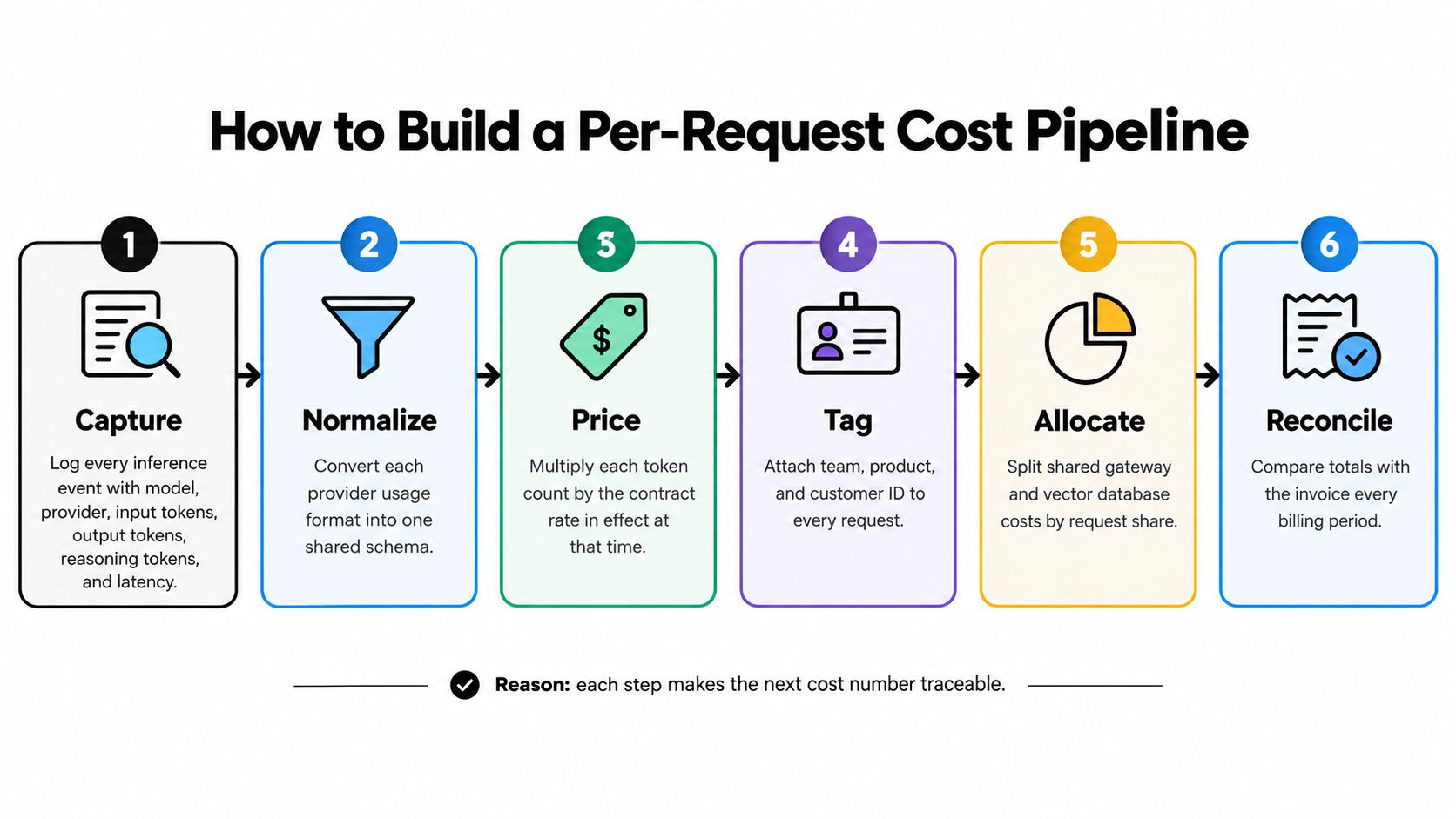
Use request events as the operational ledger, with invoices as the accounting check. The FinOps Foundation's guidance for AI recommends cost allocation, resource tagging, usage review, and monitoring latency alongside resource utilization.
Build the event ledger
Capture every inference attempt. Wrap the call in an OpenTelemetry span and record model, provider, input tokens, output tokens, reported reasoning tokens, latency, and final status. Logging only prompt tokens makes the ledger incomplete before pricing even starts.
Attach application, environment, team, customer, workflow, and budget-owner identifiers at the call site. Adding ownership tags later forces someone to infer intent from account names, which breaks when services share credentials.
Normalize provider records into a common schema. Keep the original usage payload alongside normalized fields, and distinguish a missing token count from a reported zero. Inconsistent mappings, especially where reasoning is a subset of output, produce believable but incorrect totals.
Join usage to a price table with effective timestamps, currency, contract route, and a stored price-version identifier. Applying today's rate to an older call silently rewrites history; consult the model documentation when mapping supported model identifiers rather than matching display names.
Calculate cost per request, customer interaction, and completed workflow using separate aggregation keys. Dividing by raw attempts alone rewards systems that generate extra calls without completing more work.
Reconcile before publishing trusted totals. Compare event costs with invoice usage charges and retain any unresolved difference. A dashboard published before reconciliation can spread the same accounting error into forecasts, customer margins, and budgets.
Preserve causality across workflows
Pass a parent workflow ID to every sub-agent and give each attempt its own event ID. Deduplicate exported events by that identifier so replaying a telemetry batch doesn't create additional spend.
For a basic shared-cost allocation, distribute GPU idle time and telemetry by workload request share. That's an allocation policy, not a direct measurement: request share is easy to audit but can undercharge workloads with longer runtimes or larger payloads. Move to GPU-seconds or telemetry bytes when those measurements become reliable.
Account-level totals can identify overspend. They can't identify the workflow responsible without allocation metadata.
Keep a separate allocation record for subscriptions and other charges that have no originating inference call. Traceability means explaining every dollar, not pretending every dollar is token usage.
Confirm Your Tracker Matches the Invoice
Reconcile a complete billing period before trusting the dashboard's alerts. Compare like with like: usage charges against metered usage, and payment activity against the balance ledger. A prepaid top-up isn't itself inference consumption.
The billing documentation provides the gateway-specific starting point for balances and invoice records. A consolidated invoice and daily rollups reduce export work, but they don't remove the need to verify quantities and adjustments.
Run the billing-period check
Download matching records. Export invoice line items and daily usage for the same billing period. Include credit notes and adjustments rather than comparing only the amount paid.
Align timestamps to the billing system's documented time zone before grouping events by day. Use UTC only when that matches the billing cutoff, and retain original timestamps for investigation.
Compare quantities before money. Sum input and output usage by model, provider, and billing route, then compare cost against the corresponding invoice line. Matching currency totals can conceal offsetting token-count errors.
Check price-version boundaries against model and contract changes. A rate effective during the period requires separate calculations on either side of its effective timestamp.
Separate adjustments from consumption. Track prepaid draws, promotional credits, tax, currency conversion, and rounding explicitly. Calculate usage at full precision and round at the billing system's aggregation boundary.
Investigate unexplained variance using a written acceptance rule. Set both an absolute tolerance and a relative tolerance appropriate to your ledger's precision; a percentage alone behaves badly on tiny invoice lines.
Freeze the signed-off period. Store the reconciled totals, variance, explanation, and reviewer. Apply later corrections as visible adjustments instead of replacing the approved result without a trace.
Causes of gaps between logged cost and invoice
| Gap you see | Likely cause | Check first |
|---|---|---|
| Tracker higher than invoice | Estimated charges retained for non-billable failed attempts | Filter zero-output calls, then verify input usage and billing status before excluding them |
| Invoice higher than tracker | Reasoning usage omitted from billable output | Compare normalized output with the original provider usage fields |
| Small daily gaps that net out over the month | Time zone cutoff mismatch | Re-run by the documented billing day, using UTC where applicable |
| Gap starting on a specific date | An old price version remained active after a model change | Compare effective dates with the deployment and pricing change logs |
| Gap on one provider only | Failover billed through a different route than recorded | Group costs by provider and upstream route |
| Repeated small cost differences | Premature rounding of token rates | Recalculate at full precision and round only at the billing boundary |
Keep failures distinct from billing status
A call can fail at the application layer after the upstream service has already generated billable tokens. Conversely, a rejected attempt may have no usage charge. Record application_status and billing_status separately; zero output alone isn't sufficient evidence that nothing was billed.
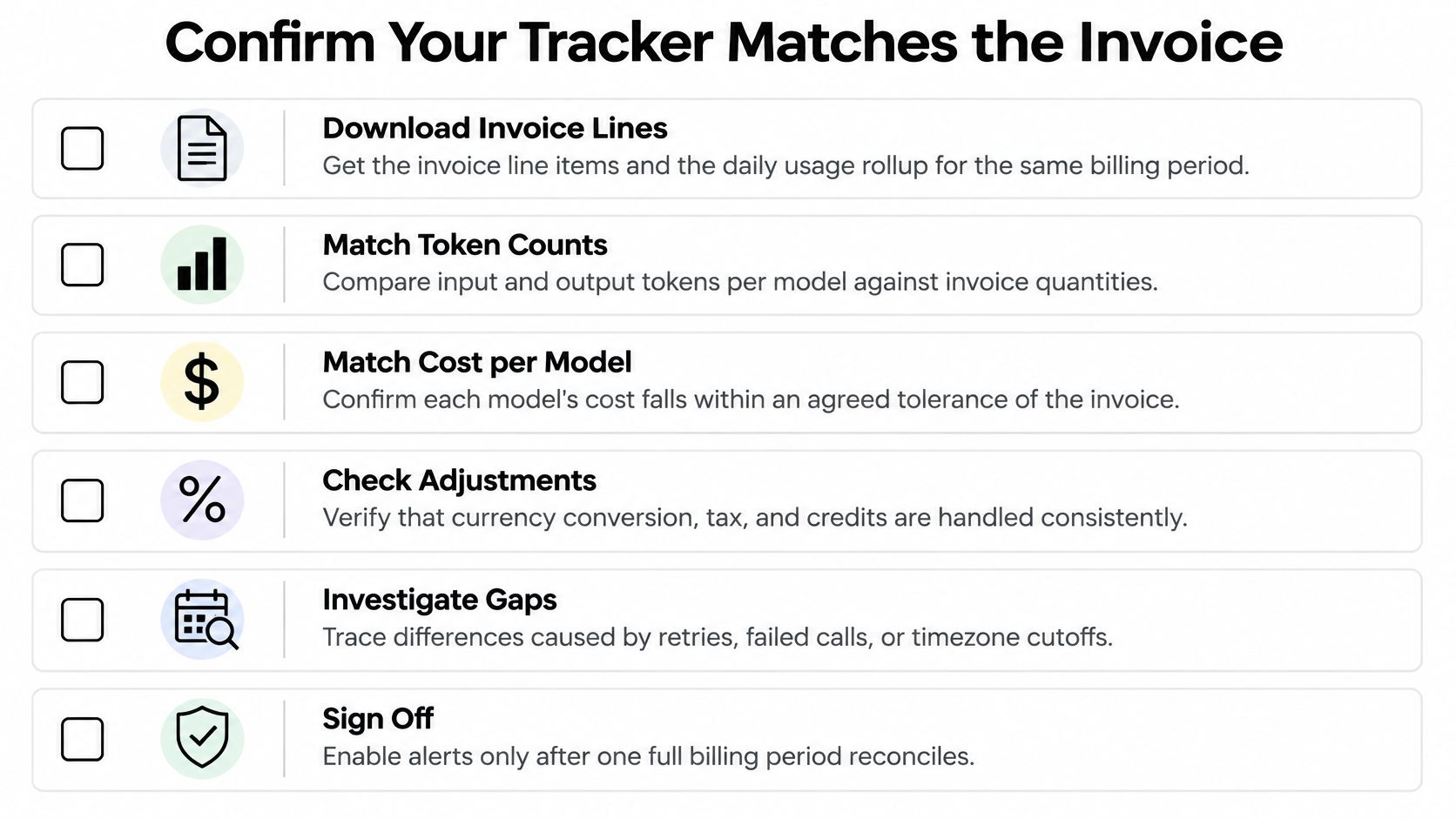
This week, reconcile the latest closed billing period and enable spend alerts only after every material line passes your written acceptance rule or has an approved explanation.
Assigning AI Costs to Owners and Customers
A model-level dashboard doesn't tell finance whose budget pays. Set the allocation policy before teams begin arguing over shared charges.
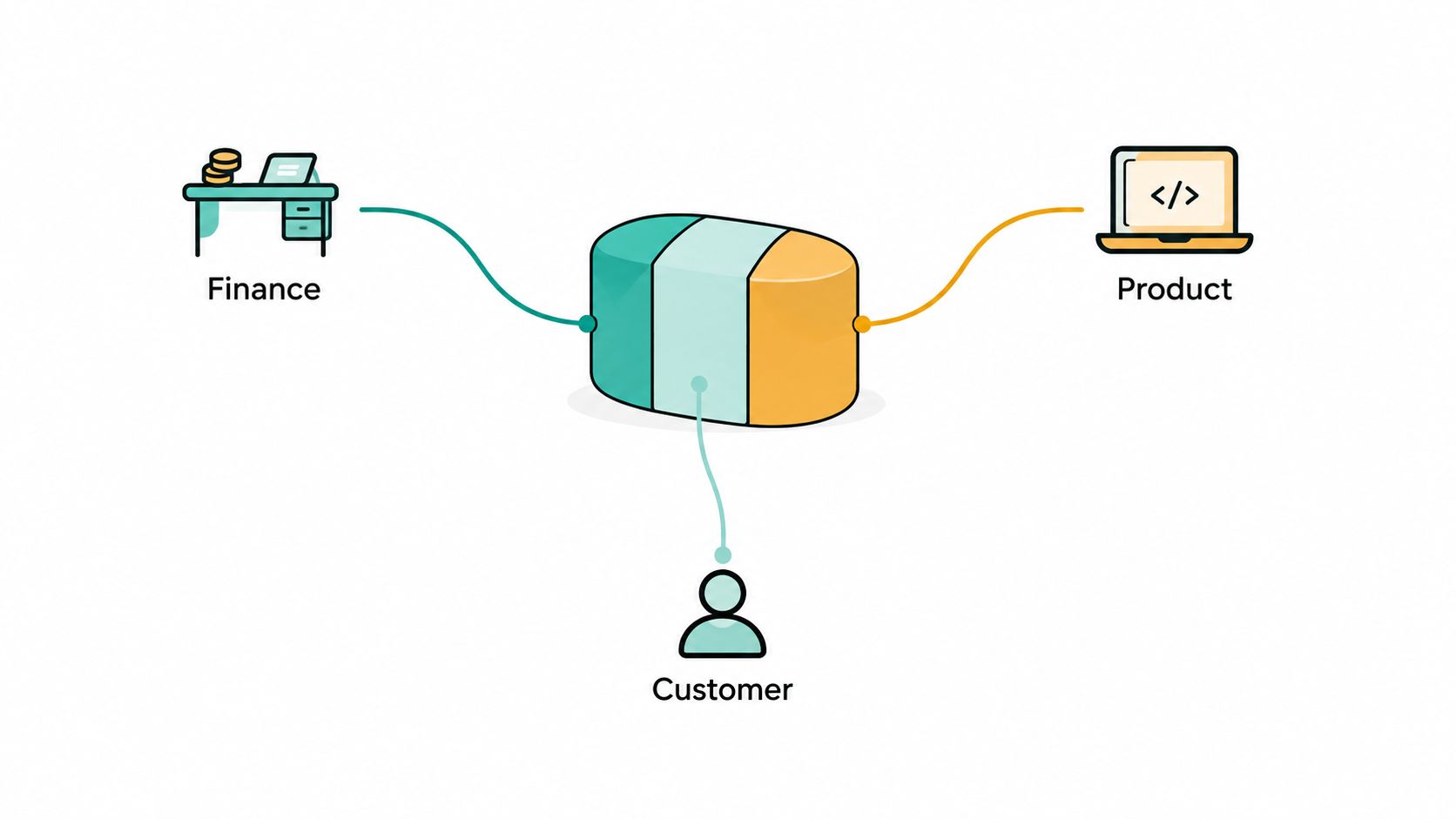
Ownership needs to connect finance, product, and the customer-facing workload.
Make the allocation decisions explicit
Choose the shared-cost rule. Use measurable consumption for shared gateways and databases, with request share as a simple fallback. Use headcount only where usage isn't measurable, and identify that allocation as estimated rather than customer-level truth.
Assign retries and reasoning usage to the initiating team. That team usually controls prompt construction, retry policy, and agent behavior. Document exceptions, such as centrally managed platform failures, so product teams aren't charged under an unwritten rule.
Find unallocated consumption. Reconcile API-key inventory against the service and team roster, and review company-card SaaS charges with procurement. Give each service and environment a separate key with an owner, limits, and a revocation path that won't interrupt unrelated production workloads.
The gap between concern and control is substantial: UC Today's coverage of AI cost-visibility surveys describes separate U.S. survey evidence in which 82% of AI-investing senior leaders were concerned about token usage and related costs, yet only 64% said their organizations actively monitored tokens and maintained budget guardrails.
The accompanying video provides additional context for the ownership discussion.
Contain agent sessions, not just individual calls
Cap steps and cumulative tokens per agent run. Attach a session ID so a looping agent appears as an expensive session rather than scattered, individually ordinary calls.
Write the policy in language finance and auditors can use. Include the charge owner, shared-cost basis, treatment of failures, unallocated-cost queue, exception approver, and effective date. Preserve historical ownership so reorganizing a team doesn't rewrite last period's allocation.
Measuring Cost per Successful Outcome
A lower per-token bill can produce a higher cost per useful result. Cheap attempts aren't cheap outcomes when the model needs repeated correction or human review.
The IBM guide to enterprise AI cost management frames cost management as a cost-and-value problem and reports that 69% of organizations describe a significant disconnect between AI spending and measurable financial outcomes. The practical response is to join spend with the outcome the product team already accepts.
Compare completed work
Use this formula when each request has a final success label:
Cost per successful outcome = average cost per attempt × average attempts per request ÷ final task-success rate
For an exact ledger calculation, divide the total cost of all attempts, including failed requests, by the number of successful requests. Use the same request cohort for numerator and denominator.
Cost per successful task for two models (illustrative values)
| Model | Cost per attempt | Attempts per request | Task success | Cost per successful task |
|---|---|---|---|---|
| Model A, cheaper per token | Measured average attempt charge | Higher when malformed output triggers retries | Lower final completion rate | Total cohort cost ÷ successful tasks |
| Model B, pricier per token | Higher average attempt charge | Lower when outputs need fewer corrections | Higher final completion rate | Can be lower despite the higher attempt charge |
These are comparison conditions, not measured model results. Say Model A frequently emits malformed JSON while Model B usually produces accepted output immediately. Model B wins only if the avoided retries and additional successful tasks outweigh its higher attempt charge.
Rank models by the cost of accepted work, not by the advertised token rate.
Include the human work
Extend the numerator to include tool calls, allocated infrastructure, and review labor:
Fully loaded cost per success = (inference + tools + allocated infrastructure + review labor) ÷ successful outcomes
Calculate review labor from recorded review time multiplied by the applicable loaded labor rate. Include review of successful outputs too, if the workflow requires it.
Define success before comparing models. Schema validity may be sufficient for extraction, while support automation may require resolution without escalation. Store request ID, attempt number, model version, final status, outcome label, and outcome timestamp so delayed acceptance can be joined back correctly.
Re-evaluate after model-version changes, and show uncertain attribution separately. An HTTP success response isn't evidence that the customer received a useful result.
Budgets, Alerts and Spike Response
Forecast token volume and effective unit price separately. Aggregate spend alone won't distinguish customer demand from longer prompts, a model upgrade, or an expensive failover route.
DevOps.com's reporting on AI-agent observability costs states that 55% of organizations cannot adequately control AI costs and 60% experience greater operational difficulty from unexpected billing spikes than from consistently high costs. Operational response matters more than another monthly chart.
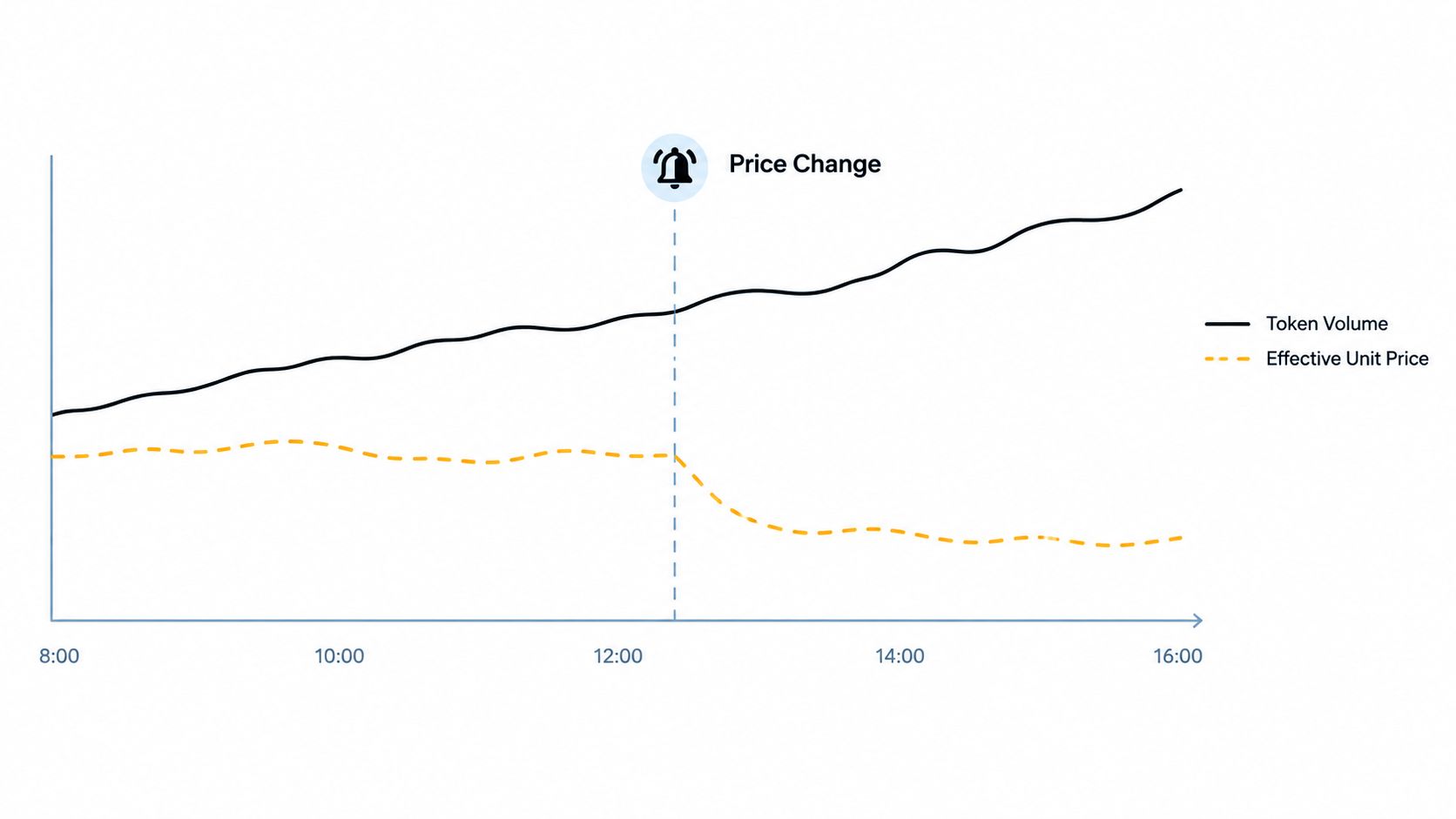
Set workload-specific starting rules
Build a rolling baseline from several billing periods, segmented by model, provider, workload, and environment. Exclude known incidents deliberately, and annotate launches rather than letting them silently redefine normal usage.
The following are configuration rules to calculate from your own baseline, not published benchmarks. Backtest them against ordinary traffic before enabling enforcement.
Starting alert thresholds and first responses
| Signal | Starting threshold | First action |
|---|---|---|
| Daily spend | Upper-tail spend for the same weekday; hard limit at an approved multiple | Notify the owner and check the top workflow by cost |
| Monthly spend | Projected month-end spend above the approved budget; separate enforced ceiling | Soft alert to the budget owner and a forecast review |
| Request rate | Sustained departure from the workload's normal rate | Check for an agent loop or retry storm |
| Input context length | Above the workload's baseline upper percentile | Review recent prompt changes and truncation rules |
| Retry volume | Above the workload's accepted retry-rate ceiling | Check failover routing and upstream error rates |
| Output-to-input token ratio | Above the workload's baseline upper percentile | Check reasoning usage and maximum-output settings |
| Effective unit price | Cost per token changes after a routing change | Confirm the model and provider mix before any budget change |
A monthly threshold needs a monthly budget or forecast distribution. Don't treat a weekday daily-spend percentile as a monthly limit.
Run the same response loop
- Detect and attribute. Say spend increases after a deployment while request volume stays stable. Group by workflow and compare context length, attempts, and route.
- Enforce and notify. If a prompt change caused the increase, restore its context cap or pause the affected job, then notify its owner. Don't automatically reroute quality-sensitive work without an approved fallback.
- Verify recovery. Check cost alongside latency, error rate, throughput, and task success, then reconcile the incident's estimated charges with billed usage.
If the alert recipient can't identify the responsible workflow promptly, fix attribution before adding more alerts.
Openbase offers consolidated model access and billing alongside granular per-call usage logs for tracking cost and performance. Visit Openbase to evaluate those records as the model-cost layer of your tracker, then join them to ownership and outcome data before making spending decisions.