
Your support team ships a chatbot, customers like it, and nobody thinks about the model provider again. Then an upstream release changes its tone, refusal rate, or latency overnight. Engineering blames procurement, procurement checks a signed questionnaire, and no one can say who owns the fix. That's the gap AI vendor management has to close.
Table of Contents
- What AI Vendor Management Covers and Why It Differs from Software Buying
- Vendor Selection Scorecard and the Evidence to Request
- How to Run a Selection Process in Five Stages
- Contract Clauses That Protect You After Signing
- Security and Compliance Requirements by Framework
- Redundancy Strategies Without Doubling Your Costs
- Owning the Vendor After Approval and Acting This Week
What AI Vendor Management Covers and Why It Differs from Software Buying
Say that chatbot handles refunds and order lookups. After the provider's release, it starts refusing valid refund questions and answering more slowly. Your team didn't deploy anything, but you're still accountable to customers. You need the model version, the change notice, the test results, and a named person who can pause traffic or switch providers.
AI vendor management is the continuous practice of selecting, contracting, monitoring, and replacing the external models, APIs, and data services your organization depends on. It's closer to managing a power supplier for a production line than buying office software once. The supply keeps flowing, its characteristics can change, and an interruption stops work downstream.
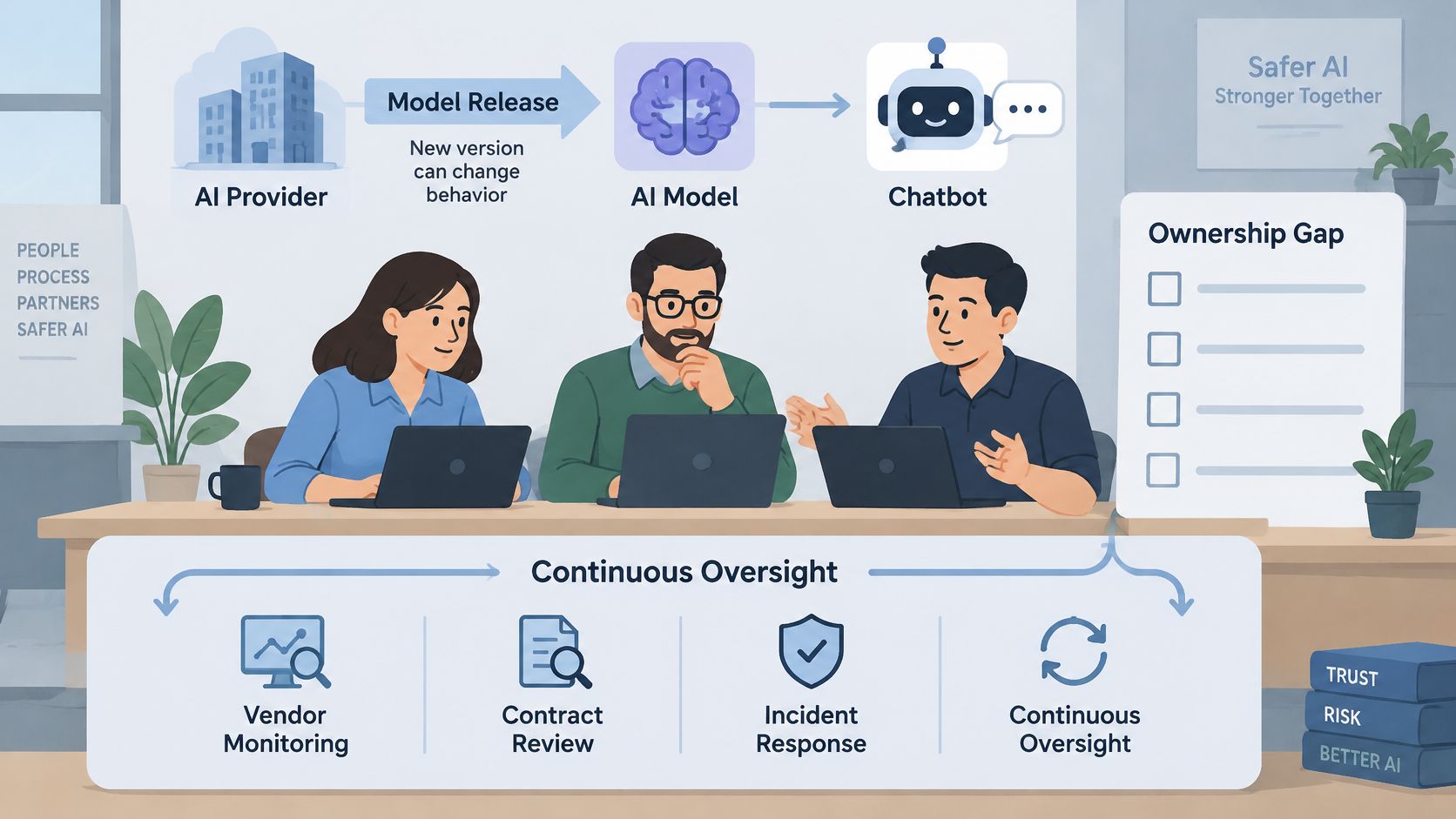
Ordinary software buying leans on a version you choose to install. AI suppliers can adjust model behavior, subprocessors, retention terms, and policies outside your release cycle, so one-time due diligence goes stale. Your controls have to keep working after approval.
That lifecycle view has a formal anchor. The U.S. National Institute of Standards and Technology published its NIST AI Risk Management Framework 1.0 on January 26, 2023, treating procurement as part of trustworthiness, evaluation, monitoring, and risk mitigation rather than as a simple purchase. The framework is voluntary, but it gives buyers a neutral basis for comparing purpose, limitations, data practices, security, and reliability.
Treat each approved model as a live dependency with an owner, evidence, and a replacement path, not as a completed purchase.
Vendor Selection Scorecard and the Evidence to Request
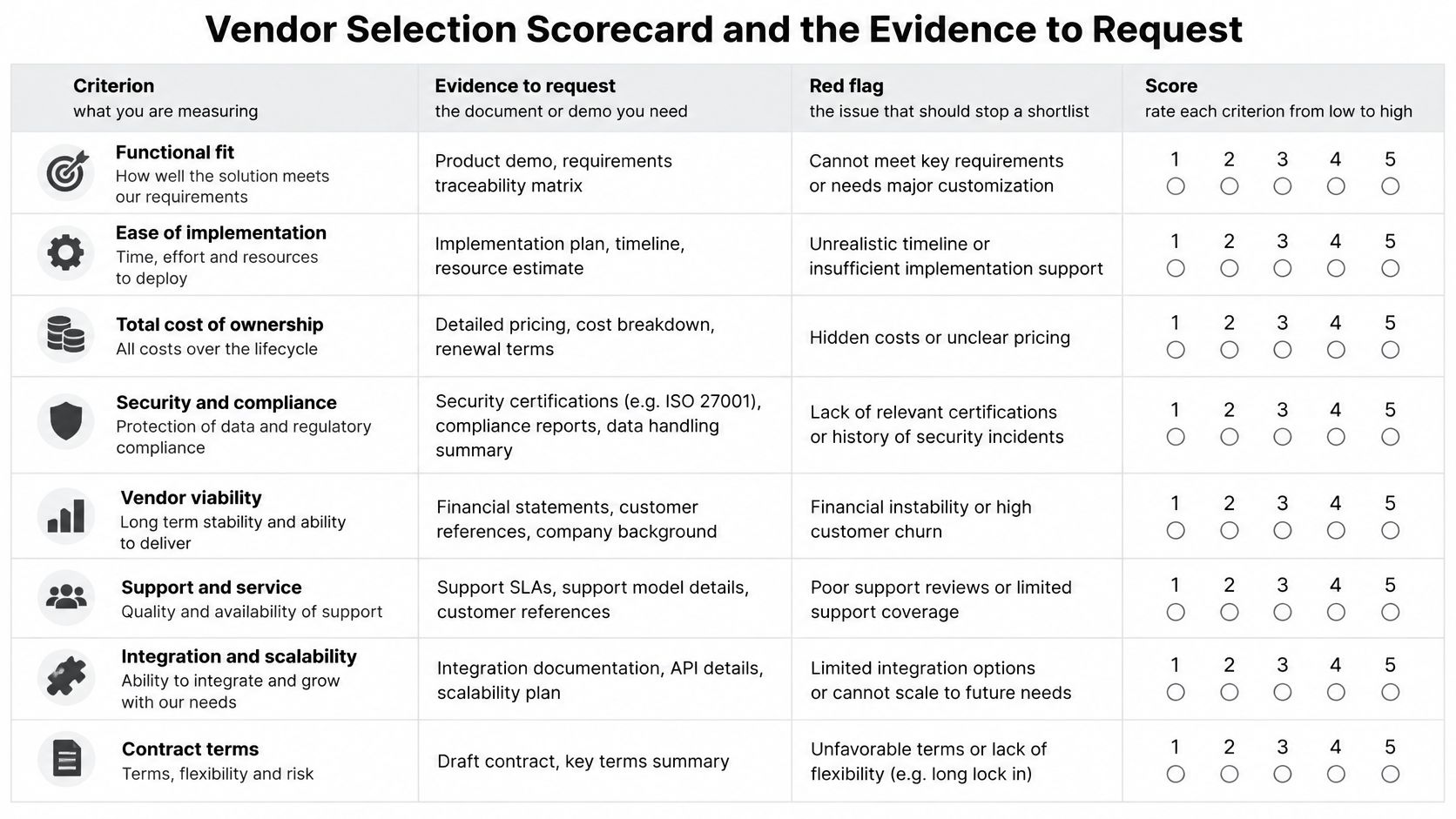
Start with one scorecard for every candidate. Identical evidence requests make weak answers visible, and you can browse the candidate pool through a unified model catalog before you score the companies behind the access route.
| Criterion | Evidence to request | Red flag |
|---|---|---|
| Model documentation | Model card, intended use, known limitations, release notes | Sparse documentation or inconsistent release practice |
| Data handling | Retention period, training-use policy, subprocessor list | Vague answer on whether prompts train models |
| Security assurance | SOC 2 Type II report, penetration test summary | No independent audit available |
| Regulatory coverage | Statement of provider or deployer role under the EU AI Act | No position on applicable regulation |
| Change notification | Notice period for model, version or subprocessor changes | Changes made without notice |
| Reliability | Uptime history, error and timeout rates, incident log | No published incident history |
| Cost transparency | Per-token rates, reasoning-token billing, rules for failed calls | Charges for failed calls with no explanation |
How to Weight and Score Each Row
Score each criterion from 1 to 5, then weight it by workload risk. A customer-facing feature should weight data handling, reliability, and change notification highest. An internal summarizer with no sensitive input can give cost more weight, because a weak answer creates inconvenience rather than a customer or regulatory incident.
Don't accept a sales claim when a document exists. A SOC 2 Type II report matters because it covers whether controls operated over a period, not just whether they existed on one day. Model cards and release notes matter for a different reason. Patchy documentation and inconsistent releases are warning signs in the NIST AI Risk Management Framework core guidance, which supports documented controls, testing, and contingency checks for third-party systems.
Apply a hard pass rule before you average anything.
- Minimum score: No vendor scores below 3 on data handling or change notification, whatever its benchmark results.
- Evidence required: Record the document name, date, and reviewer beside every score.
- Automatic removal: A red flag ends the shortlist discussion until the vendor supplies better evidence.
Copy the table into a spreadsheet, add your weights, and send the same evidence request to every shortlisted vendor in one email. You'll compare documents instead of presentations.
How to Run a Selection Process in Five Stages
A useful process produces an auditable record, not just a winner. Each stage below ends with an output you can file.
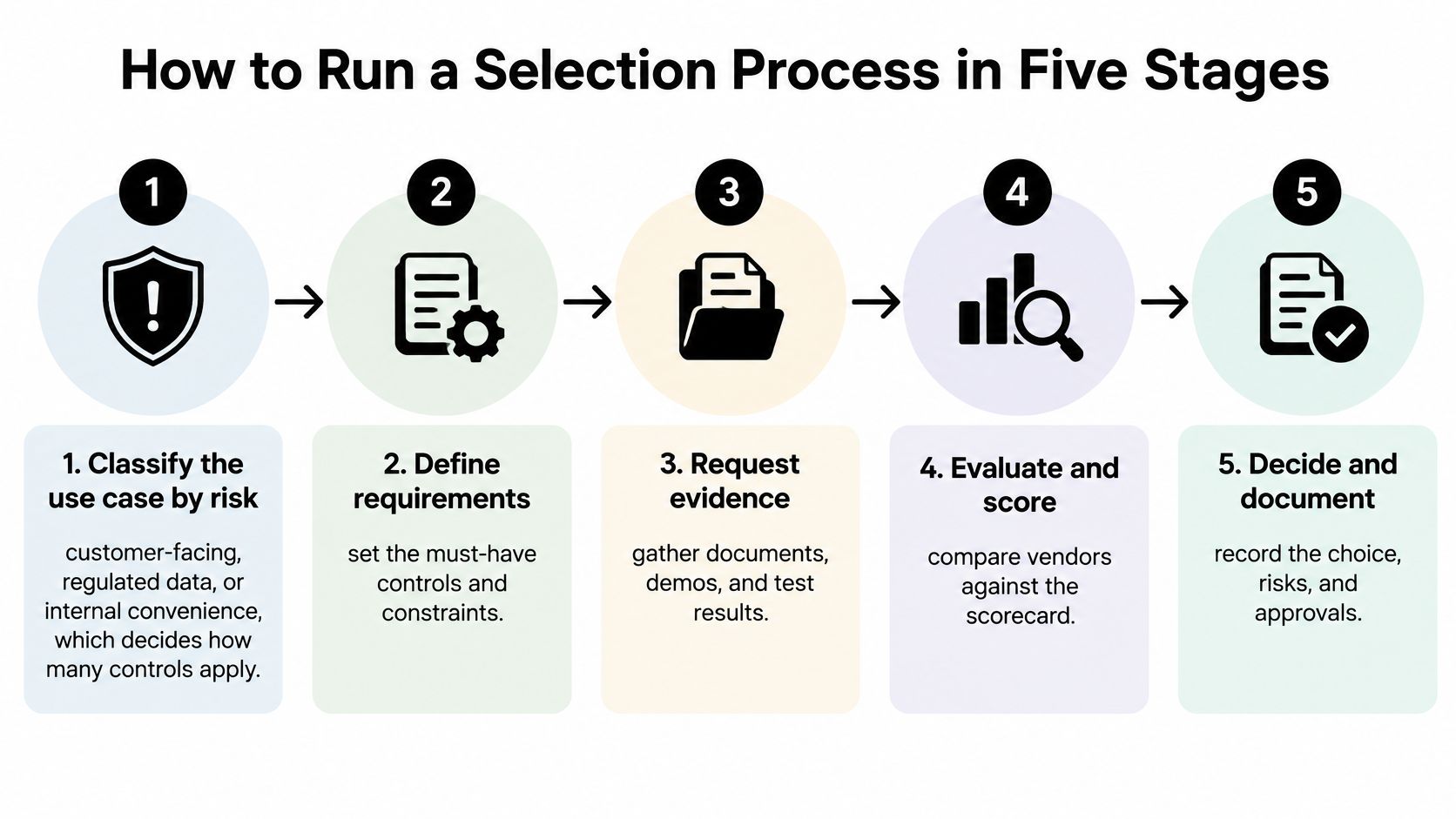
- Classify the use case by risk. Mark it customer-facing, regulated-data, or internal-convenience. That label decides how much testing, legal review, and monitoring you'll require.
- Shortlist three to five vendors. Keep only suppliers covering your required models, regions, data terms, and support route. Fewer than three hides trade-offs, while more than five usually turns testing superficial.
- Run a production-like bake-off. Use real prompt patterns, long inputs, tool calls, refusals, and messy user language. Record answer quality, latency, time to first token, error rate, retries, and cost for each completed task.
- Score and explain. Complete the scorecard and write one sentence justifying each score. Future reviewers need the reasoning, not just a number someone remembers differently.
- Approve, assign, and schedule. Record the approver, named owner, permitted use, and next review date before production traffic starts.
What the Bake-Off Catches
Say a support chatbot handles 40,000 conversations a month in a hypothetical test. Two vendors produce equally accurate answers, but one adds three seconds to time to first token. That delay breaks the live-chat target, so the cheaper or higher-benchmark option loses for an operational reason the spreadsheet alone wouldn't reveal.
Measure cost per successful outcome, not only the published token rate. Retries, long outputs, failed but metered calls, and reasoning tokens can change the effective price, which is why the FinOps Foundation guidance on AI spend supports joining provider usage records with latency, failure, and business-use-case data.
Keep one approval record containing the use case, risk tier, scores, evidence links, bake-off results, approver, owner, and next review date. If that file can't explain why you chose the vendor, the process isn't finished.
Contract Clauses That Protect You After Signing
Contracts decide what you can demand when behavior, data handling, or availability changes. Negotiate these clauses before production depends on the vendor.
| Clause | What to require | Risk it controls |
|---|---|---|
| Training use | Written commitment that your inputs and outputs are not used to train models | Your data shaping future model behaviour |
| Subprocessors | Named list, with notice before any addition | Unknown parties handling your data |
| Model change notice | Advance notice of model or version swaps, with deprecation dates | Output behaviour shifting without warning |
| Incident notification | Prompt written notice within a contractually fixed period, with scope and remediation updates | Late notice that blocks your own reporting duties |
| Audit evidence | Right to receive audit reports and supporting documentation | Claims you cannot verify |
| Data deletion | Deletion on exit with written confirmation | Data kept after termination |
| Liability and service credits | Separate, higher cap or carve-out for data incidents, plus downtime credits | Standard caps covering little of the real loss |
This isn't unusual negotiating behavior. In 2025, 40% of organizations added AI-usage language to vendor contracts to assess or monitor vendor AI usage, according to Venminder's State of Third-Party Risk Management report.
Where Standard Terms Leave You Exposed
Vendor templates often permit subprocessor or model changes on short notice. Replace that default with a notice period long enough to test the change, update your records, and reject an unacceptable subprocessor where your data duties require it.
Liability needs the same attention. A general cap tied to twelve months of fees can be small beside the cost of investigating a data incident, notifying customers, and rebuilding a feature. Ask for a separate, higher cap or carve-out for data breaches, then make service credits automatic enough that you don't have to argue over every outage.
Redline order: Start with training use, subprocessors, and incident notice. For regulated or customer data, treat those three as non-negotiable.
Security and Compliance Requirements by Framework
Frameworks answer different questions, so don't treat their names as interchangeable badges. Use the map below to decide which evidence belongs in your file, then review the detailed security and enterprise information for any gateway in the stack.
| Framework | Scope | What it asks of vendors |
|---|---|---|
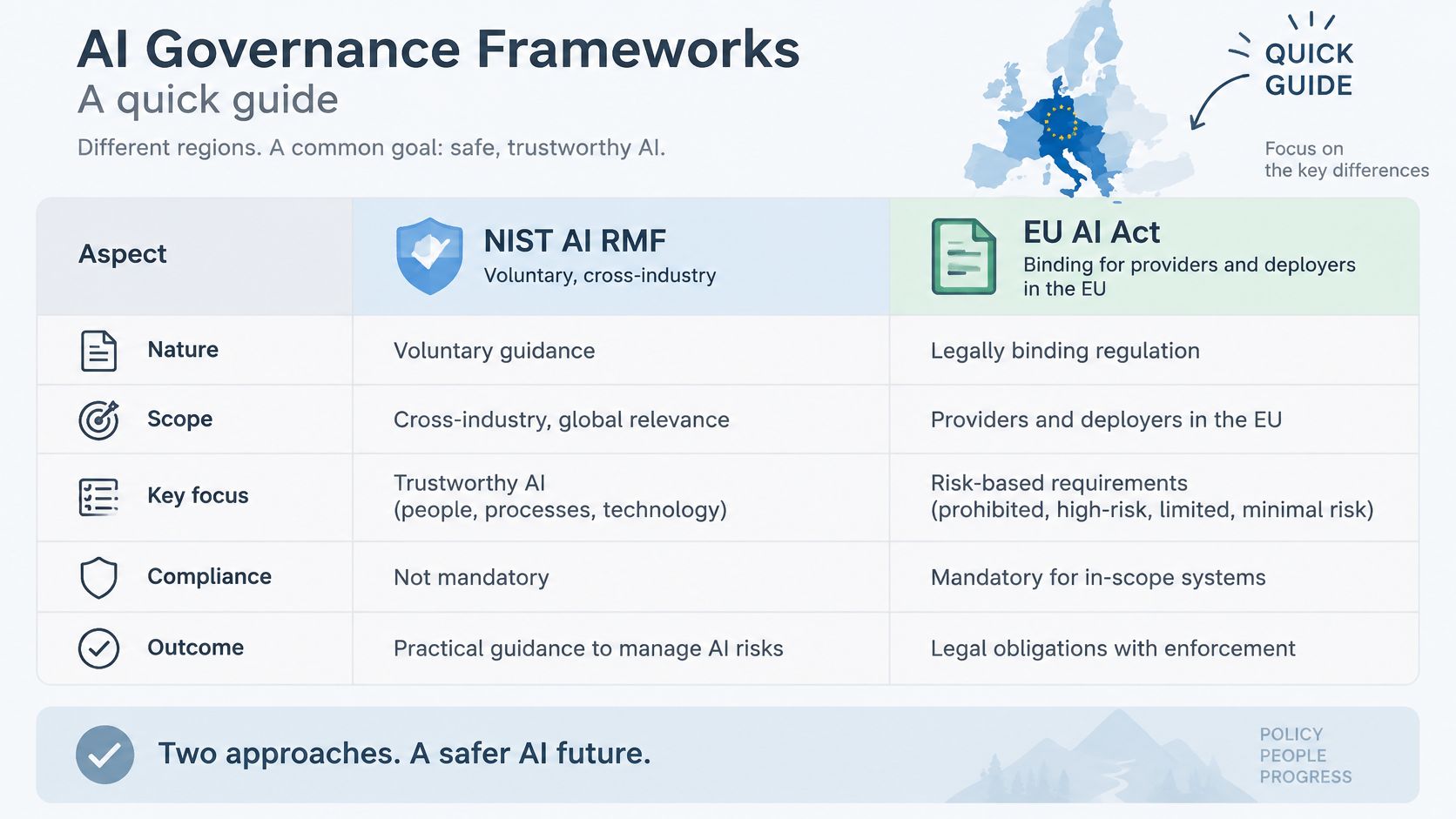
| NIST AI Risk Management Framework | Voluntary, US origin, cross-industry | Documentation, testing, monitoring and third-party vulnerability reporting |
| EU AI Act | Binding for providers and deployers placing AI on the EU market | Technical documentation, logging, human oversight and post-market monitoring |
| ISO/IEC 42001 | Certifiable AI management system standard | Documented AI policy, risk process and continual improvement |
| SOC 2 Type II | Audit of security controls over a period | Evidence that controls operated consistently |
| GDPR | Personal data processed in the EU or about EU residents | Data processing agreement, transfer safeguards and breach notification |
Provider and Deployer Duties
Your role changes your obligations. Under the EU AI Act, a business buying an external model can still carry deployer duties even though it didn't build the system. Record whether you're provider, deployer, or both before signing, then assign the logging, oversight, and monitoring tasks that follow from that role.
Timing also matters. The European Commission's EU AI Act implementation timeline states that the Act entered into force on August 1, 2024, with obligations introduced in stages. Your contract therefore needs audit cooperation and documentation access that can survive later milestones, not only today's checklist.
Ask three direct data questions for every deployment. Where are prompts and outputs stored, who can access them, and do logs contain personal data? If a salesperson can't answer, put the question in writing to the security team and file the dated reply. For us, vulnerability reports and questions about how data is handled go to security@openbase.ai.
Keep an evidence file containing the signed data processing agreement, current audit report, subprocessor list, framework mapping, and dated vendor answers. That file is what turns a compliance claim into something your auditor can test.
Redundancy Strategies Without Doubling Your Costs
Redundancy should protect specific workloads, not duplicate every contract. Compare the failure each option covers before you pay for it, and use the published pricing and routing costs when you model gateway-based failover.
| Strategy | Best for | Failover speed | Relative cost |
|---|---|---|---|
| Single vendor, actively monitored | Low-risk, internal workloads | Manual, hours to days | Lowest |
| Warm standby at a second provider | Important workloads with tested prompts | Minutes after a manual switch | Moderate, from standby contract and test runs |
| Automatic gateway failover | Customer-facing features needing continuity | Mid-request retry to a healthy upstream | Low idle spend, cost follows traffic split |
| Same model family, two access routes | Protection from a single provider outage | Fast | Low, but a shared upstream failure remains possible |
Provider Redundancy Is Not Model Redundancy
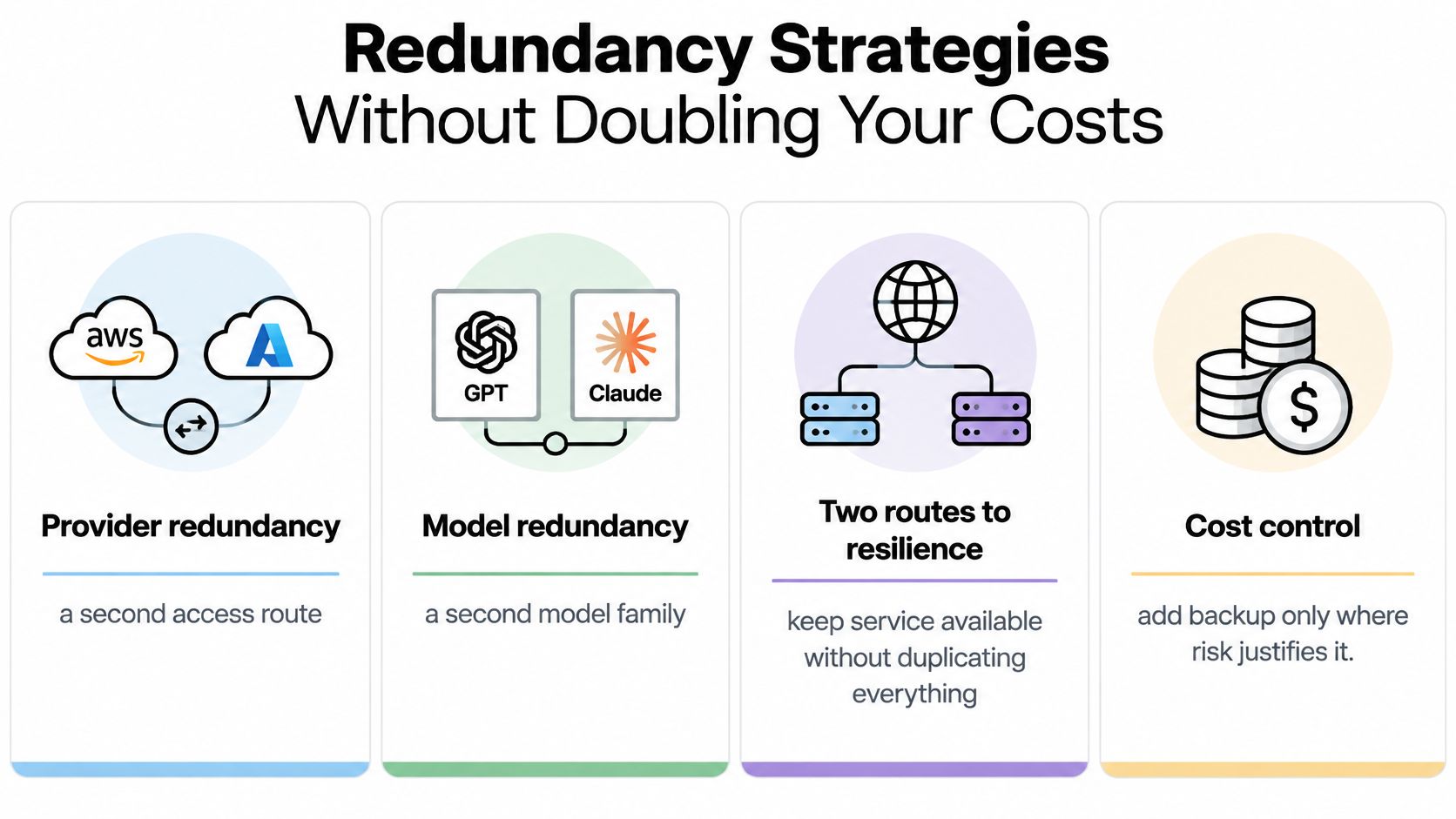
Provider redundancy gives you a second access route. Model redundancy gives you a second model family. Two routes to the same underlying model can survive one provider's outage, but they won't protect you if that model family itself fails, changes behavior, or loses a needed capability.
Check who serves the traffic. The vendor prefix in a model slug identifies who built the model, not necessarily who serves it. You can pin a provider by sending a provider object with an explicit order, and you can disable fallbacks to receive an error instead of a substitution when silent replacement would be unsafe.
Classify workloads into three tiers.
- Critical: Fail over within minutes because customers or revenue are directly affected.
- Important: Restore within a business day while staff use a workaround.
- Deferrable: Accept delay and spend nothing on standby capacity.
Test the backup with production-like prompts, then record quality drop, latency, tool-calling failures, safety differences, and data-residency conflicts. A backup that answers quickly but mishandles tools isn't a working backup.
Use a simple cost rule. In a hypothetical example, two outage hours a month at 1,500 per hour create 3,000 a month in expected loss. A tested standby costing 1,000 a month is worth keeping, while one costing 4,000 is not. Consolidation also helps because we use one account, one key and one invoice for all providers, whereas direct provider APIs need one account, key and invoice per provider.
Owning the Vendor After Approval and Acting This Week
Approval starts ownership. It doesn't end it. Split responsibility across four named roles so contract, security, technical, and business decisions don't drift between teams.
- Procurement owner: Holds the contract, renewal date, price threshold, and exit terms.
- Security owner: Maintains the evidence file, reviews subprocessors, and leads vendor incident response.
- Engineering owner: Tracks latency, errors, model changes, and failover test results.
- Business owner: Owns the outcome, usage, spend, and decision to continue or replace the vendor.
Central coordination still helps. In 2025, 57% of organizations used centralized, enterprise-wide third-party risk management programs, up from 54% in 2023, according to EY's Global Third-Party Risk Management Survey. Central doesn't mean one person does everything. It means one register shows who owns each decision.
Reapproval Triggers and Proof the Policy Works
Require fresh approval after a model or version change, new subprocessor, retention-term change, price increase above your threshold, or sustained breach of a risk tolerance. Also trigger review after a serious incident or a major change in how your team uses the model. A tool approved for internal drafts shouldn't become a customer-facing decision system.
Measure execution rather than document counts. Track reassessment completion, unresolved findings older than 30 days, time to revoke access after offboarding, and whether suppliers meet notification duties. Tag requests by team and environment, track cost per successful outcome, and review variance monthly so the business owner can see drift before renewal.
Key control belongs in that same register. Customers are responsible for everything done with their keys and account, including by their own users and systems, so record who can create, rotate, and revoke each key. For commercial changes, sales handles volume pricing, committed capacity, self-hosting and contract terms, and is reached at sales@openbase.ai.
Build an ownership matrix with one row per vendor and columns for owner, approver, next review date, reapproval triggers, failover tier, and evidence file location. That single view prevents the familiar answer, "someone in engineering probably has it."
A policy nobody can enforce is just stored text. Give the owner authority to pause traffic, demand evidence, and start replacement.
Take three steps this week. First, score current and candidate vendors and mark every red flag. Second, assign a redundancy tier to each workload and set a failover test date. Third, name one owner per vendor and book the first reassessment. At the next review, success means every vendor has a named owner, a tested fallback, and a dated evidence file.
Openbase gives your team one OpenAI-compatible gateway for models from multiple providers, with consolidated usage records for provider, tokens, latency, and cost, plus routing controls you can use in your vendor reviews and failover tests. Visit Openbase to consolidate access under one account and key, then put your first vendor scorecard and redundancy tier into practice.