
One API gateway is not universally best, and treating it that way leads teams into bad trade-offs. A cloud-native team, a hybrid enterprise, a security-first platform group, and an ML team shipping LLM features all need different control points, different policy depth, and different levels of operational effort. The right choice depends on whether you care most about deployment control, routing precision, rate limiting, observability, integration depth, or the amount of day-two work your team can absorb.
That's why api gateway tools should be compared through the same operational lens, not by vendor slogans. The category started as a response to exposed API complexity, with the modern pattern emerging as APIs became productized and needed authentication, throttling, routing, and observability at scale, as the historical record around 2005 shows in the API gateway lineage InfoQ's history of API gateways. Today, the market spans fully managed cloud gateways, self-hosted runtimes, enterprise API management suites, edge security layers, and AI-focused gateways that unify model access. That makes the central question simpler, and harder, than “which gateway is best?” It's “which gateway fits the workload without creating a second job for the people who run it?”
Table of Contents
- 1. Openbase
- 2. Kong Gateway (Kong Konnect)
- 3. Tyk API Gateway and Management Platform
- 4. Amazon API Gateway
- 5. Apigee
- 6. Azure API Management
- 7. Cloudflare API Gateway
- 8. NGINX API Connectivity Manager
- 9. IBM API Connect
- 10. Gravitee API Management
- Top 10 API Gateway Tools Comparison
- Turn the Shortlist Into an Architecture Decision
1. Openbase
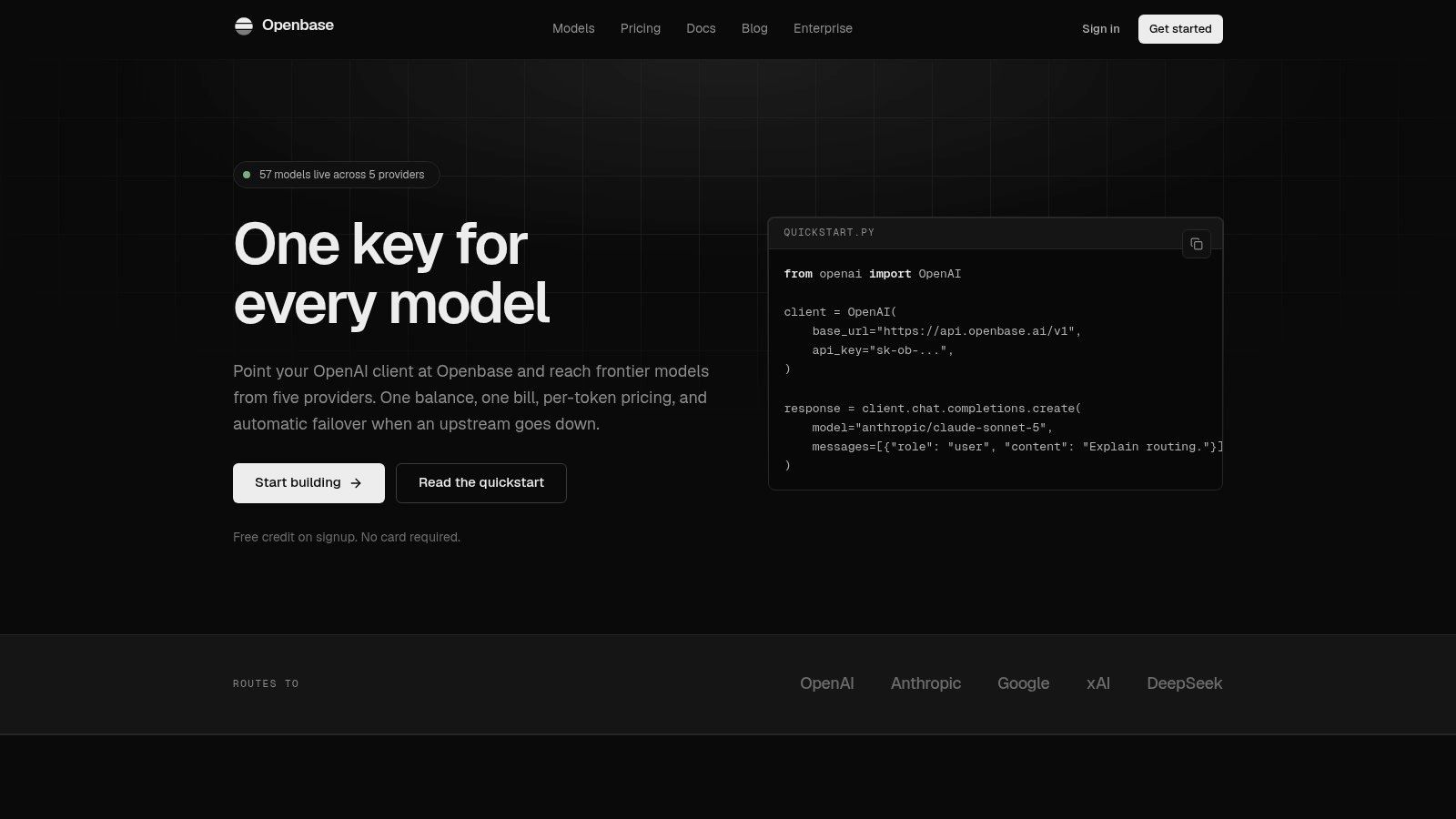
Openbase is a better fit when the gateway problem is really an LLM operations problem. It exposes a single OpenAI-compatible API so teams can keep existing SDKs, streaming code, and tool or function calls while routing requests across providers such as OpenAI, Anthropic, Google, xAI, and DeepSeek through one endpoint. That keeps integration work low while giving platform teams a clearer control point for traffic.
Why it behaves like a gateway, not just a wrapper
Openbase's main value is provider redundancy and request-level visibility. It supports automatic mid-flight failover across upstream providers, and its retry policy is scoped to transient failures, while client errors surface immediately instead of consuming retry budget. It also pools rate limits across providers serving the same model, which reduces the risk that one upstream throttles a live feature path.
Practical rule: if your team already ships against the OpenAI Chat Completions shape, keep that contract and move only the base URL and key. That preserves the client code while changing the routing layer underneath.
Cost control and operational fit
Openbase also gives teams a cleaner billing model than most direct-provider integrations. It meters per token at published per-million rates, includes explicit reasoning token accounting, and bills only when a request produces tokens. The platform adds one balance, one invoice, daily usage rollups, and per-call logs that record model, provider, input and output tokens, latency, time to first token, and exact cost. Per Openbase's published signup terms, new accounts receive free credit without a card, which lowers trial friction for product teams and platform engineers.
The trade-off is straightforward. You add a third-party gateway layer, so some extra dependency and a small latency cost are possible. For teams building production LLM features, the offset is clearer billing, cross-provider failover, and per-request cost visibility in one place. Openbase fits best when the alternative is stitching together multiple provider accounts, dashboards, and retry policies by hand.
2. Kong Gateway (Kong Konnect)
Kong stays near the top of gateway shortlists because it lets teams separate control from runtime without forcing one deployment model. The open-source core, plugin system, and Konnect control plane give platform teams room to standardize policy while still choosing how and where data planes run. Kong's own API gateway overview frames gateways as the point where routing, authentication, and policy enforcement meet, which aligns with how teams typically use them.
Where Kong earns its keep
Kong's value is policy depth with deployment choice. Teams can run it self-managed, in hybrid setups, or through cloud services, then apply plugin-based rules for auth, rate limiting, and request transformation through declarative config. Konnect adds a managed control plane, service catalog, developer portal, analytics, and monetization, so the product moves beyond runtime enforcement into broader API management.
That split matters operationally. A platform team can keep the gateway close to workloads that need it, while still using one policy model and one observability layer across business units. For organizations with mixed ownership, that is often more important than feature count, because it reduces drift between teams without centralizing every data plane.
What to watch before you commit
Kong is less attractive if you want a fully managed SaaS with no runtime ownership. OSS and enterprise deployments still require SRE time for upgrades, scaling, plugin maintenance, and incident response. That flexibility is useful, but it is not free.
For readers comparing gateway strategy and model-routing strategy at the same time, Openbase's blog material is useful context because it shows how gateway thinking now extends into AI traffic as well. Choose Kong when different business units need their own data planes, but the platform team still has to keep routing, policy, rate limiting, and observability consistent.
3. Tyk API Gateway and Management Platform
Tyk is the kind of platform teams pick when they want a gateway they can stand up quickly, understand quickly, and still grow with. Its open-source base and commercial management layer create a practical on-ramp for teams that want control without immediately signing up for a heavyweight enterprise rollout.
A pragmatic middle ground
Tyk's appeal is self-hostability with a clean upgrade path. It supports REST and GraphQL, brings a policy library and OAS-first design, and can run as self-managed, hybrid, or cloud SaaS. That deployment range matters because it gives infrastructure teams room to keep sensitive environments local while still using the same product family in less constrained places.
Teams that start with Tyk usually do it for one reason, they want the gateway to be understandable on day one and replaceable on day two if the architecture shifts.
Why the feature split matters
The platform's developer portal, analytics, and productization features sit in paid tiers, which is a normal commercial boundary but still a real planning input. If you only need runtime enforcement, the open-source side may be enough. If you need lifecycle tooling and reporting, you should assume you're buying into the full platform rather than just the gateway.
The main trade-off is pricing variability by deployment footprint. That doesn't make Tyk unpredictable in an operational sense, but it does mean procurement and platform design need to happen together. For teams that value a capable gateway with a gradual path to broader management, that's often acceptable.
4. Amazon API Gateway
Amazon API Gateway is the obvious answer for AWS-native teams, and that's both its biggest strength and its biggest constraint. If your workloads already live around Lambda, IAM, CloudWatch, and the rest of the AWS stack, the operational burden drops fast because the gateway sits inside the ecosystem you're already using.
Why AWS teams pick it
Its strongest case is managed convenience. You get REST, HTTP, and WebSocket APIs, caching, usage plans and keys, authorizers, response streaming for REST APIs, and built-in monitoring tied to AWS services. The 12-month free tier for new accounts lowers entry friction, which makes it easy for smaller teams to start inside the platform they already pay for elsewhere.
The trade-off is less about features and more about lifecycle pressure. AWS-managed convenience makes sense for serverless and event-driven stacks, but it can make cost forecasting harder at variable scale. It also narrows portability if the long-term architecture may need multi-cloud or hybrid control.
Operational reality
Amazon API Gateway is a good example of a gateway that reduces runtime management while increasing platform dependence. That's fine if your team is committed to AWS and wants the least amount of infrastructure to manage. It's a weaker fit if your architecture team cares about moving workloads across clouds or standardizing gateway policy outside a single vendor ecosystem.
For teams checking pricing or procurement details, the link between gateway runtime and commercial packaging matters more than with self-hosted tools. The pricing page is worth reviewing directly through Openbase's pricing context because it helps frame how gateway pricing behaves when you compare service layers, not just product names.
5. Apigee
Apigee is the enterprise governance answer on this list. It fits organizations that need lifecycle control, strong analytics, monetization, and hybrid topologies, not just request routing. If your API portfolio is a business surface as much as a technical one, Apigee tends to make more sense than a lightweight gateway.
Governance is the point
Apigee's value comes from platform breadth. It offers two proxy styles, Standard and Extensible, which implies an important architectural trade-off between simplicity and policy depth. It also supports advanced security add-ons, rich analytics, monetization, and environment-based deployment with SLAs and multi-region support.
That combination is useful when you need to govern API products, partner access, and internal enforcement in the same place. It's especially relevant for organizations that want a single platform for design, security, analytics, and commercialization rather than stitching together separate tooling.
Where it gets expensive in practice
The downside is not just learning curve, although that is real. Pricing can be difficult to reason about because it's shaped by calls, environments, and add-ons. That puts more pressure on architecture planning before procurement, which is exactly what many teams fail to do.
Apigee is strong when the business can justify the overhead of a full API management suite. It's less attractive when the actual need is just to route traffic, enforce a few policies, and keep runtime complexity down. In those cases, a narrower gateway often wins.
6. Azure API Management
Azure API Management is the natural choice for Microsoft-centric organizations that need more than a gateway and less than a sprawling custom control plane. It spans multiple SKUs, includes a self-hosted gateway option, and integrates tightly with Azure networking and identity patterns, which is what makes it practical for enterprise teams with mixed deployment needs.
The strength is SKU choice
Azure's appeal is deployment flexibility inside a managed umbrella. The Consumption tier uses per-operation billing, while Premium and Isolated are aimed at more advanced networking and enterprise isolation needs. That range makes it easier to align spend with environment type, which matters when development, staging, and production do not need the same footprint.
The self-hosted gateway option is especially important for hybrid scenarios. It lets teams keep enforcement local while still using the Azure management plane, which is often the actual requirement behind “cloud strategy” conversations.
The operational trade-off
Azure API Management can be harder to price quickly because region and SKU influence the final number, and advanced capabilities are often reserved for higher tiers. That makes it a stronger fit for organizations that already know they're buying into the Azure ecosystem, not teams comparing every possible cloud gateway on pure simplicity.
Operational insight: if your network team already thinks in VNETs, regions, and governed environments, Azure API Management feels coherent. If your team wants a cheap and simple edge proxy, it can feel heavier than the job needs.
For security review context, Openbase's security materials are a useful example of how gateway vendors increasingly need to present operational trust, not just routing features.
7. Cloudflare API Gateway
Cloudflare's gateway story is different because it starts at the edge. That makes it a better fit for internet-facing API estates where security, discovery, schema enforcement, and edge delivery matter as much as the application logic behind the API.
Edge-first changes the operating model
Cloudflare API Gateway leans on network-edge delivery rather than infrastructure you manage yourself. It ties directly into Cloudflare's broader security stack, including WAF, bot management, and DDoS protection. That reduces the amount of separate defense machinery your team needs to maintain, which is a major operational simplification for public APIs.
It also supports API discovery and schema enforcement, which helps security teams spot unknown endpoints and enforce contract consistency. For organizations with a lot of externally exposed surface area, that's a serious governance advantage.
The trade-off is platform gravity
The biggest limitation is procurement and ecosystem dependence. Cloudflare's gateway is typically positioned for enterprise buyers, and it makes the most sense if the rest of your internet-facing stack is already going through Cloudflare. If you standardize there, the gateway becomes part of a larger edge architecture. If you don't, it can feel like a piece that wants the rest of the platform attached to it.
Cloudflare is strongest when the architecture is public-facing, global, and security-heavy. It is less compelling if you need a gateway mainly for internal service policy or hybrid runtime control.
8. NGINX API Connectivity Manager
NGINX API Connectivity Manager is compelling for teams that already trust the NGINX data plane and want a centralized way to govern it. The reason it matters is simple, many organizations already run NGINX widely, so the question isn't whether to adopt a new runtime, it's how to standardize policy around the one they have.
Why existing NGINX users care
Its value is centralized control over a familiar runtime. The platform works with NGINX Plus instances across on-prem and cloud, adds policy management for authN/Z and rate limiting, provides a developer portal and analytics, and integrates with CI/CD and Kubernetes ingress patterns.
That combination is useful when teams need to bring order to a large deployed base instead of replacing it. It's a classic “govern what already exists” play, which is often the right answer in enterprise environments.
The cost is runtime ownership
The downside is that you still manage the runtime, and licensing is part of the stack. That means the product is not the simplest option for teams hoping a vendor will absorb most of the operational burden. It is, however, a strong fit for teams that want performance characteristics associated with NGINX and are comfortable owning the deployment side.
NGINX works best when you have operational maturity and want consistency more than novelty. If your team values control and already runs NGINX at scale, the fit is obvious.
9. IBM API Connect
IBM API Connect is built for environments where security, governance, and hybrid deployment come first. It's a serious enterprise platform, not a lightweight gateway, which is exactly why it keeps showing up in regulated and complex IT estates.
Enterprise governance comes first
API Connect supports full lifecycle management, design, secure, socialize, and analyze, alongside a developer portal and migration tooling for large portfolios. It also pairs with DataPower for high-security enforcement, which gives security teams a stronger story than a simple reverse-proxy-style gateway.
The platform is also available across private cloud, on-prem, and IBM Cloud topologies. That makes it suitable for organizations that can't standardize on a simple SaaS model and need tighter control over where the enforcement layer runs.
What makes it a heavier choice
The main downside is footprint and licensing complexity. It's not the kind of platform you pick because you want to move quickly with a small team. You pick it because the governance requirements already justify the overhead.
IBM API Connect makes the most sense when compliance, security, and lifecycle management are the decision drivers. If you only need runtime enforcement, it's probably more platform than you need.
10. Gravitee API Management
Gravitee stands out because it treats APIs, event streams, and AI traffic as part of the same governance problem. That broadens the gateway conversation beyond HTTP routing, and it's one reason the platform is increasingly relevant to teams that need one control plane for several traffic types.
One control plane for more than REST
Its strength is cross-protocol governance. Gravitee supports REST, GraphQL, gRPC, and event streams from a single control plane, and its policy set covers API key, OAuth2, JWT, mTLS, and webhooks. That's a strong fit for teams whose architecture is already moving beyond traditional request-response APIs.
The platform also supports a developer portal, analytics, and management APIs, which gives it a more complete management story than a runtime-only gateway. That matters when internal teams need both policy enforcement and self-service consumption.
Where it fits best
Gravitee is most compelling when event-driven architecture and AI agent traffic are part of the same operational picture as standard APIs. That makes it relevant for teams that don't want separate tools for REST APIs, streams, and agent-facing access patterns.
The trade-off is vendor ecosystem size. Smaller ecosystem reach is not the same thing as weaker technology, but it does matter for procurement and integration depth. Teams that want a broad market of integrators and adjacent tooling may still gravitate to larger platform vendors.
Top 10 API Gateway Tools Comparison
| Provider | Core features | Reliability & quality (★) | Pricing & value (💰) | Target audience (👥) | Unique selling points (✨/🏆) |
|---|---|---|---|---|---|
| Openbase 🏆 | OpenAI‑compatible gateway; multi‑provider models; streaming & function calls; per‑call logs | ★★★★★, auto mid‑flight failover; pooled rate limits | 💰 Prepaid per‑token; consolidated invoice; free signup credit | 👥 Engineering, platform & ML teams; enterprises needing redundancy | ✨ Drop‑in OpenAI API replacement; granular cost/observability; automatic provider failover |
| Kong Gateway (Konnect) | Plugin policies; managed control plane; analytics & monetization | ★★★★, mature, high performance | 💰 OSS free; Konnect enterprise quotes | 👥 SREs and enterprises needing extensible gateway | ✨ Large plugin ecosystem; hybrid & service‑mesh support |
| Tyk API Gateway | REST & GraphQL; OAS‑first; self‑managed or SaaS | ★★★★, lightweight, dependable | 💰 OSS + paid tiers; clear commercial plans | 👥 Teams wanting easy self‑hosting and hybrid options | ✨ Simple upgrade path from OSS to full platform |
| Amazon API Gateway | Managed REST/HTTP/WebSocket; Lambda, IAM, CloudWatch | ★★★, auto‑scales; AWS dependent | 💰 Pay‑as‑you‑go; costs can grow at scale | 👥 AWS/serverless stacks | ✨ Deep AWS integrations; serverless native |
| Apigee (Google Cloud) | Enterprise API mgmt; analytics, monetization, security add‑ons | ★★★★, enterprise SLAs & governance | 💰 Subscription + usage; complex pricing dimensions | 👥 Large programs and partner ecosystems | ✨ Rich lifecycle tooling and advanced security add‑ons |
| Azure API Management | Multiple SKUs; self‑hosted gateway; dev portal & policies | ★★★★, multi‑SKU reliability & networking | 💰 Multiple SKUs; region/SKU pricing | 👥 Azure‑centric enterprises | ✨ Tight Azure/VNET integration; self‑hosted gateway option |
| Cloudflare API Gateway | Edge delivery; schema enforcement; WAF, bot & DDoS protection | ★★★★, global anycast & edge resilience | 💰 Enterprise focus; sales engagement | 👥 Internet‑facing APIs at global scale | ✨ Edge security + threat mitigation integrated with CDN |
| NGINX API Connectivity Manager | NGINX Plus data plane; central control; policy & analytics | ★★★, high performance but self‑managed | 💰 Requires NGINX Plus license & ACM costs | 👥 Teams operating NGINX at scale | ✨ Leverages NGINX performance; CI/CD & K8s friendly |
| IBM API Connect | Full lifecycle; DataPower gateway; governance & hybrid topologies | ★★★★, strong security & hybrid support | 💰 Enterprise licensing; quote based | 👥 Regulated industries & large enterprises | ✨ Deep governance, compliance, and security tooling |
| Gravitee API Management | API + event streams control plane; OSS + commercial tiers | ★★★, solid OSS with event focus | 💰 Cloud trial; commercial predictable models | 👥 Teams needing API + event governance; OSS advocates | ✨ Governs REST/GraphQL/gRPC & event streams from one plane |
Turn the Shortlist Into an Architecture Decision
The right way to choose among api gateway tools is to start with deployment constraints, not feature lists. Ask where the gateway must run, who owns the runtime, and how much control the platform team needs over upgrades, failover, and policy deployment. A gateway that is perfect on paper can still be wrong if it forces the wrong operating model on the people who have to keep it alive.
Next, map the routing and traffic policies you need. That means auth, throttling, transformation, failover behavior, and whether the gateway must handle REST alone or also GraphQL, WebSocket, event streams, or AI traffic. Many teams discover at this stage that they are really comparing a gateway runtime against a broader API management platform, or even against an AI gateway pattern, rather than against another narrow proxy.
Observability is the next filter. If you can't see per-route usage, latency, failures, and policy outcomes, you won't know whether the gateway is helping or hiding problems. Governance matters just as much, because developer portals, lifecycle controls, and analytics often decide whether a gateway becomes a real platform or just another operational hop.
Then test the traffic you expect, not a generic benchmark. The benchmark data in the market makes that point plain, with one 2026 comparison showing a large performance gap between gateways under the same test conditions and another source highlighting that managed gateways often trade off throughput for lower operational burden F5 benchmark coverage. That's why architecture decisions should compare the full operating cost, not just raw request handling.
Pricing model deserves the same scrutiny. Per-call pricing, subscription pricing, and mixed enterprise plans all behave differently as traffic grows, and the wrong commercial model can outweigh a decent feature set. Teams often fixate on initial purchase cost and ignore the cost of policy drift, runtime maintenance, and fragmented visibility. Those are the costs that show up later.
Openbase belongs in the shortlist when the gateway question is really about LLM access, not just HTTP traffic. It gives teams an OpenAI-compatible runtime with provider redundancy, consolidated billing, per-call cost visibility, and token-aware accounting, which is exactly the kind of control platform teams want when AI features move from prototype to production.
If you're evaluating gateway options for LLM workloads, compare them on operational effort first, not marketing claims. Openbase is built to reduce integration work and make provider failover, billing, and observability much easier to manage, so it's worth a serious look if your team wants one gateway for frontier model access with less fragmentation. Visit Openbase to review the gateway, check the model catalog, and see whether its OpenAI-compatible approach fits your API operations stack.