
Say your team shipped a support assistant on one provider's SDK, hard coded the model name, and wired billing alerts to that vendor's dashboard. Then a busy Monday brings 429 rate limit errors, slow first tokens, and no clean way to move traffic without rewriting request code, auth, and retry logic. That's the moment the best AI API stops being a model leaderboard question.
You're really choosing who owns failover, rate limits, cost visibility, and model switching when production traffic gets messy. A managed gateway shifts that work to the vendor. A self hosted gateway gives you control and an on call burden. A hosted inference provider optimizes one catalog well but won't unify every proprietary model. I've ranked seven options by workload and integration burden, with weight on OpenAI compatible chat completions, streaming, tool calling, embeddings and vision where relevant, plus what breaks first under load.
Table of Contents
- 1. Openbase
- 2. OpenRouter
- 3. LiteLLM
- 4. Portkey
- 5. Together AI
- 6. DeepInfra
- 7. Replicate
- How the seven AI APIs compare on fit, pricing model, deployment, and reliability approach
- Matching the Best AI API to Your Workload and Team
1. Openbase
Openbase fits teams whose code already uses OpenAI-style chat completions and that need to reach models from several providers without maintaining separate integrations. It provides one OpenAI-compatible endpoint for OpenAI, Anthropic, Google, xAI, and DeepSeek. Change the base URL and key, keep the request and response bodies, SDKs, streaming, and tool calling, and select models with provider-prefixed names.
Enterprise model use spans multiple providers. Menlo Ventures' 2025 survey of 495 U.S. enterprise AI decision-makers estimated enterprise LLM API spending shares at 40% for Anthropic, 27% for OpenAI, and 21% for Google, with those providers representing 88% of the market. A single-provider integration can constrain model choices at renewal, during an outage, or when another model better suits a workload.
Where It Earns Its Place in Production
Openbase provides automatic provider routing and mid-flight retries for rate limits, timeouts, and upstream outages. Pooled provider rate limits reduce exposure to throttling at one provider. It retries transient failures but avoids retrying 400 and 404 responses, which indicate request problems rather than temporary faults. That distinction matters in tool-calling workflows, where an indiscriminate retry can duplicate side effects.
The usage dashboard records provider, model, input and output token counts including reasoning tokens, latency, time to first token, and exact per-call cost. This makes it easier to inspect the cost of agent loops that retry or produce long reasoning traces, rather than relying only on a per-million-token rate. Billing uses published per-million-token rates and a prepaid balance. Charges apply when a request produces tokens, and usage rolls into one invoice. Unlimited API keys with per-key limits let teams separate staging, production, and individual services, then revoke a key without rotating every credential.
Practical rule: judge a gateway by a failed request, not a successful demo. Check what it retries, what it logs, and whether you can see which provider served the call.
Openbase's trade-off is another routing layer to assess against your security and enterprise requirements. Per-token prices can change, so confirm current published rates before modeling cost. For teams building chat, extraction, coding, or agent features across frontier models, the shared endpoint and usage visibility can reduce integration and billing work. Teams that only need one provider's models may prefer a direct API and its simpler architecture.
2. OpenRouter
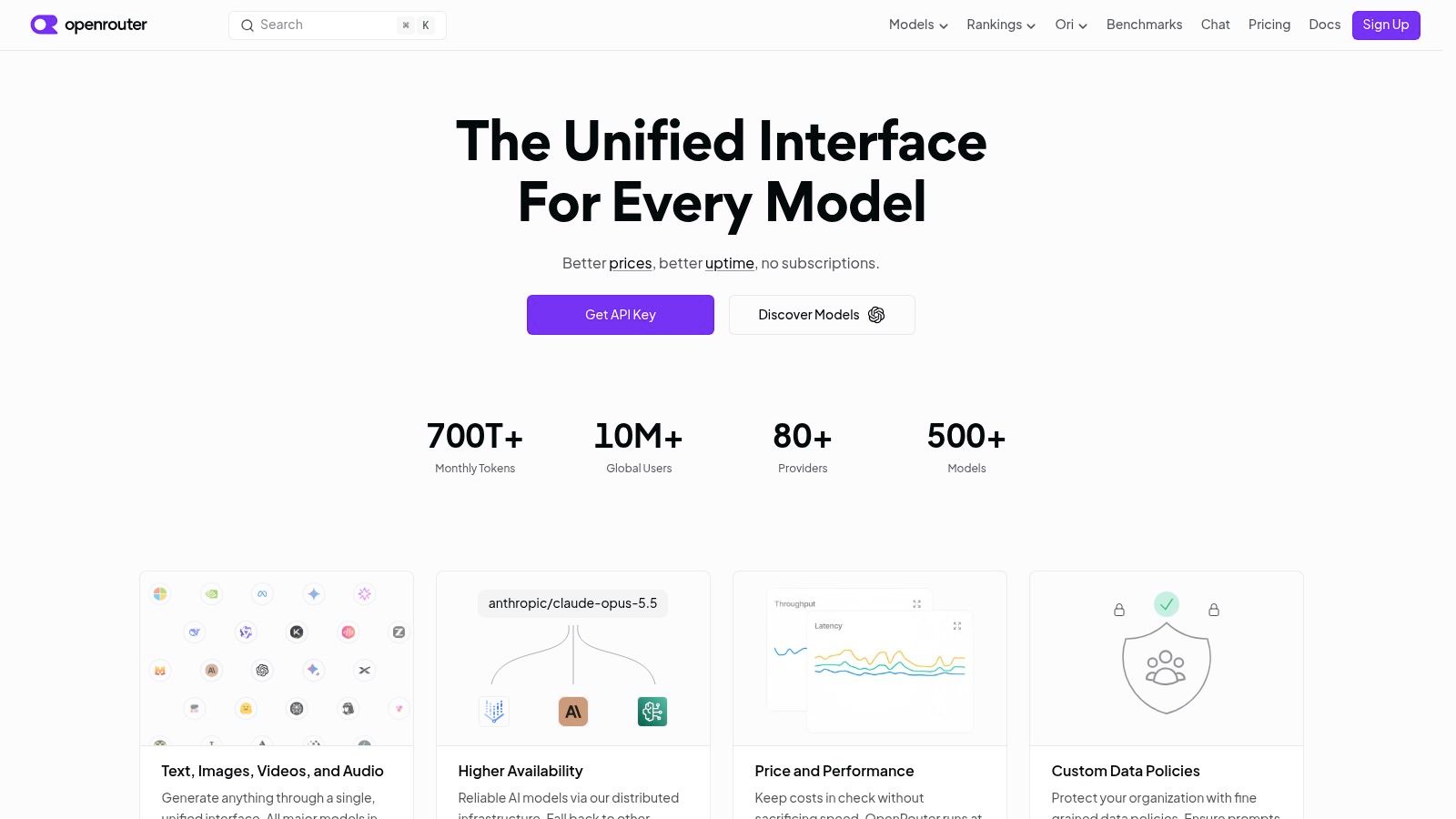
If your app already uses OpenAI-style requests and you need to compare models quickly, OpenRouter keeps integration work low. Its broad catalog spans many model providers, with chat completions, streaming, and tool use when supported by the selected model. You can run the same prompt set across different models without building a separate provider integration for each one.
Provider routing is configurable, and model pages show provider-level latency and throughput. Check the serving provider before choosing a route: the same model name can differ in latency, availability, and request processing location depending on who serves it. Those differences matter in production, where a slow or unavailable route can affect user-facing requests.
OpenRouter suits evaluation and workloads where switching models is part of the product. Postman's 2025 State of the API report reports that 83.2% of respondents used some form of API-first development, while 24.3% were designing APIs with AI agents in mind. For those integrations, stable request and response schemas make it easier to change the model without rewriting application code.
The trade-off is another service between your application and the model provider. Standard credit purchases carry a stated platform fee, so include that in cost comparisons. Choose OpenRouter when a broad catalog and fast model switching matter more than minimizing the number of services your team governs. If you have already settled on a small set of providers and need tightly controlled billing and failover policies, a narrower gateway may be easier to manage.
3. LiteLLM
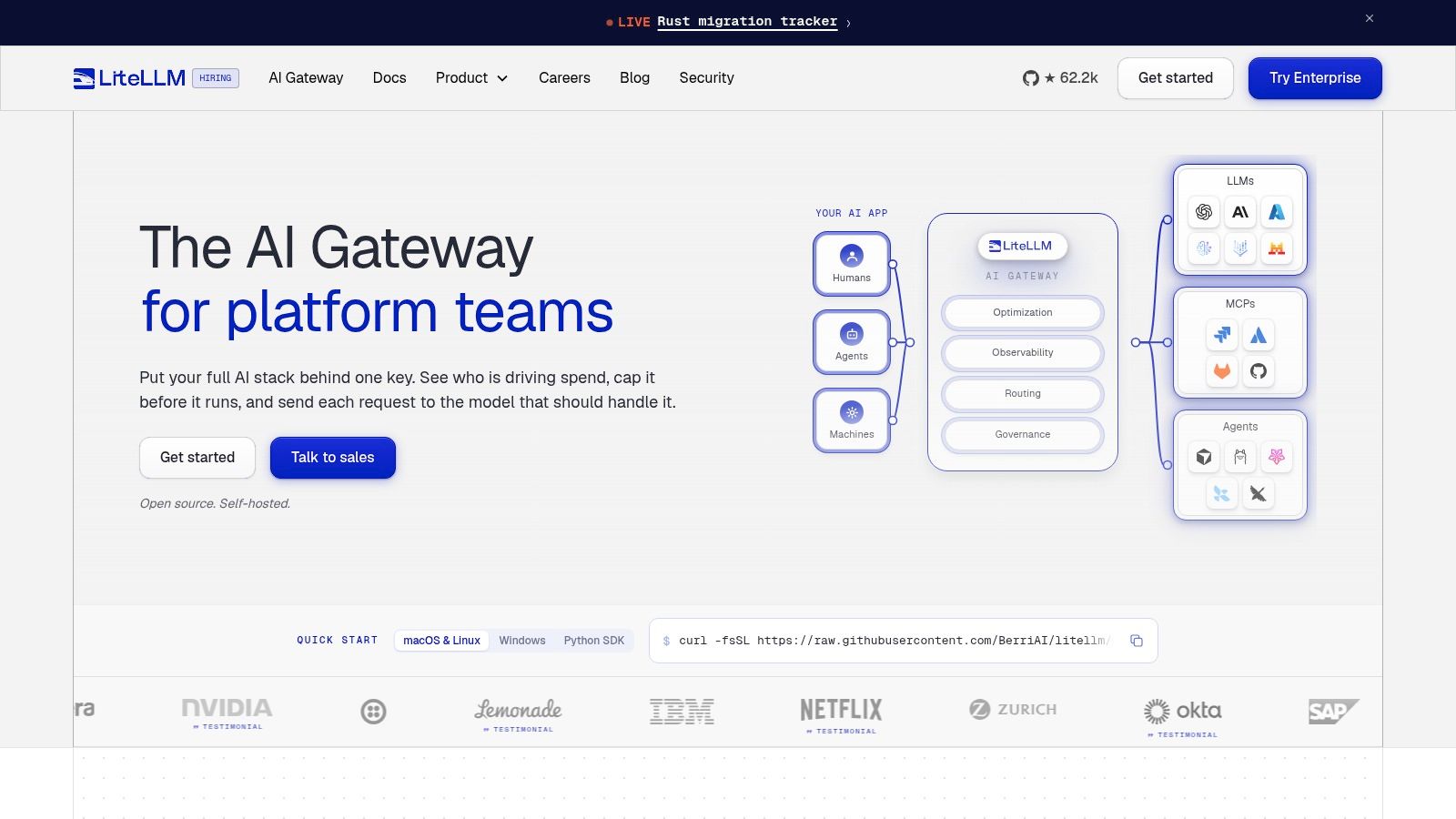
LiteLLM is the pick when your platform team wants to own the gateway outright. It's an open source SDK and self hosted proxy that gives you an OpenAI compatible interface for 100+ providers, so application teams call one internal endpoint while you keep provider credentials, routing, and policy under your control.
What You Get and What You Own
The feature set is built for internal platforms:
- Router controls: retries, fallbacks, and load balancing across provider deployments
- Virtual keys and budgets: per team rate limits and spend tracking so one service can't burn the shared budget
- Admin UI: a management layer for keys, models, and usage across teams
The open source version is free to self host, and that control is genuine. You decide where requests run, how credentials are stored, and how logs are retained. For regulated environments or companies with an existing internal developer platform, that's often the deciding factor.
But free software isn't free operations. Your team owns deployment, scaling, upgrades, and incident response for the proxy itself. Production setups may need a database and, for multi instance deployments, Redis. Enterprise security and support features require a sales conversation. I've seen teams underestimate this by comparing a managed gateway's fee against zero, rather than against the engineer hours spent keeping the gateway patched and available. Choose LiteLLM if you have platform capacity and a real requirement for self hosting. Don't choose it to save money on paper.
4. Portkey
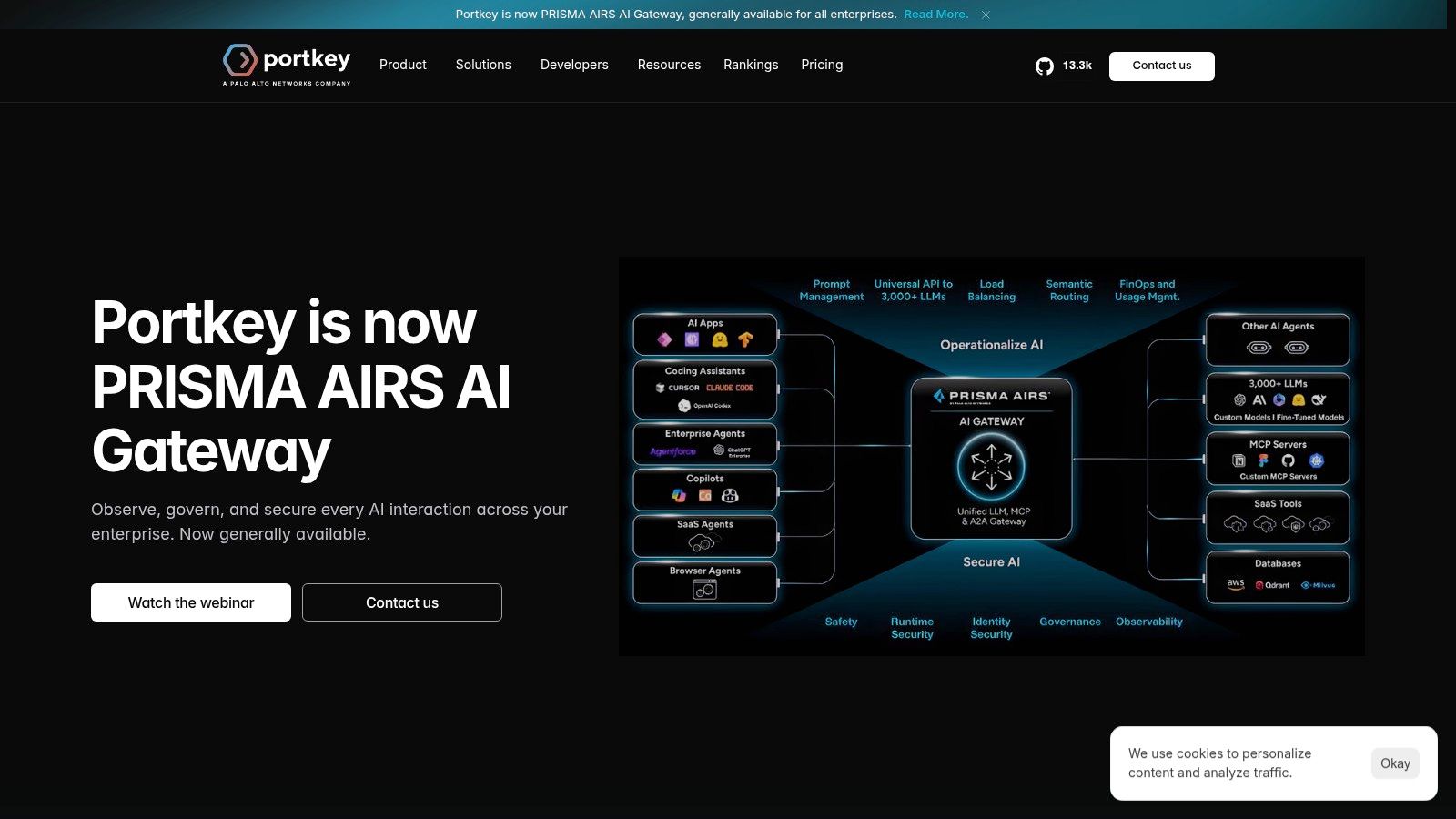
Portkey sells the combination most production teams eventually ask for, a gateway plus observability. It provides a universal API and key management across supported providers, then layers on logs, traces, metadata, alerts, and usage analytics so you can see what a request did, not just that it returned.
Reliability controls include fallbacks, load balancing, retries, and request timeouts, and fallback traces show which targets failed and which succeeded. That visibility matters because provider trouble is routine, not rare. Independent monitoring summarized in a provider reliability comparison reported 177 incidents across nine providers and 29 models in one month, with average uptime of 99.28%. A gateway that retries without a trace leaves you debugging quality changes blind.
Portkey also adds prompt templates and versioning, caching, and guardrails on applicable plans. Prompt versioning helps when product and engineering both touch prompts, though it also creates a second place where behavior can change outside your codebase if you aren't disciplined about review. Caching suits repetitive, low variance requests and does little for unique long context calls.
Pricing needs attention at scale. There's a free tier for prototyping and a published Production plan, but the free plan is described as unsuitable for production workloads. Production logging limits and overage charges can bite at high volumes, and enterprise capabilities may require custom pricing. Pick Portkey when request level tracing and prompt operations are central requirements, and model the logging cost at your real request volume before rollout.
5. Together AI
Together AI isn't trying to be a neutral front door to every proprietary provider. It's managed inference focused on open weight models, with an OpenAI compatible API that lets you prototype without provisioning GPUs, then move into provisioned throughput or dedicated deployments as traffic and reliability needs grow.
That progression is its strength. Serverless inference billed by tokens suits early validation and uneven traffic. Provisioned throughput adds reserved capacity and SLA backed options when a feature becomes business critical. Dedicated inference covers custom or fine tuned models on managed infrastructure, which is where open weight strategies usually get expensive and operationally messy if you self host too early.
Demand for that path is broad. Stanford University's 2025 AI Index, chapter 4, drawing on a global survey of 1,363 respondents, reported 78% of organizations used AI in at least one business function, up from 55% in 2023, while 71% regularly used generative AI in at least one business function. Teams are moving past pilots, and dedicated capacity becomes a planning question, not a research luxury.
The constraint is catalog scope. If your roadmap needs frontier proprietary models from several vendors behind one key, Together AI won't be that layer. Dedicated capacity also demands more forecasting than serverless, and rates vary by model and deployment type. Choose it when open weight models, fine tunes, or reserved inference capacity are the strategy.
6. DeepInfra
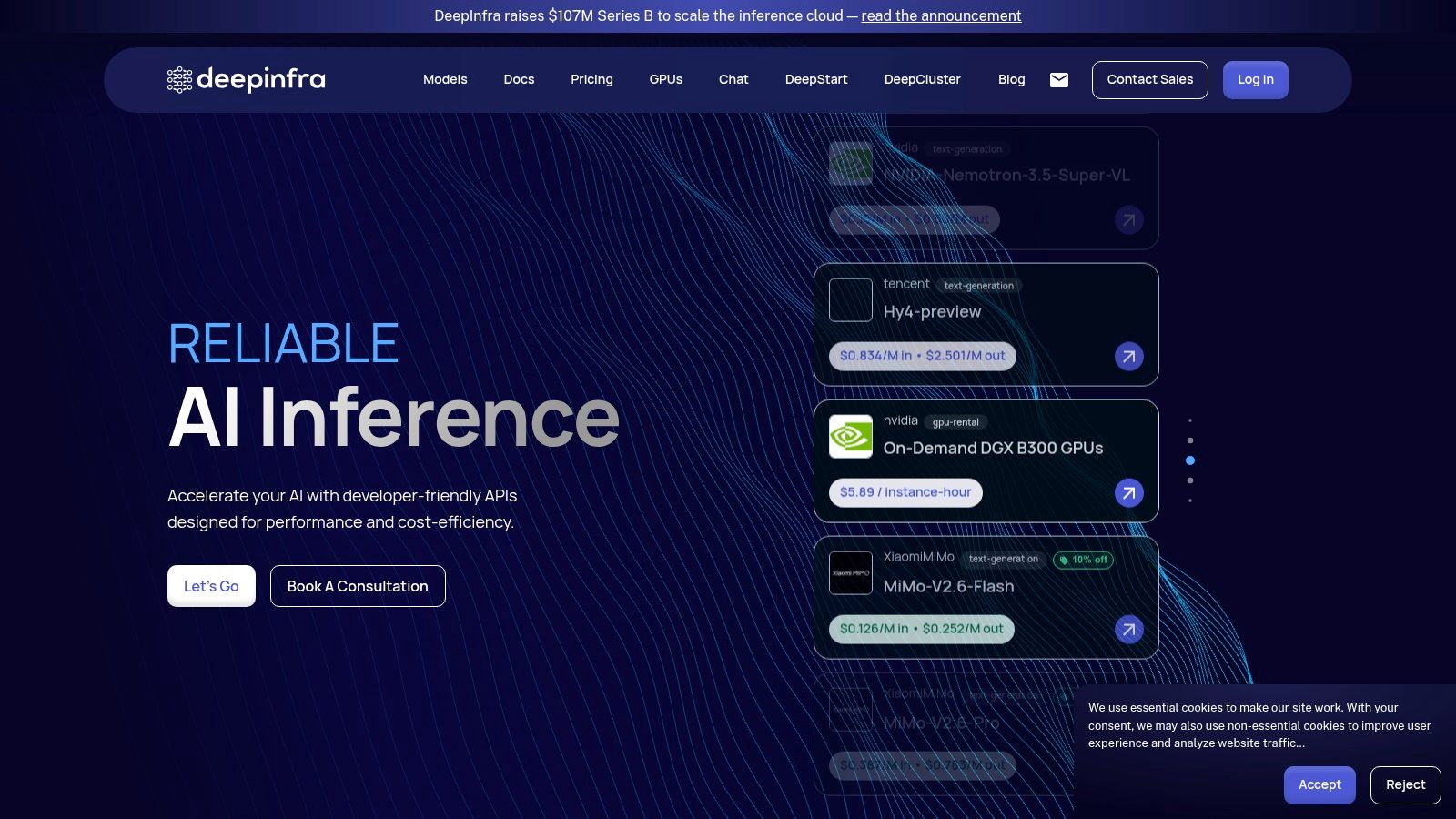
Cost clarity is the reason to look at DeepInfra. It serves hosted models for language, embeddings, image generation, and other inference workloads, with OpenAI compatible endpoints for chat completions, embeddings, and image generation plus native endpoints for additional model types. Published model pricing lets you estimate before you write integration code.
Service Tiers Decide the Real Price
DeepInfra offers standard, priority, and flex tiers, and the tier is where the trade off lives:
- Flex: discounted from base price for workloads that tolerate slower responses or occasional unavailability, good for batch enrichment and offline embeddings
- Standard: best effort during peak demand, fine for internal tools where a slow response isn't a customer incident
- Priority: costs more when you need stronger treatment under load
That structure is honest in a way many price pages aren't. Published token rates also only tell part of the story, since Deloitte's analysis of AI token spend dynamics describes AI demand as variable because every interaction is metered in tokens, and complex reasoning models can consume more tokens than simpler tasks. Your workload shape, not the rate card, sets the bill.
Custom model deployments on dedicated GPU hardware are available if you outgrow shared endpoints. Billing requires a card, prepay, or an invoiced account. I recommend DeepInfra for developers comparing hosted open model costs across chat and embeddings, especially when some traffic can run on flex. Don't put latency sensitive customer chat on a tier designed to be interruptible.
7. Replicate
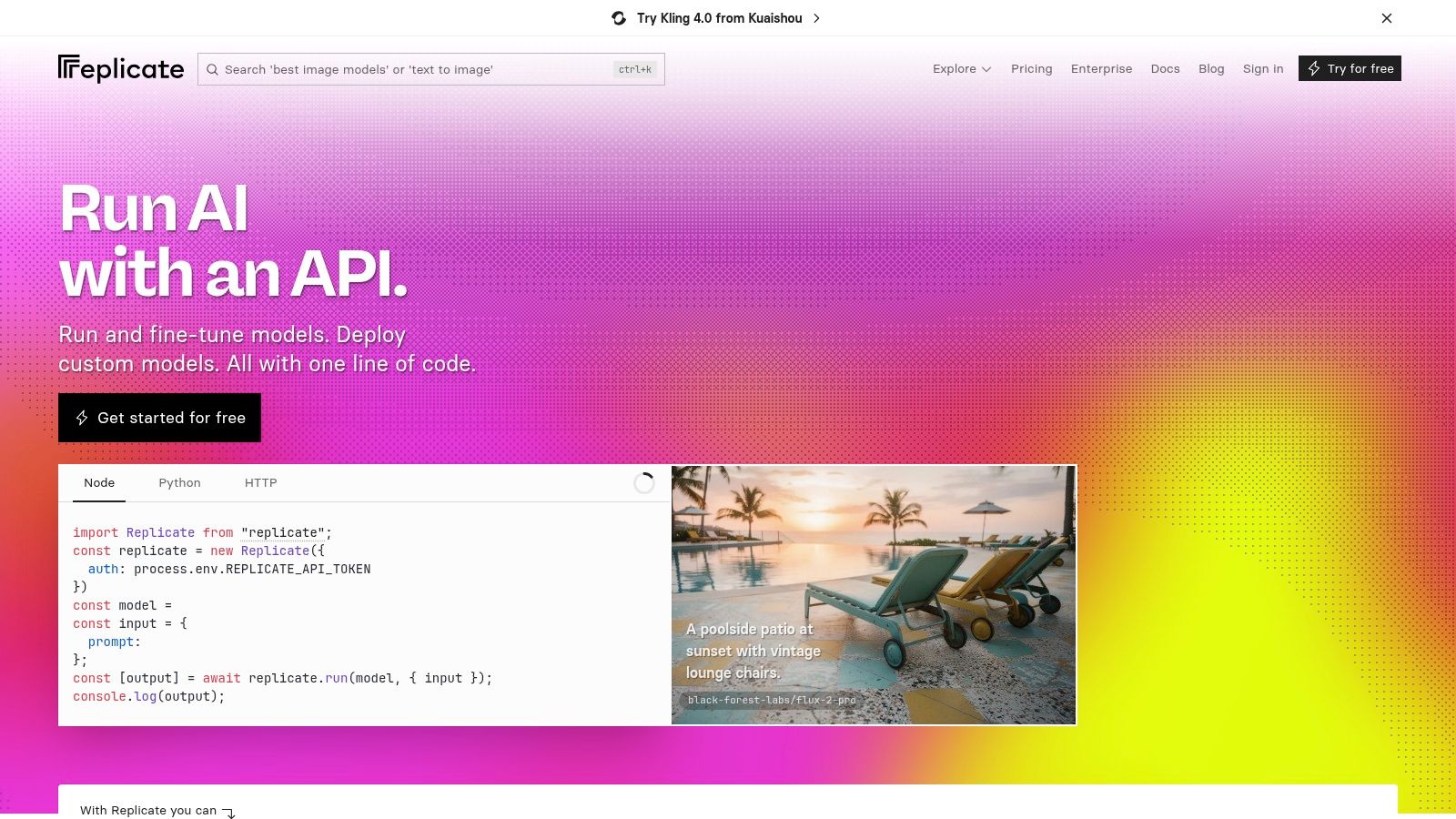
Replicate earns its place when your product is multimodal. It provides API access to a broad range of public models across image, video, audio, and text generation, so a team building generative media features doesn't need a separate vendor and request model for every modality.
Its most production friendly surface is the set of more than 100 maintained official models with stable APIs. Official model pricing is based on units such as output images, video duration, or tokens, which can be more predictable than pure runtime billing when you're pricing a creative feature per asset. You can also create public or private models and select hardware for custom deployments, giving research heavy teams a path from experiment to hosted endpoint.
Price media workloads per finished asset, not per call. Retries, rejected outputs, and longer video durations are what your unit economics actually feel.
The limits follow from that breadth. Pricing and request formats vary by model, so your integration burden grows as you add model types. Non official models may be billed by hardware and runtime, which makes cost forecasting harder and cold behavior less uniform. Replicate also isn't the closest fit for a unified chat API spanning major proprietary providers, and it shouldn't be judged as one. Pick it when image, video, or audio generation is core to the product, or when you need to publish and run custom models without building serving infrastructure.
How the seven AI APIs compare on fit, pricing model, deployment, and reliability approach
| Item | Best For | Pricing Model | Deployment | Reliability Approach |
|---|---|---|---|---|
| Openbase | Accessing multiple frontier-model providers through one API | Published per-million-token rates; pay only for requests that produce tokens | Managed API gateway | Automatic provider routing, retries, and pooled rate limits |
| OpenRouter | Testing and switching among a wide range of models | Usage-based; no minimum spend; platform fee on standard credit purchases | Managed API gateway | Provider routing and fallback |
| LiteLLM | Teams wanting control over model access, budgets, and infrastructure | Free open-source self-hosting; enterprise features require a sales conversation | Self-hosted gateway or SDK | Retries, fallbacks, and load balancing |
| Portkey | Teams needing gateway controls with observability | Free tier and published Production plan; enterprise pricing may be custom | Managed gateway; deployment options may vary | Fallbacks, retries, load balancing, and timeouts |
| Together AI | Prototyping and deploying open-weight models | Model-specific token pricing; dedicated and provisioned options vary | Serverless, provisioned throughput, or dedicated inference | Reserved capacity and SLA-backed options available |
| DeepInfra | Cost-conscious hosted model inference across multiple workloads | Published model pricing with standard, priority, and flex tiers | Managed endpoints or custom dedicated-GPU deployments | Service tiers trade off cost, speed, and availability |
| Replicate | Multimodal and custom-model applications | Model-specific pricing by output units or hardware runtime | Hosted public models or custom deployments | Stable APIs for maintained official models; reliability details vary by model |
Matching the Best AI API to Your Workload and Team
Start with the workload, not the vendor list. Chat and agents need stable OpenAI compatible schemas, streaming, tool calling, clear timeout behavior, and fallback that won't change output quality. Embeddings and batch extraction reward published pricing and discounted flexible tiers, because a slow response rarely harms anyone. Vision and media generation push you toward catalogs priced per asset, where request formats vary and that's an acceptable price for coverage.
Then decide who owns the infrastructure. That choice has become urgent because usage is now mainstream but returns lag. McKinsey's 2025 global survey of 1,993 participants in 105 countries found 88% of respondents said their organizations regularly used AI in at least one business function, while 39% reported some level of EBIT impact and most of that group said AI contributed less than 5% of organizational EBIT. The gap is where API operations live. Retries, reasoning tokens, provider outages, and unpriced logging decide whether a feature pays for itself.
A managed gateway like Openbase, OpenRouter, or Portkey trades a platform layer for speed, consolidated access, and someone else's routing work. LiteLLM trades engineer time for control over credentials, deployment, and data handling. Together AI and DeepInfra trade provider neutrality for managed inference economics and capacity options, while Replicate trades chat uniformity for multimodal breadth. None of those trades is wrong in isolation. Each is wrong for a specific team.
A Two Week Trial That Settles It
Run real traffic through two candidates for two weeks, using the same prompts, tools, and traffic mix you'd ship. Track these fields per request:
- Latency: time to first token and total completion time, split by provider and model
- Failure handling: error class, retry count, fallback target, and whether tool side effects stayed safe
- Real cost: input, output, and reasoning tokens plus retries, expressed as cost per successful task
Include one unpleasant test on purpose. Force a timeout, hit a rate limit, and send a malformed request, then check whether the logs explain what happened without you opening a support ticket. Compare cost per successful task, not cost per million tokens, since a cheaper model that retries or rambles can cost more. Commit to a single key, invoice, or self hosted deployment only after that evidence is in. The best AI API for your team is the one whose failure behavior and bill you can predict.
If you want frontier models from OpenAI, Anthropic, Google, xAI, and DeepSeek behind one OpenAI compatible key, with automatic failover and per call logs for tokens, latency, and exact cost, start your two week trial with Openbase. Point your existing chat completions code at the new base URL, run your real workload, and judge it on the failed and retried requests, not just the easy ones.