
Your chat feature works in staging, then production traffic arrives. One provider starts returning rate-limit responses, retries pile onto the same constrained endpoint, and users see delayed or incomplete answers. The application may have healthy web servers and a perfectly adequate database, yet the AI experience still stalls because the system treats one volatile inference dependency as if it were an ordinary REST service.
LLM load balancing addresses that failure mode at the routing layer. It considers provider health, request shape, token consumption, geography, streaming state, model quality, and cost before dispatching work. A unified gateway can also hide provider-specific credentials and request differences, giving the application one operational boundary while the gateway manages several upstream paths.
Table of Contents
- The Hidden Bottleneck in Production AI Workloads
- Why Generative AI Requires Specialized Routing
- Mid-Flight Failover and Pooled Rate Limits
- Provider Prioritization and Performance Trade-Offs
- Token-Aware Fairness and Rate Limit Management
- Implementing a Unified Gateway Architecture
- Measuring Success and Observability
The Hidden Bottleneck in Production AI Workloads
A common production incident starts with a single upstream dependency. A team launches an assistant against one model provider, adds a retry policy around transient failures, and assumes the provider's rate limits are a temporary nuisance. During a traffic burst, the provider returns a 429. The client retries, other requests wait behind longer generations, and the retry traffic makes the original bottleneck worse.
The web tier may remain green throughout the incident. Traditional health checks still pass because the application process is alive and the provider's hostname resolves. The user, however, experiences a timeout, a frozen stream, or an answer that arrives after the interaction has already failed.
Why ordinary balancing falls short
A conventional HTTP load balancer usually distributes requests by connection count, round robin, or a simple health signal. Those policies work reasonably well when requests have similar execution costs. An LLM request can contain a short prompt or a large retrieved context, generate a brief answer or a long response, and remain active while tokens stream to the client.
That makes connection count a weak proxy for capacity. One active generation may be cheap to serve while another occupies substantial prefill and decode capacity. A router that sees only queues can also miss provider-specific limits, model availability, regional latency, and the value of an already-warm prompt cache.
Practical rule: Route according to the work a request represents, not merely the fact that a request exists.
A unified gateway creates the missing control plane. The application sends one compatible request, while the gateway chooses among configured providers or self-hosted inference clusters. It can centralize authentication, record usage, enforce tenant policies, and decide whether a failure deserves a retry.
The failure boundary matters
Not every error should trigger failover. A malformed request, unsupported model, invalid tool schema, or authentication problem usually needs correction rather than another upstream attempt. A transient timeout, rate-limit response, or provider-side server error may justify a controlled retry, but only when the gateway can preserve response semantics and avoid multiplying load.
Streaming makes that decision more difficult. Once the gateway has delivered tokens, it can't blindly restart the request without risking duplicated content. A reliable design therefore tracks stream state, distinguishes pre-first-token failures from interruptions after delivery, and exposes a clear policy for continuation or graceful termination.
The architectural shift is simple to state but significant in operation: your application should depend on a routing and resilience boundary, not on the availability of one provider endpoint.
Why Generative AI Requires Specialized Routing
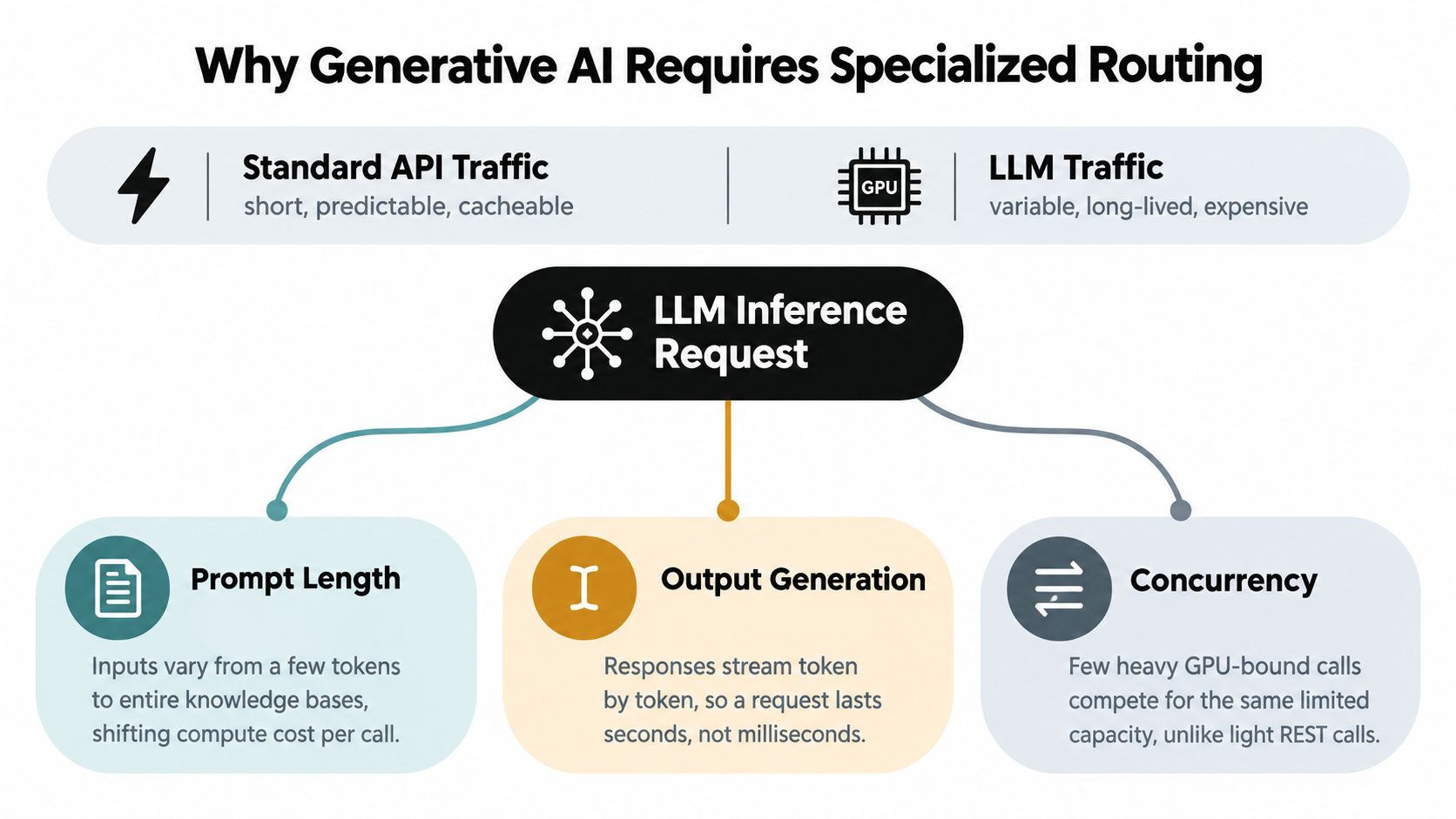
Standard API requests are often short-lived and relatively uniform. LLM inference requests aren't. The prompt length affects prefill work, generated output affects decode duration, and concurrency determines how many sequences compete for accelerator memory and scheduling opportunities.
A request can also benefit from prefix or KV-cache locality. Sending it to a replica that already holds relevant context may reduce repeated computation, while sending every request through round robin can scatter related traffic across the fleet. Cache affinity isn't an absolute rule, though. A cache-hot replica that's already near saturation may be slower than a colder replica with available capacity.
Three variables change the scheduling problem
Prompt length changes the cost of the prefill phase. A retrieval-heavy request may carry far more context than a conversational greeting, even though both count as one HTTP request.
Output generation keeps the request active while the model produces tokens. Streaming improves perceived responsiveness, but it doesn't make the underlying generation free. The router must account for a request that occupies capacity over time rather than completing immediately after dispatch.
Concurrency creates competition for GPU resources. A small group of long-running, token-heavy requests can produce more pressure than a larger group of short calls. Queue depth alone can't express that difference.
A 2026 survey of efficient LLM inference serving describes cluster-level load balancing as a way to prevent node overload and underutilization, connecting distribution decisions directly to throughput and service quality. The same survey reports examples including 1.12 to 2.06 times higher throughput, 1.74 to 6.30 times lower latency, and 25% lower serving cost for one cross-region balancer, while another cluster balancer on a 12-GPU setup increased serving capacity by up to 16.7% and reduced P99 tail latency by up to 49.5%.
Live signals beat static policies
Static round robin assumes that replicas are interchangeable and that request cost is roughly stable. Neither assumption holds for a changing LLM workload. A recent serving study reports that traffic characteristics evolve across requests, models, users, and instances, which helps explain why a fixed policy can misallocate capacity as the request mix changes.
A practical scheduler should combine signals such as:
- Arrival rate: Detects whether pressure is building before queues become large.
- Token budget: Estimates the work represented by the input and permitted output.
- Running work: Captures active generations, not just waiting requests.
- Memory state: Includes KV-cache occupancy and fragmentation where available.
- Cache locality: Rewards useful reuse, but only when its latency benefit outweighs extra queueing.
- Provider health: Tracks recent timeouts, rate limits, error classes, and recovery.
The best policy isn't the one with the most inputs. It's the one that turns those inputs into a decision that remains useful as traffic shifts. In self-hosted clusters, predicted latency can be more actionable than a hand-tuned weighted score. In multi-provider systems, the equivalent decision includes regional endpoint behavior, model quality, quotas, and price.
Mid-Flight Failover and Pooled Rate Limits
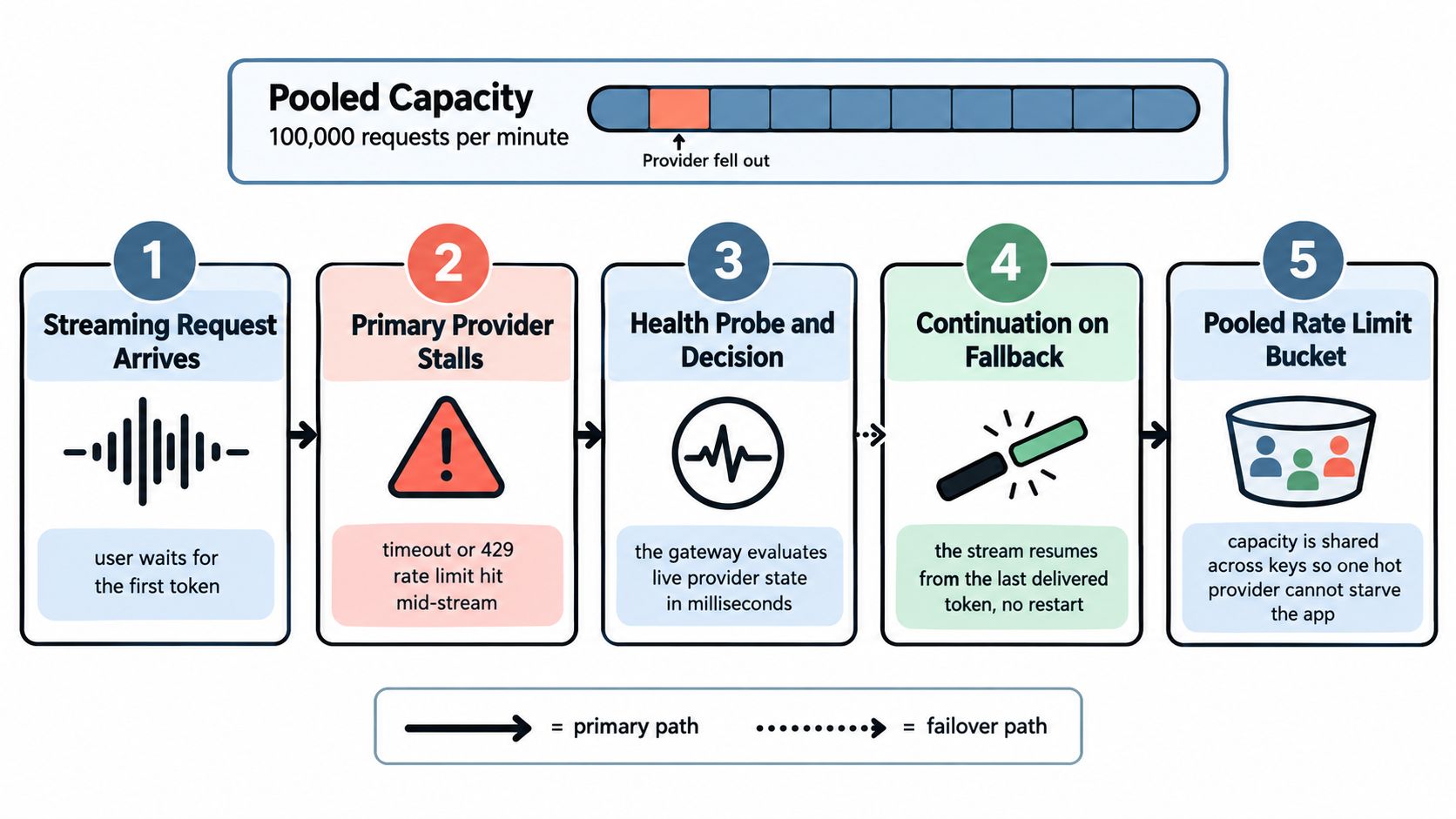
Failover is easy before a request reaches an upstream. The gateway receives a connection failure, selects another provider, and sends the request again. Mid-flight failover is harder because the client may already be receiving a stream.
A usable design starts by separating the stream into states:
- Before dispatch: The gateway can select a healthy route and apply normal retries.
- After dispatch, before the first token: A timeout, 429, or transient server error can often be retried on a fallback provider.
- After tokens have been delivered: The gateway must preserve what the client has seen and decide whether continuation is safe.
- After a non-retryable error: The gateway should return the error instead of creating duplicate work elsewhere.
The error policy needs to be explicit. Transient 408 and 5xx responses, connection interruptions, and applicable rate-limit responses can enter a bounded retry path. Fatal 400 and 404 responses generally indicate a request or routing problem, so retrying them against another provider only adds noise.
Preserve continuity without hiding failure
For a stream that has already emitted content, the gateway needs a continuation strategy. It may resend the request with enough context to continue, but the model can produce different tokens, and the client must understand whether the fallback is a continuation or a restarted generation. In some applications, the safer behavior is to terminate cleanly and let the client offer a retry.
That trade-off should be tested with tool calls and structured output, not just plain text. A partial JSON object or a tool invocation interrupted mid-arguments can be more dangerous to replay than a prose response.
Use an error taxonomy rather than a generic “retry on failure” switch. The Openbase error reference is one example of the kind of explicit error surface teams should document for clients, gateways, and operational runbooks.
Pool capacity across equivalent routes
If several providers can serve the same model, treating each quota as an isolated dependency leaves capacity stranded. A gateway can maintain a pooled view of usable capacity, then route around a provider that's throttling while preserving that provider as a later fallback.
Pooling doesn't mean ignoring provider headers or sending unlimited traffic. The router still needs per-provider budgets, cooldowns, concurrency controls, and circuit breakers. It means the application doesn't have to fail merely because one credential or region reached its immediate limit.
The routing objective is to keep the active path below the saturation knee while retaining fallback headroom. A 2026 production study on distributed load balancing reported a 17% reduction in median latency and a 13% reduction in p95 tail latency after migration from a legacy routing baseline. Those measurements matter because tail latency often determines whether interactive chat and agent workflows feel dependable.
Provider Prioritization and Performance Trade-Offs
Choosing a provider isn't a binary decision between “fast” and “cheap.” A useful router evaluates at least latency, output quality, reliability, geography, and cost, then applies different priorities to different workloads.
Interactive chat usually values time to first token and stable streaming. Background enrichment can tolerate more delay if it lowers cost. An agent may prefer a provider with stronger tool behavior even when another endpoint responds faster. A safety-sensitive workflow may require a particular model family regardless of the cheapest route.
Geography can dominate the result. A 2026 router latency benchmark found Tokyo at 3.08 seconds compared with Ireland at 1.61 seconds, and reported one router reaching time to first token in 0.640 seconds compared with 0.712 seconds for direct OpenAI access in the measured comparison. Those figures aren't universal guarantees, but they show why location belongs in the routing policy rather than in an after-the-fact dashboard.
Routing Priority Matrix
| Workload Type | Primary Metric | Routing Strategy |
|---|---|---|
| Interactive chat | Time to first token and stream stability | Prefer a nearby, healthy endpoint with predictable tail behavior. Keep a quality-compatible fallback warm. |
| Tool-using agents | Successful tool execution and end-to-end completion | Prioritize providers with compatible tool semantics, then score latency and health. Avoid mid-tool replay unless state handling is explicit. |
| Background classification | Cost per completed task | Route to a lower-cost compatible model or provider, with bounded retries and asynchronous handling. |
| Long-context analysis | Capacity headroom and sustained generation | Use token-aware admission control and avoid endpoints with high memory pressure or long queues. |
| Sensitive production flows | Reliability and policy compliance | Restrict the candidate set first, then prioritize health and latency within the approved routes. |
Provider ordering should be policy-driven, not hardcoded into application branches. The request can carry workload metadata, while the gateway maps that metadata to a route profile. A model catalog, such as the one described in Openbase model documentation, can help teams keep model identifiers and provider choices visible instead of burying them in scattered SDK configuration.
One mistake is optimizing every request for the same metric. Another is switching providers too aggressively based on a single slow response. Use rolling health signals, cooldowns, and clear route eligibility. The router should avoid a degraded provider without causing oscillation between endpoints.
Token-Aware Fairness and Rate Limit Management
A request counter treats a greeting and a large context window as equal units. They aren't equal from the scheduler's perspective. One may complete quickly, while the other consumes substantial prefill work, decode time, memory, and provider quota.
Token-aware fairness starts by reserving capacity before dispatch. Estimate input and maximum output tokens, reserve against the tenant or workload budget, then reconcile the reservation with actual usage when the response completes. If the request ends early, release the unused portion. If it consumes more than expected, record the overage and apply the appropriate policy.
This matters most in shared environments. A single tenant running long generations can consume the cluster's useful capacity while other teams still appear to be within a request-per-minute limit. The gateway needs separate controls for users, API keys, products, environments, and provider pools.
Design the budget around real ownership
A practical hierarchy might include:
- Per-key limits: Isolate development, staging, and production traffic and make revocation straightforward.
- Per-tenant token budgets: Prevent one customer or internal team from exhausting shared capacity.
- Workload classes: Give interactive traffic different admission rules from batch processing.
- Provider-specific ceilings: Honor upstream headers and maintain local safety margins.
- Retry budgets: Stop a failing dependency from consuming the same tenant's capacity repeatedly.
The Openbase rate-limit documentation illustrates the kind of operational detail teams should expose to developers. The important principle is that rate limits must be understandable at the same level as billing and capacity planning.
Reservation and reconciliation also improve cost attribution. Record estimated tokens at admission, actual input and output tokens at completion, and any reasoning-token usage separately when the provider exposes it. Don't charge or penalize a tenant for a retry that produced no tokens, but do account for generated output from a failed continuation if the upstream billed it.
Fairness isn't only about equal quotas. It means the scheduler protects latency-sensitive work, prevents noisy neighbors, and makes the cost of expensive requests visible before they saturate the system.
Implementing a Unified Gateway Architecture
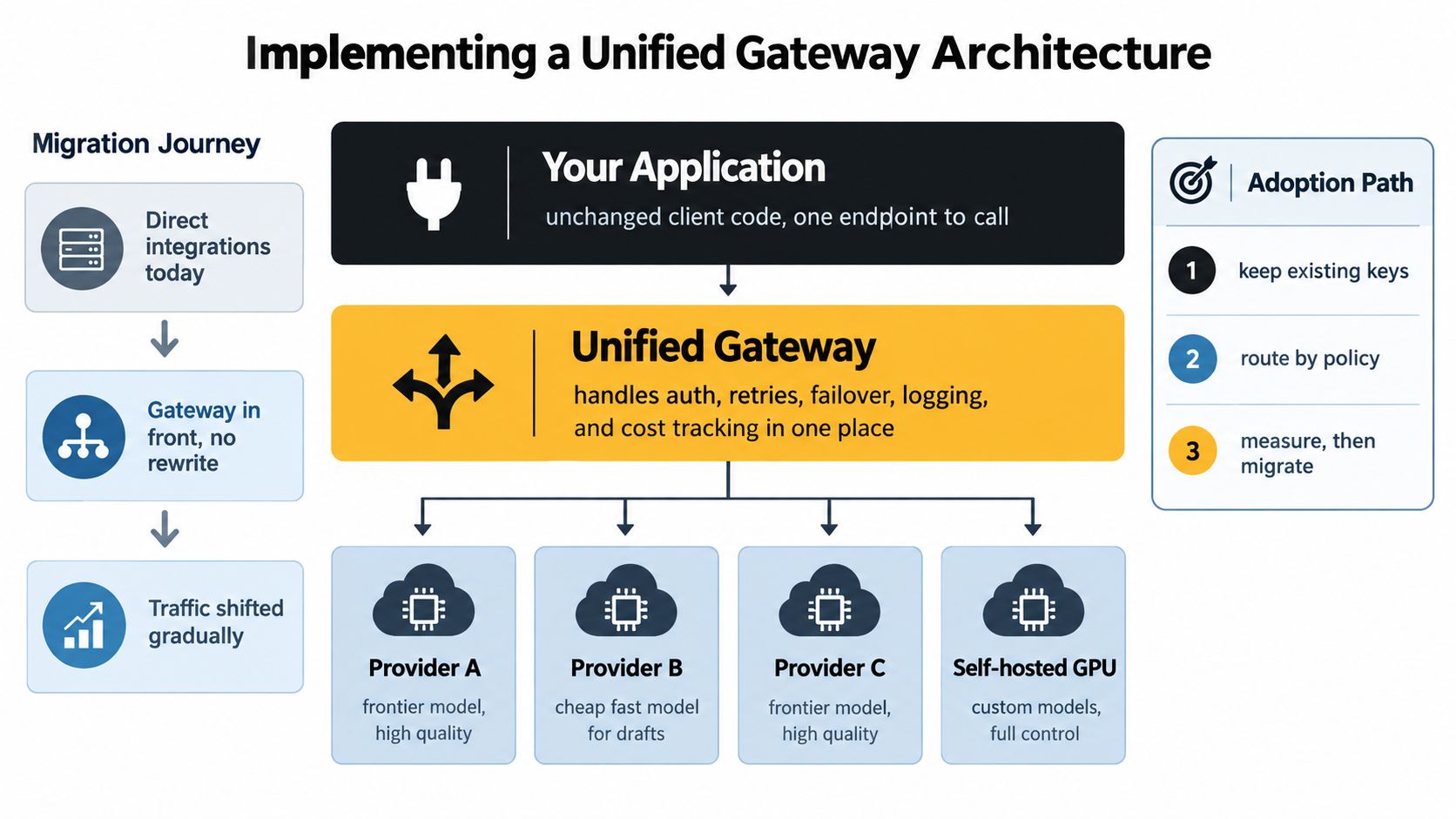
You don't need to rewrite every LLM integration to introduce a gateway. The least disruptive path is to place an OpenAI-compatible endpoint in front of existing clients, change the base URL and credential handling, and preserve the request and streaming shape wherever compatibility allows.
Start with one non-critical workload. Send traffic through the gateway without changing model behavior, then compare provider selection, latency, errors, token usage, and cost against the direct path. Keep rollback simple. A gateway that can't be bypassed during its own maintenance window becomes a new single point of failure.
Put policy in the gateway
The gateway should own concerns that otherwise get duplicated across services:
- Credentials: Store provider keys centrally and keep application services on a controlled gateway credential.
- Routing: Select a provider using model availability, health, geography, workload class, and cost.
- Retries: Apply error-specific retry rules with bounded attempts and a retry budget.
- Streaming: Preserve event formatting, cancellation, and usage reporting across providers.
- Metering: Log provider, model, token counts, latency, time to first token, and exact per-call cost.
- Model addressing: Use provider-prefixed model names when teams need deterministic provider selection.
Provider-prefixed addressing is useful during migration. It lets engineers compare routes deliberately while retaining one client library and one request contract. Once the route is trusted, policies can map a logical model to several eligible providers without forcing product code to understand each upstream.
Openbase is one option in this gateway category. It provides an OpenAI-compatible chat completions endpoint, access to models from multiple providers, automatic failover, pooled rate-limit handling, per-request usage logging, and consolidated billing, according to the publisher's product overview.
Shift traffic in controlled stages
A sensible rollout has three phases:
- Observe: Mirror or route a small, reversible workload and validate logs, cancellation, errors, and token accounting.
- Constrain: Add provider priorities, tenant budgets, retry limits, and circuit breakers before increasing traffic.
- Expand: Move workloads gradually, keeping direct-provider rollback available until the gateway's operational behavior is established.
Don't treat compatibility as proof of equivalence. Providers can differ in tool-call details, stop reasons, content filtering, token accounting, and streaming edge cases. Build contract tests around the request types your application uses.
Measuring Success and Observability
A load balancer isn't successful because it has several upstreams configured. It succeeds when engineers can explain why each request took its route and whether that decision improved the user experience without creating hidden cost.
Track time to first token, total latency, inter-token timing, completion status, retry count, provider, region, model, input tokens, output tokens, reasoning tokens where available, and exact cost. Break those measures down by workload, tenant, route, and error class. Aggregate dashboards are useful for trends, but per-call records are what make incidents and invoices reconcilable.
Watch the trade-offs directly
A route that lowers median latency may worsen tail latency. A cheaper provider may increase retries or produce more tool-call failures. A cache-aware policy may improve prefill for one workload while concentrating traffic on a hot replica. Keep those outcomes visible together instead of optimizing a single chart.
Useful alerts include:
- Tail latency: Detect degradation that averages conceal.
- First-token delay: Protect the initial interaction in streaming applications.
- Retry concentration: Identify providers that are consuming recovery capacity.
- Token-budget exhaustion: Find tenants or workloads approaching admission limits.
- Cost divergence: Compare expected and actual per-call spend.
- Fallback rate: Confirm whether redundancy is available and actually usable.
Run reviews after traffic-shape changes, model migrations, and provider policy changes. LLM load balancing is an operational discipline because request mix, model behavior, cache state, and provider health keep changing. Start by instrumenting the direct path, add a gateway with a reversible route, and measure decisions at request level before tuning the policy.
Openbase provides a unified OpenAI-compatible gateway for routing LLM requests across providers, with failover, pooled rate-limit handling, and detailed token, latency, provider, and cost logs. Visit Openbase to evaluate whether its gateway can give your team a practical control layer for reliable, observable LLM load balancing.