
A security architect reviewing a Java estate finds five services that all handle the same kinds of untrusted input, but each team has written its own validation, escaping, and error-handling routines. One service returns a generic error; another exposes implementation details. A third encodes output differently depending on who last touched the code. The resulting audit findings aren't surprising. The harder question is how to give teams a consistent starting point without pretending a shared library can make application-specific security decisions for them.
That's the practical role of the OWASP Enterprise Security API (ESAPI). It's a free, open-source Java library designed to provide reusable security controls for new applications and existing systems, as described in OWASP's ESAPI project listing. For an enterprise, its value is less about installing a silver bullet and more about creating a common vocabulary for secure coding, review, remediation, and governance.
Table of Contents
- Why Enterprises Still Lean on ESAPI in 2026
- The Core Security Controls ESAPI Provides
- Where ESAPI Meets the OWASP API Security Top 10
- Mapping ESAPI Controls to Enterprise Compliance
- The Authorization Problem ESAPI Does Not Solve
- Embedding ESAPI Inside an AI Gateway Architecture
- How ESAPI Fits Alongside ASVS, WAFs, and API Gateways
- A Practitioner's Checklist for Rolling Out ESAPI at Scale
Why Enterprises Still Lean on ESAPI in 2026
A platform team adding an AI gateway to a Java estate may inherit different validation and error-handling patterns across services. Those inconsistencies make shared controls harder to review and maintain. ESAPI gives teams reusable security functions to build on, while application owners remain responsible for decisions specific to each service.
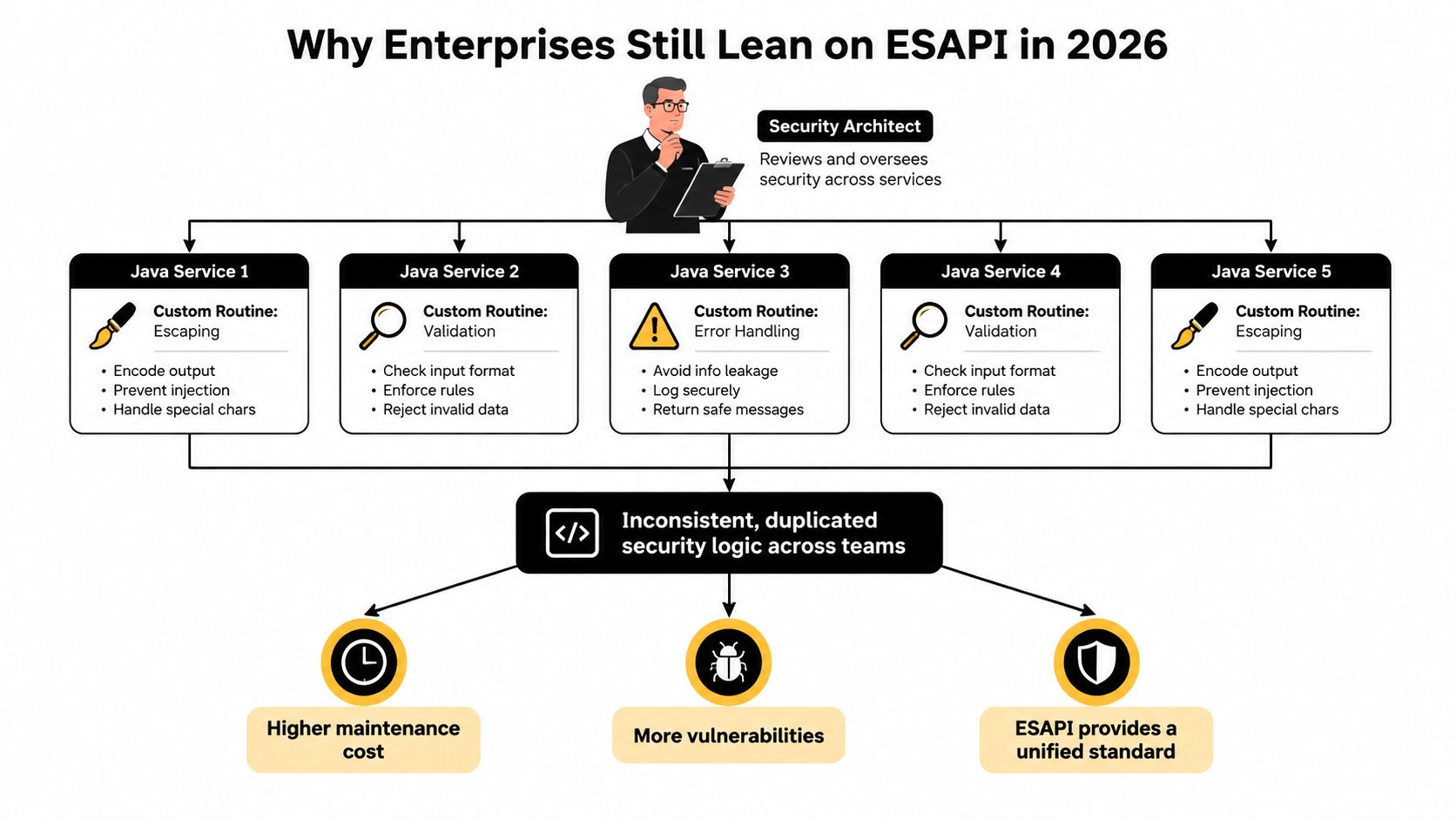
OWASP describes ESAPI as a Java project for retrofitting security into existing applications and supporting new development. Its reusable functions address recurring controls across development and maintenance, which suits organizations running legacy code alongside newer Java services. The project listing reports 71 contributors, 649 GitHub stars, and 15,976 downloads as of its last update on OWASP's project page. These are project-platform counters, not a measure of enterprise deployments; packaged dependencies, internal mirrors, and older releases may not appear in them.
A shared vocabulary, not a universal policy
A shared library can make control use more consistent. It cannot decide whether a user may access a customer record, whether an administrative action is appropriate, or what an organization should log. Those decisions belong in application logic and enterprise policy.
That boundary matters even more in AI gateways. Provider pooling, failover during a request, and tenant-specific model entitlements can make a traditional user-to-resource authorization check insufficient. ESAPI can support consistent security practices, but it does not define those entitlements or govern how they change as requests move between providers. Teams need explicit gateway policy, with the OWASP API Security Top 10 informing how they assess and govern API risks.
The architectural case for ESAPI is a shared set of primitives that teams can govern. Security teams can define approved usage, reviewers can check for consistent patterns, and platform teams can reduce duplicated implementations. Adoption alone is not evidence that an application is secure. Keep design review, testing, and clear ownership in the control process.
The Core Security Controls ESAPI Provides
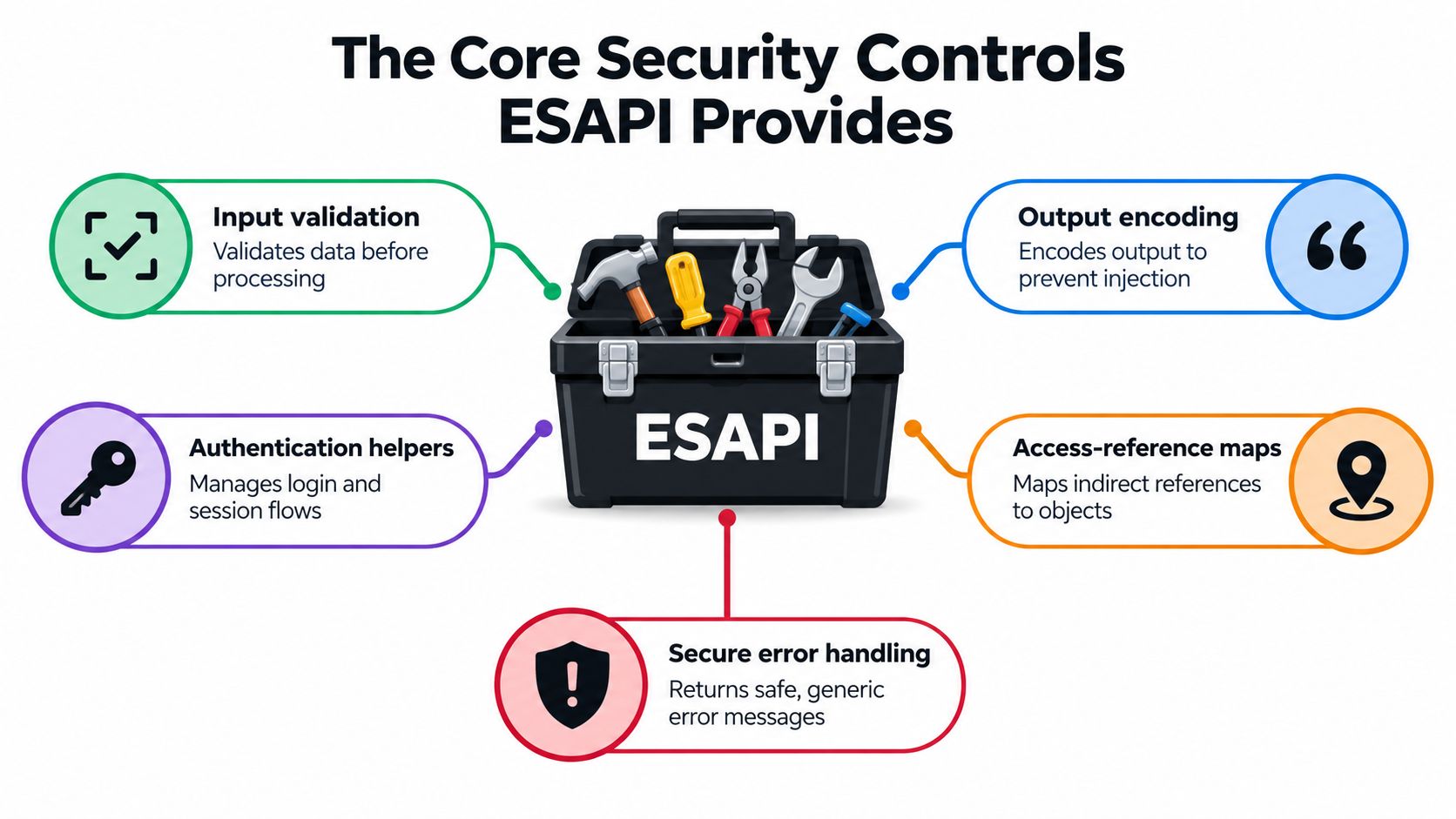
ESAPI supplies reusable security functions that developers can apply at specific points in a request lifecycle. Its capabilities include input validation, encoding, authentication-related protections, and secure error handling, as described in the OWASP project overview.
Follow the request from input to response
When untrusted data arrives, validation checks whether it matches application expectations before processing. A controller accepting a customer identifier, for example, can check its format and relevant business rules. Validation limits what the application accepts; each later use still needs the control appropriate to its context.
At the point where data is rendered or sent to a sensitive output context, encoding helps prevent it from being interpreted as executable content. The correct encoding depends on the destination. A value placed in HTML needs different handling from data written elsewhere, so a generic “sanitize once, use anywhere” routine does not replace context-aware output handling.
ESAPI also provides authentication helpers and access-reference maps. These can support identity handling and map indirect references to application objects. The application still needs to enforce authorization for each operation. A logged-in user may lack permission to read a particular record or invoke a privileged function.
Secure error handling reduces the risk of exposing implementation details in responses while allowing operators to investigate failures through appropriate internal logs. Keep diagnostic detail in controlled logging, and return errors that do not disclose sensitive internals.
Practical rule: Apply each control where its security property matters. Validation does not replace output encoding, and authentication does not establish authorization.
For AI gateways, these primitives can support input handling and identity checks, but they do not govern pooled providers, mid-request failover, or per-tenant model entitlements. Those decisions need explicit gateway policy, informed by the OWASP API Security Top 10. ESAPI can enable implementation of selected controls; governance must define which provider and model a tenant may use, and how that decision is enforced when routing changes.
Pair the library with code-review guidance and behavioral tests. For example, test that an invalid customer identifier is rejected before it reaches the persistence layer, rather than checking only that a validator call exists.
Where ESAPI Meets the OWASP API Security Top 10
Traditional application security often emphasizes input handling and output encoding. Modern APIs add a problem that those controls can't settle: whether the caller is allowed to access this object, change this property, or invoke this function. The OWASP API Security Top 10 for 2023 makes that distinction hard to ignore. Three of its first five categories concern access control: Broken Object Level Authorization (BOLA), Broken Object Property Level Authorization (BOPLA), and Broken Function Level Authorization (BFLA).
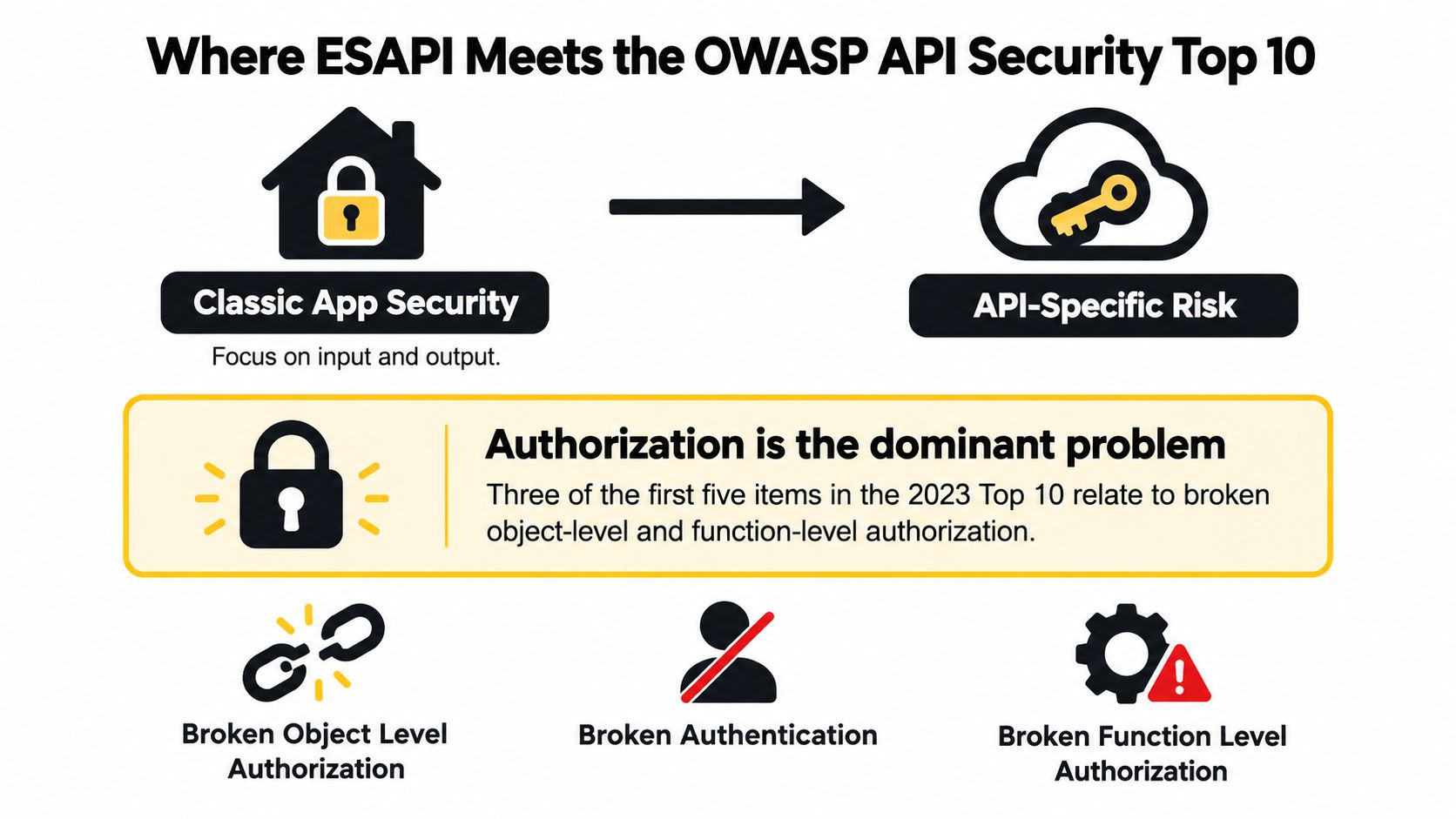
ESAPI can contribute useful identity and reference-handling primitives inside an application. It doesn't automatically enforce the decision that a principal associated with one tenant can access a particular object, or that a role can change only approved fields. Those checks must be expressed in application logic, backed by tests that try unauthorized combinations rather than merely confirming that valid requests work.
Move beyond the perimeter assumption
A service behind one gateway still has many authorization boundaries. A client may be authenticated but lack access to a specific model, provider, tool, tenant's usage record, or administrative operation. A gateway that accepts a valid key and then assumes every downstream action is permitted has authenticated the caller without completing authorization.
For BOLA, bind the caller's tenant and identity to each object lookup. For BOPLA, restrict which fields a role can read or modify, using explicit allowlists for administrative updates. For BFLA, separately protect privileged actions such as creating keys, changing spending limits, or exporting audit records. OWASP recommends enforcing authorization in application logic and testing for broken object-level access, as outlined in its API Top 10 project material.
A practical test replays equivalent requests under different tenants, keys, and roles. It should verify that changing an object identifier doesn't expose another tenant's records, and that a retry through a different upstream path doesn't inherit permission without review. For gateway teams, rate controls are another part of the operating boundary. Openbase documents its approach to rate limits, but rate limiting and authorization answer different questions. ESAPI helps establish reusable application controls; API-specific policy must govern objects, properties, functions, and each downstream hop.
Mapping ESAPI Controls to Enterprise Compliance
Compliance mapping is useful when it records what a control contributes and what it leaves to the organization. ESAPI routines can support secure-engineering practices by giving developers a consistent way to validate input, encode output, and avoid unsafe error disclosure. They don't, by themselves, prove that a company meets SOC 2, ISO 27001, or PCI DSS requirements.
Use the table as a starting point for a control narrative, then attach the organization's own evidence: design decisions, test results, code-review records, dependency reviews, and operational procedures. The relevant audit question isn't “Do we use ESAPI?” It's whether the control is correctly applied, tested, maintained, and connected to the risks in scope.
| ESAPI Capability | Primary Compliance Support | Residual Gap |
|---|---|---|
| Input validation | Supports secure-development practices by constraining data before application processing. | Doesn't establish authorization, detect runtime abuse, or prove that validation rules cover every endpoint. |
| Output encoding | Supports safer output handling and reduces reliance on ad hoc encoding choices. | Developers must select encoding appropriate to each output context and verify it through testing. |
| Authentication-related helpers | Can support consistent handling of authentication concerns within an application. | Identity checks don't define permissions across tenants, objects, models, or administrative operations. |
| Access-reference maps | Can help manage indirect references to application objects. | Object-level authorization still requires application-specific policy and negative tests. |
| Secure error handling | Supports limiting sensitive information in responses. | Centralized logging, alerting, and runtime detection require separate operational controls. |
| Library adoption and maintenance | Provides a reusable control layer for secure engineering. | Dependency scanning, patch management, release approval, and vulnerability response remain organizational responsibilities. |
Turn the mapping into evidence
For SOC 2, connect the library's use to the organization's documented secure-development and change-management practices. For ISO 27001, show how engineering procedures define and review security controls in development and maintenance. For PCI DSS requirement 6, document how application teams address common vulnerabilities, test implementations, and keep dependencies under governance. These are mapping prompts, not claims that ESAPI automatically satisfies any certification or requirement.
Centralized authorization is a separate gap, particularly for APIs that expose tenant-specific objects or operations. Runtime detection is another: a library call in source code doesn't tell the security operations team whether a deployed service is being abused. Dependency scanning and release review matter too, because a security library creates its own maintenance obligation.
A useful compliance artifact names the control owner, the implementation location, the test that verifies it, and the evidence retained for review.
Teams can extend this mapping with their own control IDs and system boundaries. For broader organizational security information, consult Openbase security information as part of vendor or platform evaluation, while keeping the company's own assurance evidence separate from the ESAPI mapping.
The Authorization Problem ESAPI Does Not Solve
An OpenAI-compatible gateway can present one client-facing endpoint while selecting among upstream providers. It may retry a request when an upstream service is degraded, and different tenants may be entitled to different models or tools. ESAPI's classic application primitives weren't designed to govern those routing decisions across a pooled, multi-provider gateway.
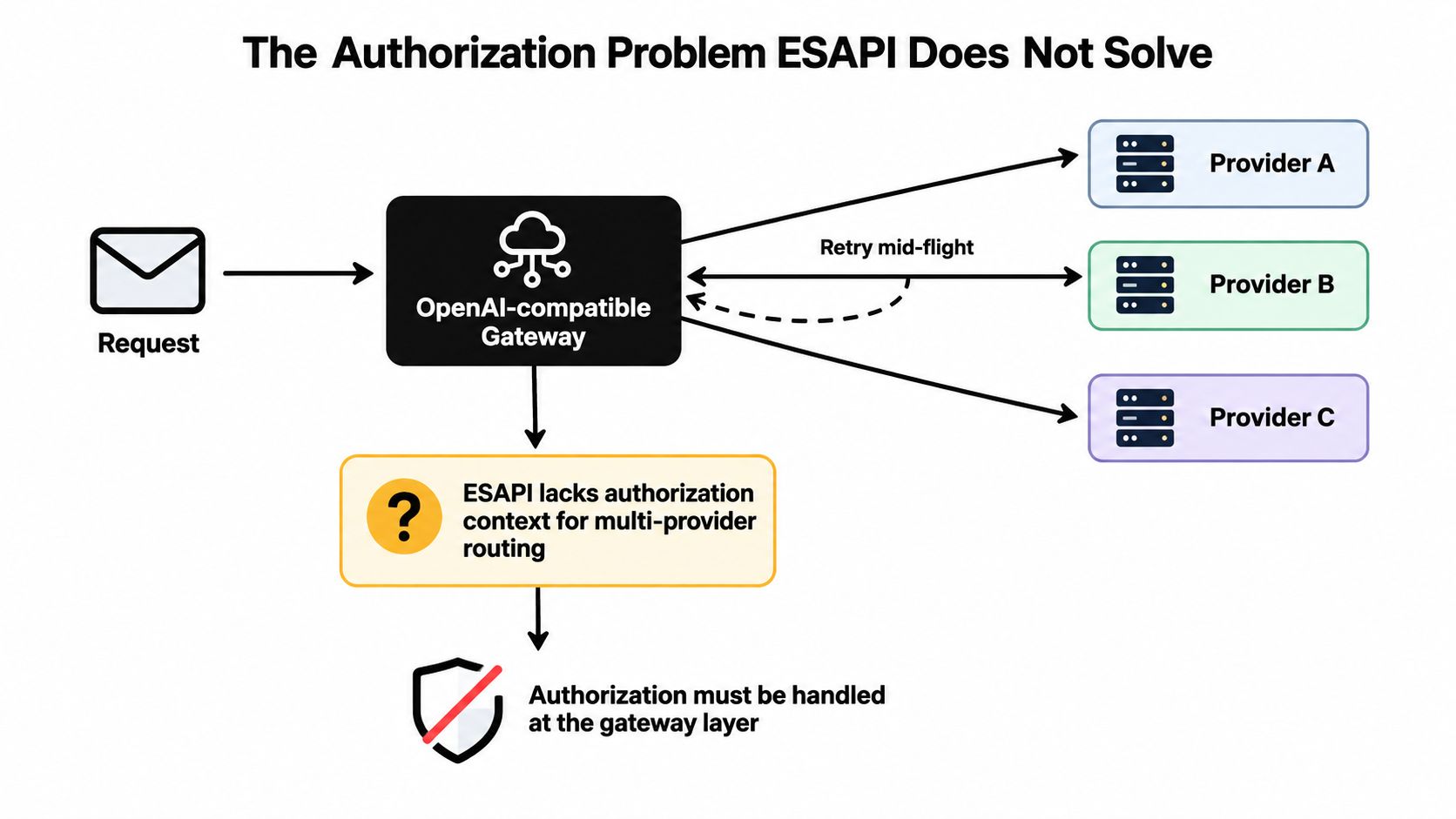
Consider a request that passes an initial API-key check for tenant A. The gateway chooses provider A, then retries through provider B after a failure. If the retry path relies on an earlier decision without rechecking the tenant's model entitlement and provider policy, the request may cross a boundary the original authorization never covered. The same weakness can affect access to usage logs, provider metadata, cost records, or model configuration.
Authentication is only the entry check
OAuth, API keys, and ESAPI authentication helpers can establish who is calling. They don't answer every downstream question. A gateway must also determine which tenant owns the request, whether that tenant may invoke the selected model and provider, whether the requested tool is allowed, and which response fields the caller may see.
That decision should be explicit and repeatable. Bind principal, tenant, key, model, provider, tool, and usage project to a policy evaluation. Preserve that context across retries, but don't treat preservation as permission: re-evaluate the policy whenever routing changes. If the fallback provider isn't approved, fail closed rather than assuming that authorization to use the gateway grants access to every upstream route.
This is the operational gap in many classic authorization models. A caller may be authorized for the front door but not for every object or service reachable behind it. Openbase's authentication documentation is relevant when assessing gateway credential flows, but teams still need a policy model for entitlements and upstream routing.
The contrarian point: More credentials don't fix a missing authorization decision. The gateway has to check access at every boundary where the resource, operation, or provider can change.
Embedding ESAPI Inside an AI Gateway Architecture
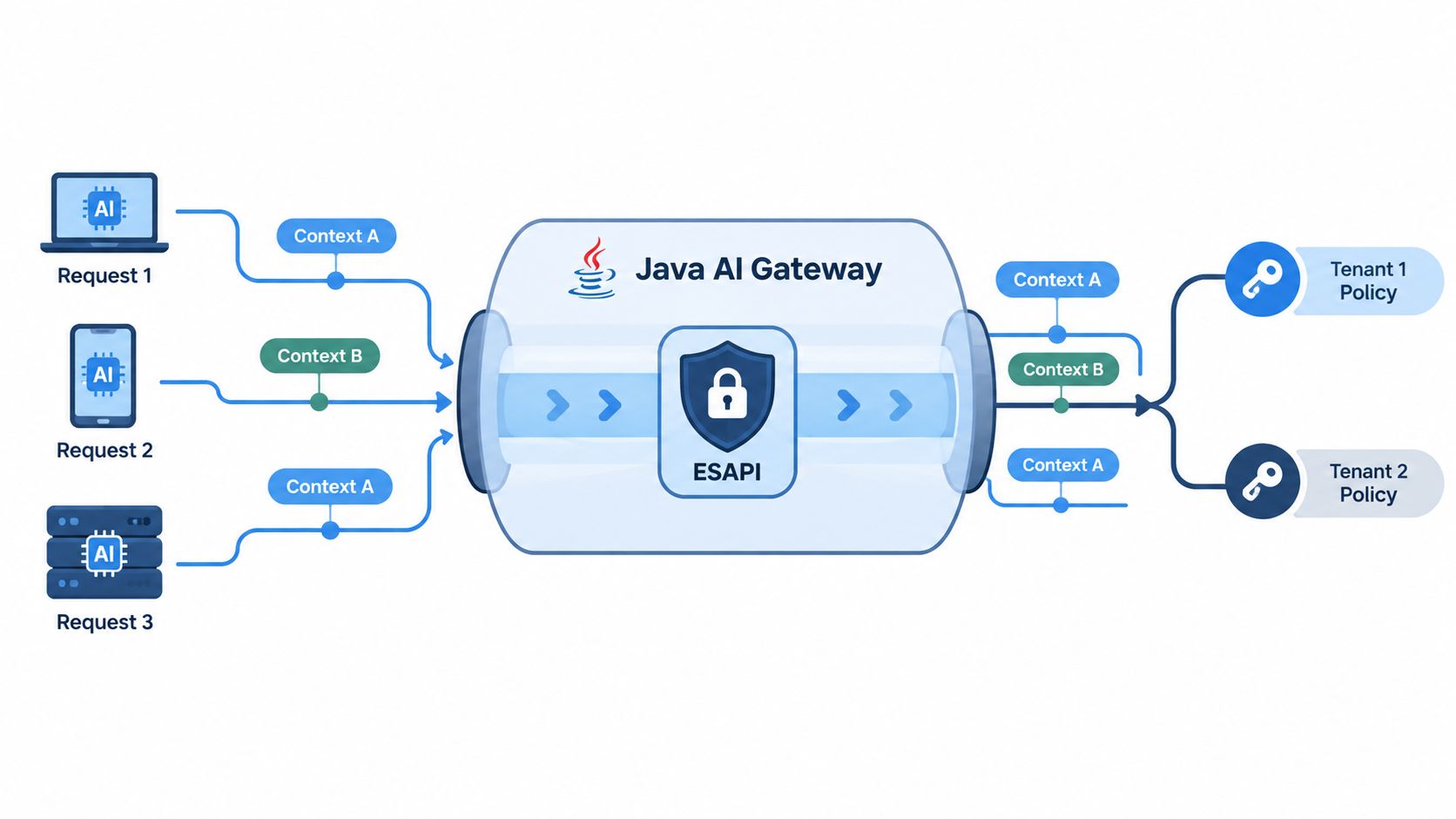
A Java gateway can use ESAPI without asking the library to become the policy engine for every model and provider. The practical pattern is to keep reusable in-process controls close to request handling, while placing tenant and model entitlements in an explicit policy layer. That division gives developers shared security routines without hiding business authorization inside a collection of unrelated helper calls.
Carry a request-scoped security context
At ingress, authenticate the caller and create an immutable request context containing the principal, tenant, API key, requested model, and usage project. Validate request fields before routing. Keep this context scoped to the request so concurrent requests can't accidentally reuse another caller's identity or entitlements.
Before dispatch, ask the policy layer whether the tenant may use the requested model, provider, region, and tools. The answer should apply to the actual route being selected, not only to the public endpoint. If the gateway chooses a fallback provider, run the decision again against that provider and the same immutable tenant context.
A compact implementation pattern looks like this:
- At ingress: Authenticate the principal, bind the tenant, and validate the request shape.
- Before routing: Check the requested model, provider, tool, and usage project against tenant policy.
- After a route change: Reauthorize the fallback destination and validate any changed request or response assumptions.
- At response time: Apply output controls and restrict sensitive metadata to callers entitled to receive it.
Make decisions observable
Write structured audit events for authorization outcomes, including principal, tenant, model, provider, tool permissions, and the reason for a denial. Avoid logging sensitive prompt content by default; define what is necessary for investigation and apply the organization's data-handling rules. ESAPI's shared controls can help standardize validation and error handling, while the policy layer decides whether a route or operation is allowed.
The point is not to build a bottleneck that requires a bespoke security review for every request. Make policy evaluation predictable, keep tenant context immutable, and define failure behavior when the policy service is unavailable. Tests should cover allowed and denied routes, tenant isolation, privileged actions, and retries. Audit events then let platform and security teams confirm that the gateway enforced the decision they intended.
How ESAPI Fits Alongside ASVS, WAFs, and API Gateways
These tools answer different questions. OWASP ASVS provides a way to specify security requirements for an application. ESAPI supplies reusable in-process controls that may help developers implement some of those requirements. A WAF filters traffic at the edge, while an API gateway can centralize concerns such as authentication and rate enforcement. None of those roles makes the others redundant.
A common mistake is to install one layer and treat it as proof that the rest is covered. A WAF may reject a request pattern without understanding whether a caller can read a particular tenant's invoice. A gateway can authenticate a key while leaving the application to enforce object-level access. ESAPI can provide useful validation and encoding functions while lacking the operational view to identify abuse across services.
| Layer | Question it answers | Where it earns its place |
|---|---|---|
| OWASP ASVS | What security requirements should the application meet? | Architecture reviews, development standards, and verification planning. |
| ESAPI | Which reusable application controls can developers call in-process? | Consistent validation, encoding, and related security functions in Java applications. |
| WAF | Which traffic should be filtered at the application edge? | Screening requests against configured rules and reducing exposure to common malicious patterns. |
| API gateway | Which cross-cutting API controls belong at the traffic boundary? | Centralized routing, authentication integration, and rate-limit enforcement. |
| Application policy | Is this principal allowed to perform this action on this object now? | Tenant, object, property, model, provider, and function-level authorization. |
Assign ownership by boundary
Keep the policy boundary explicit. Security architects can define requirements, platform teams can provide gateway and logging capabilities, and application teams can enforce decisions where business objects and operations are understood. The same division applies to AI gateways: an edge control can manage traffic, but tenant entitlements must govern model and provider access.
ESAPI isn't a replacement for ASVS, a WAF, a gateway, or application policy. It's a control-enablement layer within a defense-in-depth design. Each layer earns its place when it owns a specific decision, and each needs tests or operational evidence that it performs that job.
A Practitioner's Checklist for Rolling Out ESAPI at Scale
A rollout works when Java teams share a maintained baseline and apply controls at the right points in their applications. Inventory services, find duplicated security logic, and decide which ESAPI functions belong in shared coding patterns. Avoid migrating calls mechanically. Trace data flows and output contexts first, then document where each control protects an application boundary.
Use this checklist to make adoption operational:
- Choose and pin a release line: Set an approved version and a review process for upgrades. The Maven Repository ESAPI record lists ESAPI's 2.7.x line with a June 28, 2025 release entry, following 2.6.x entries in 2024 and 2.5.x entries in 2023. Check current releases and dependencies before setting your baseline.
- Review vulnerabilities before deployment: The repository record lists two vulnerabilities for the 2.2.x line. This finding concerns that line, not every ESAPI release. Include dependency scanning and named patch ownership in the regular release process.
- Encode at each output sink: Document approved patterns for the contexts your applications use. Test those patterns; a generic sanitizer is not a substitute.
- Centralize security events: Send relevant exceptions and authorization decisions to structured logs, with defined access controls and retention rules.
- Test tenant and route boundaries: Exercise cross-tenant object access, unauthorized field changes, privileged functions, and fallback-provider decisions. For AI gateways, confirm that failover cannot bypass tenant entitlements.
- Assign a maintenance owner: Track dependency advisories, review updates, and plan how to manage legacy services that cannot upgrade immediately.
ESAPI can reduce duplicated logic and give Java teams shared security functions. It does not own your patch decisions, application tests, or authorization policy. Those responsibilities matter especially when a pooled AI provider or mid-flight failover changes which model serves a request. Pair library controls with explicit tenant-level checks for model, provider, and function access.
Openbase offers a unified gateway for accessing language models through an OpenAI-compatible API. If your team is assessing pooled providers and tenant-level model access, use the failover and entitlement questions above as evaluation criteria, then decide whether Openbase's gateway model fits your platform requirements.