
The global enterprise routers market was valued at USD 18.21 billion in 2025 and is projected to reach USD 27.52 billion by 2031. For AI workloads, a router for enterprise is a gateway that provides a single OpenAI-compatible endpoint, pooled rate limits, and automatic failover across multiple model providers.
Your production assistant doesn't care which provider is having a bad morning. It still needs to classify a ticket, summarize a document, call a tool, or answer a customer. Yet the application behind it may be juggling separate credentials, SDKs, request formats, rate limits, timeout behaviors, and billing dashboards for every model vendor.
That arrangement works during a prototype. It becomes fragile when a provider throttles traffic, a model starts responding slowly, or finance asks which department consumed the most tokens. The right abstraction is not another application-level conditional. It's a routing layer that treats model access as shared infrastructure.
Traditional enterprise routers move packets between networks. An enterprise LLM router moves requests between capable model endpoints while preserving a stable interface for the application. The operational priorities are similar, though. You need clear policies, measurable performance, controlled failure domains, and a reliable way to shift traffic when an upstream path degrades.
Table of Contents
- What Enterprise LLM Routing Actually Solves
- Core Capabilities of a Modern Router
- Direct SDKs Versus a Unified Gateway
- How Priority Routing and Failover Work
- Solving the Integration and Cost Friction
- When to Implement Enterprise Model Routing
- Building for Scalability and Resilience
What Enterprise LLM Routing Actually Solves
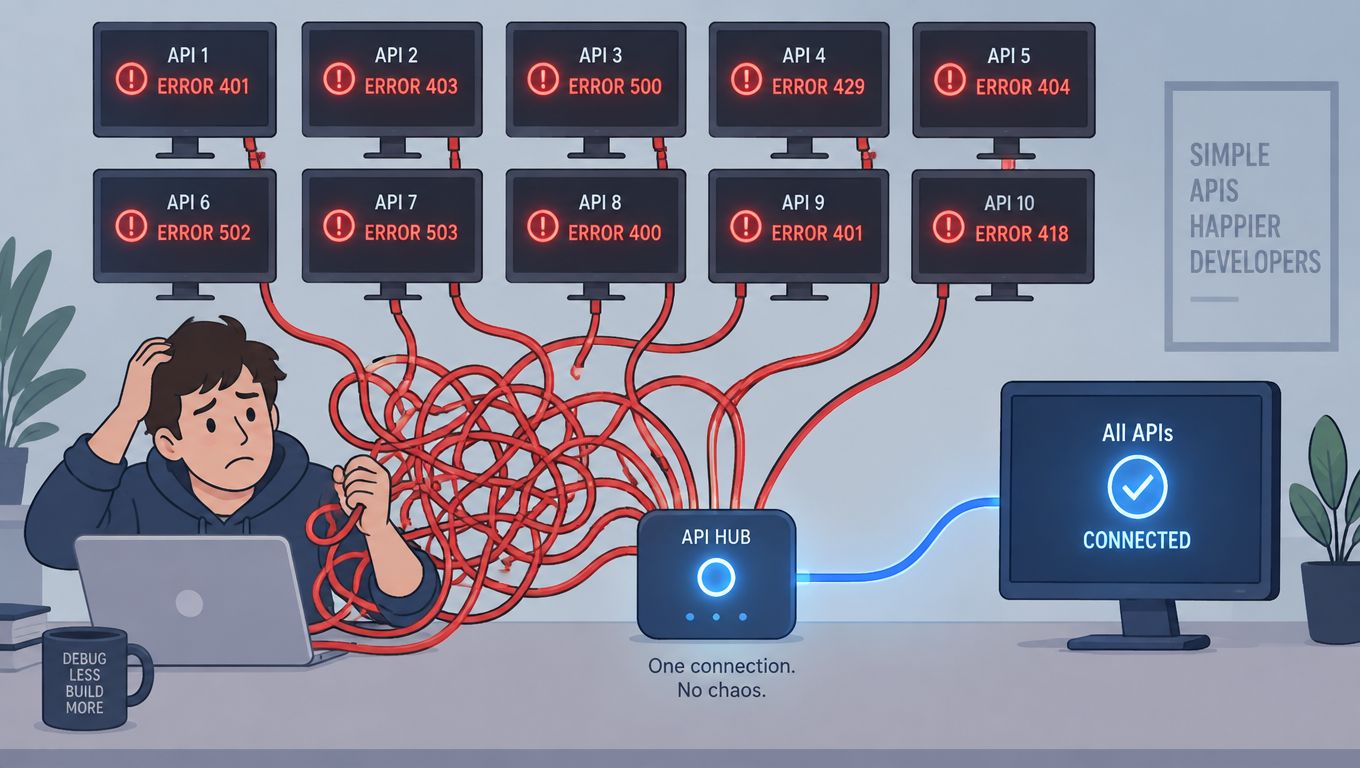
A production assistant can be healthy at 9:00 and failing by 9:15 because one model provider is throttling requests. The application still needs to classify tickets, summarize documents, call tools, and answer customers. If each feature connects directly to a provider, engineers must handle another credential, SDK, request format, timeout behavior, error taxonomy, and billing view every time the architecture expands.
A second provider may add capacity. A smaller model may handle routine work at lower cost. A regional requirement may restrict where requests can run. Product teams may also require fallback behavior without a coordinated rewrite across every service. Direct integrations make each change an application concern.
The gateway becomes the control point
A unified gateway gives applications one contract. The client sends an OpenAI-compatible request, while the routing layer resolves the model, selects an available upstream, translates provider-specific details when required, and returns a consistent response. The application can then apply product rules without embedding every provider's behavior.
That separation matters during an incident. A timeout from one vendor may represent a temporary upstream failure, while a rate limit from another may require a different route. The gateway can classify those outcomes, apply retry rules, and avoid repeating a tool call when doing so could duplicate an action or increase spend.
A gateway also provides one place to enforce policy:
- Credentials: Store and rotate upstream access centrally rather than distributing provider keys across services.
- Traffic policy: Set preferred providers, fallback order, regional restrictions, and workloads that must remain pinned.
- Failure handling: Separate transient upstream faults from invalid application requests.
- Usage control: Apply limits by team, environment, service, or API key.
- Auditability: Record the model, provider, token usage, latency, and cost for each request.
The enterprise AI gateway approach fits organizations where several teams need model access without building separate provider abstractions. It does not replace sound application design. It gives those applications a stable dependency and keeps upstream decisions in an operational layer that engineers can observe and change.
Physical networking follows different constraints, as shown by enterprise router market data from Mordor Intelligence. AI routing focuses on traffic orchestration between competing model endpoints. In practice, teams feel the difference when on-call must correlate several provider dashboards to explain one latency spike. A gateway can expose route, latency, error, and usage data in one control point, making failover behavior measurable rather than buried in scattered application logs.
Core Capabilities of a Modern Router
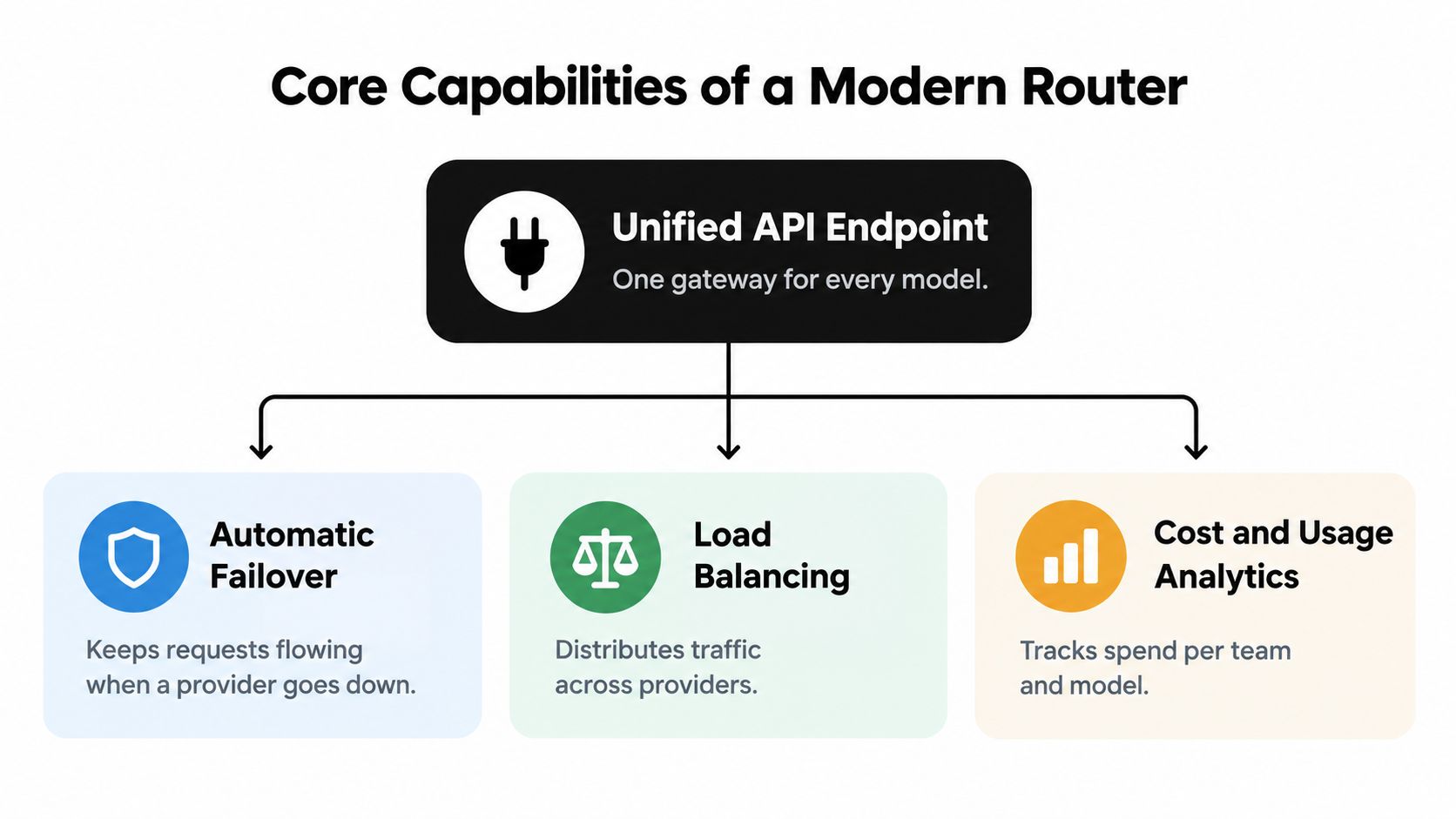
A modern router should do more than forward a request. It should make model access consistent, keep traffic moving through partial failures, and expose enough telemetry for engineers and finance teams to understand what happened.
One endpoint, several upstream paths
The first capability is a stable API contract. Existing OpenAI-compatible clients and streaming implementations can use the gateway without introducing a different request shape for every provider. Model names can identify the desired capability while the router handles provider-prefixed addressing and upstream selection.
That consistency matters most during change. If a model is replaced, a provider is added, or a preferred route changes, the application shouldn't need a coordinated SDK migration across every service.
Model discovery also needs to be explicit. A useful model catalog and API reference should show supported models, capabilities, addressing conventions, and known request limitations. Without that information, teams end up testing production behavior to discover whether a model supports streaming, tool calling, or a particular context requirement.
Failover and traffic distribution
A router can attempt a preferred provider first and move to another eligible provider when the first path returns a transient error or times out. For workloads with several providers serving the same model, pooled rate limits can reduce exposure to a single provider's throttling boundary.
Failover isn't automatically safe for every request. A retry may be appropriate for a read-only completion, but a tool call that triggers an external action needs an idempotency strategy and careful duplicate protection. Routing policy should therefore understand workload types, not just HTTP status codes.
Metering, billing, and observability
Per-request records should include more than a success flag. At minimum, capture:
- Identity: Team, application, environment, API key, and model.
- Upstream path: Selected provider, fallback attempts, and final response status.
- Performance: Total latency, time to first token, streaming completion time, and timeout state.
- Consumption: Input tokens, output tokens, and reasoning tokens when the provider exposes them.
- Financial impact: Exact cost associated with the completed request.
This data lets an engineer separate a slow model from a slow provider path. It also lets finance reconcile spend without manually combining several dashboards. Daily rollups, per-key limits, and consolidated invoices turn routing from an invisible proxy into an accountable platform service.
Operational rule: If the router can't show which provider handled a request, how long the first token took, and what the request cost, it isn't providing enough information to operate an AI dependency.
Direct SDKs Versus a Unified Gateway
Direct integrations have a legitimate advantage: there are fewer moving parts at the start. A small service calling one provider can use the vendor's SDK, follow its documentation, and deploy without introducing another control plane.
The trade-off appears when the service needs choice. Calling OpenAI, Anthropic, and Google directly means maintaining separate authentication paths, request and response handling, streaming behavior, error policies, and usage accounting. A unified gateway shifts that work into one shared layer.
| Feature | Direct Provider APIs | Unified Enterprise Router |
|---|---|---|
| Application interface | Each provider can require a different SDK and request shape | One OpenAI-compatible endpoint for supported models |
| Provider changes | New models may require new clients, adapters, and tests | Model selection changes at the routing boundary |
| Failure handling | Each application implements retries and fallback logic | Central policy can handle eligible transient failures |
| Rate limits | Limits are often isolated by provider account or key | Traffic can be coordinated across eligible upstream paths |
| Billing | Separate balances, invoices, and usage exports | Consolidated balance, metering, and finance reporting |
| Observability | Teams normalize several vendor dashboards | One event format can include provider, latency, tokens, and cost |
| Governance | Controls are duplicated across services | Policies can be applied by key, model, team, or environment |
| Operational risk | A provider outage can become an application outage | The router can redirect eligible requests when policy permits |
Where direct access still fits
Direct SDKs remain sensible when one service uses one model, the workload is low-risk, and the team has no need for provider redundancy. They also make sense when a provider-specific feature isn't available through a compatibility layer and the engineering team is willing to own that coupling.
A gateway becomes more attractive when several products need the same models or when platform engineers must enforce consistent controls. The SDK integration documentation should make the migration path clear, including supported clients, streaming behavior, and error semantics.
The key comparison isn't “proxy versus no proxy.” It's local simplicity versus shared operational complexity. Direct calls keep the first implementation small. A routing layer keeps future provider changes, incident response, and cost reconciliation from spreading through every application.
How Priority Routing and Failover Work
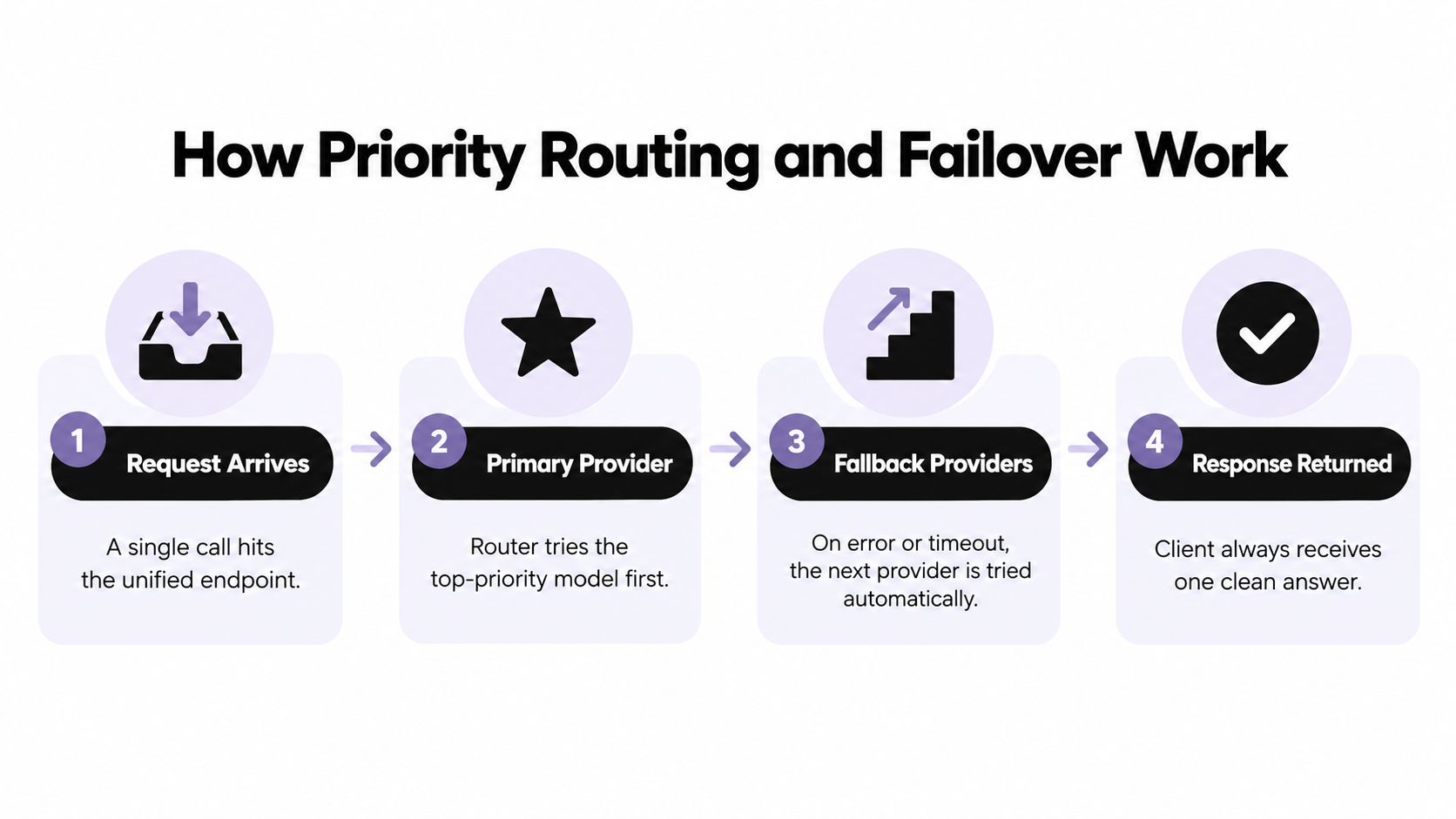
Priority routing starts with an ordered decision, not a random provider choice. The router receives a request, checks its model and policy requirements, then tries the highest-priority eligible path. If that path fails in a way that indicates a temporary upstream problem, the router can continue down the configured fallback chain.
A practical decision sequence
Validate the request first. Check authentication, model availability, required parameters, tool definitions, and policy constraints before spending an upstream attempt. A malformed request should return an actionable client error, not travel through every provider.
Select the primary path. Choose the preferred provider or model according to priority, region, capability, and current health signals. A policy might prefer one provider for quality, another for locality, or a specific route for regulated data.
Classify the failure. Rate-limit responses such as 429, request timeouts such as 408, server-side 5xx responses, and connection timeouts are commonly treated as transient conditions. Invalid requests such as 400 and unavailable resources such as 404 generally need correction rather than repetition.
Retry within controlled limits. If the failure is eligible, move to the next provider or route. Preserve the original request context, avoid unbounded retries, and record every attempt so the final latency and cost remain explainable.
Return one clean result or a useful error. The caller shouldn't have to understand which upstream failed. It should receive a normal response, or an error that identifies whether the issue belongs to the request, policy, or available capacity.
The router must also protect non-idempotent operations. For ordinary text generation, a fallback may be straightforward. For tool calling, the application should separate generation from action execution or use a mechanism that prevents the same external action from running twice.
A second concern is control-plane failover. In conventional multi-homed enterprise networks, BGP can withdraw failed routes and shift traffic to another ISP, but typical convergence may take 30 to 90 seconds without fast-failure enhancements, as described in this BGP redundancy guidance. AI routers need the same respect for failure timing. Track detection time, retry delay, fallback completion, and recovery state instead of declaring success merely because a later request worked.
Solving the Integration and Cost Friction
The integration tax isn't measured only in lines of code. It appears in duplicated tests, provider-specific runbooks, inconsistent timeout defaults, and the quiet maintenance burden of keeping several SDK versions compatible with production services.
A direct integration often starts with a simple branch:
- Send the request to provider A.
- Catch its error format.
- Retry according to its rules.
- Transform the response.
- Add provider B when capacity or quality changes.
- Repeat the entire path for another service.
That branch becomes platform logic without the platform ownership. Each product team makes slightly different choices about retries, logging, and fallback. During an incident, engineers can't assume that two applications treat the same upstream failure in the same way.
Reliability needs a financial view
A request can succeed while still creating a cost-management problem. A model may expose input and output usage differently from another model. Reasoning tokens may be reported separately. A fallback attempt may add latency or consumption, and a single provider dashboard won't show the complete path.
A routing layer should connect the operational event to the financial record. For each completed call, the team should be able to answer:
- Which application made the request?
- Which model and provider handled it?
- Did the router attempt another path?
- How many input, output, and reasoning tokens were used?
- What was the time to first token and total latency?
- Which team or cost center owns the spend?
That record changes budget reviews from estimates into reconciliation. It also helps engineers spot a workload that is technically successful but economically unsuitable.
Middleware earns its place through consistency
The strongest case for a gateway is not that every application must use one. It's that shared model access deserves shared controls when multiple teams depend on it. A central policy can standardize authentication, usage limits, provider selection, and incident visibility while application teams focus on product behavior.
A fallback that isn't observable is just a second source of uncertainty.
The router should expose failed attempts rather than hiding them. If the final response succeeds after a degraded primary route, that event still matters. It may explain a latency increase, indicate a provider health problem, and justify a policy change before customers notice a full outage.
When to Implement Enterprise Model Routing
A full routing layer isn't mandatory for every AI feature. A small internal experiment that calls one provider directly may be easier to understand and cheaper to operate. The question is whether the team is approaching the point where provider coupling creates more risk than the gateway adds.
Use the following decision signals.
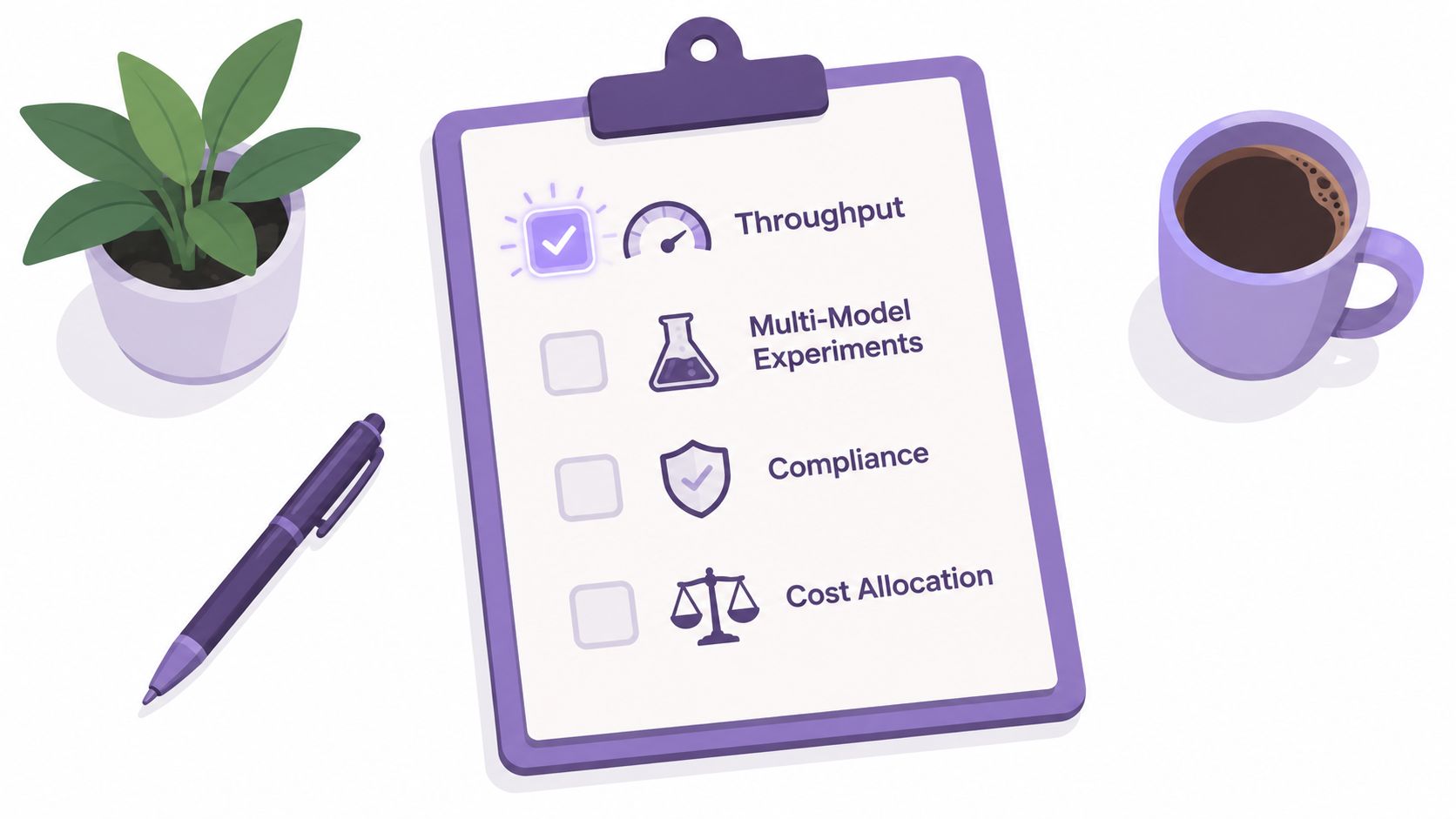
Throughput and shared demand
A router earns attention when several services compete for model capacity or when one provider's rate limit can interrupt a customer-facing workflow. Centralized limits and pooled upstream paths give platform engineers a place to allocate capacity deliberately instead of letting each application retry independently.
Model experimentation
Teams testing multiple frontier and specialist models benefit from changing routing policy without rewriting business code. This is especially useful when the application needs one model for tool use, another for long-context analysis, and a lower-cost option for routine classification. The gateway should preserve a stable request contract while the model policy evolves.
Compliance and governance
If data residency, provider eligibility, or environment isolation matters, routing rules belong in a controlled layer. The router can restrict which providers are eligible for a workload, prevent fallback where policy requires a fixed path, and issue separate credentials for development, staging, and production.
Cost allocation
Shared AI infrastructure becomes difficult to govern when finance receives separate invoices and engineering teams use different labels. Per-key limits, team-level attribution, and request-level cost records provide the detail needed to identify owners and set budgets.
When direct integration is the better choice
Stay with a direct SDK when the workload has one provider, low operational exposure, minimal experimentation, and a team prepared to own the integration. Don't introduce a gateway only because the architecture diagram looks more mature.
Choose routing when the organization needs provider redundancy, consolidated metering, central policy, or a consistent interface across several products. Before implementation, define the metrics that will prove the layer is working:
- Availability: Successful responses, eligible fallback success, and final failure rate.
- Responsiveness: Time to first token, total latency, and streaming interruption rate.
- Routing health: Primary success rate, fallback frequency, retry causes, and provider-specific timeout patterns.
- Economics: Cost per request, token mix, spend by team, and cost associated with fallback attempts.
- Safety: Duplicate tool execution, policy-blocked routes, and requests rejected before upstream transmission.
These measurements keep the decision practical. The router is justified when it gives the organization control and evidence that direct integrations can't provide economically.
Building for Scalability and Resilience
A production AI service may handle interactive chat, background extraction, tool calls, evaluation jobs, and edge-triggered inference at the same time. Each workload has different latency limits, retry risks, and model requirements. A single global routing rule will eventually create poor trade-offs.
Treat model access as infrastructure owned through explicit contracts, not as provider logic scattered across applications. Define timeout behavior, fallback eligibility, request identity, usage events, and model capabilities. Test degraded conditions deliberately, including rate limiting, higher latency, provider outages, malformed responses, and partial recovery.
Measure the failure domain
A reliable router limits how far an upstream failure travels. Monitor the boundary between the application, router, provider, and external tool system. Dashboards should separate request-validation errors, routing-policy decisions, provider capacity problems, and downstream action failures.
The broader enterprise router market reflects continued investment in shared connectivity, as described in Mordor Intelligence's enterprise router forecast. For platform teams, the operational implication is to design policy for heterogeneous traffic, including chat, extraction, and tool calls, instead of optimizing for one request shape.
IDC reported that the enterprise router market contributed $1.2 billion in 2Q26 and grew 20.1% year over year, connecting that demand with SD-WAN modernization and AI-ready branch and edge environments in its market analysis. The relevant lesson is operational rather than hardware-focused: model routing must handle changing traffic, competing providers, and observable recovery.
A router for enterprise AI should let product teams change providers without destabilizing applications, let finance trace spend without reconstructing requests manually, and let on-call engineers identify why latency increased. Track provider success rates, fallback frequency, time to first token, total latency, streaming interruptions, retry causes, and spend by team. Those measures show whether abstraction is improving reliability or only adding another failure boundary.
Openbase provides a unified gateway for frontier language models through an OpenAI-compatible API, with pooled access, automatic failover, per-request usage logging, latency and token visibility, and consolidated billing. Use Openbase to evaluate a routing layer for AI workloads and give the team one controlled path across multiple model providers.