

Most advice on semantic search vs vector search starts with the wrong question. These aren't rival products sitting on a shelf. One is a user-facing outcome, the other is a retrieval mechanism.
That distinction matters because bad architecture decisions usually come from category mistakes. Teams adopt "semantic search" when what they really bought was approximate nearest-neighbor lookup over embeddings. Then they discover, a few weeks later, that product codes, acronyms, legal terms, and error strings still need exact matching. The disappointment isn't because vector search is weak. It's because dense retrieval was asked to solve jobs it was never good at.
Production search systems fail at the edges, not on demo queries. A query like "how do we handle retry storms" rewards semantic retrieval. A query like "ERR_AUTH_Z-17" doesn't. If you're evaluating semantic search vs vector search as a binary choice, you're already framing the problem too loosely.
Table of Contents
- Why This Comparison Is Mostly Misleading
- How Each System Actually Works
- Trade-offs That Matter in Production
- Benchmarking Beyond QPS Numbers
- Real-World Retrieval Scenarios
- Why Hybrid Search Keeps Winning
- Choosing the Right Architecture for Your Stack
- When to Switch and What Breaks
Why This Comparison Is Mostly Misleading
The phrase semantic search vs vector search sounds sensible, but it's structurally wrong.
Semantic search is the product goal. You want a system that understands intent, meaning, paraphrase, and context well enough to return useful results even when the query wording doesn't match the document wording. Vector search is one way to implement part of that goal. It gives you nearest-neighbor retrieval over dense embeddings.
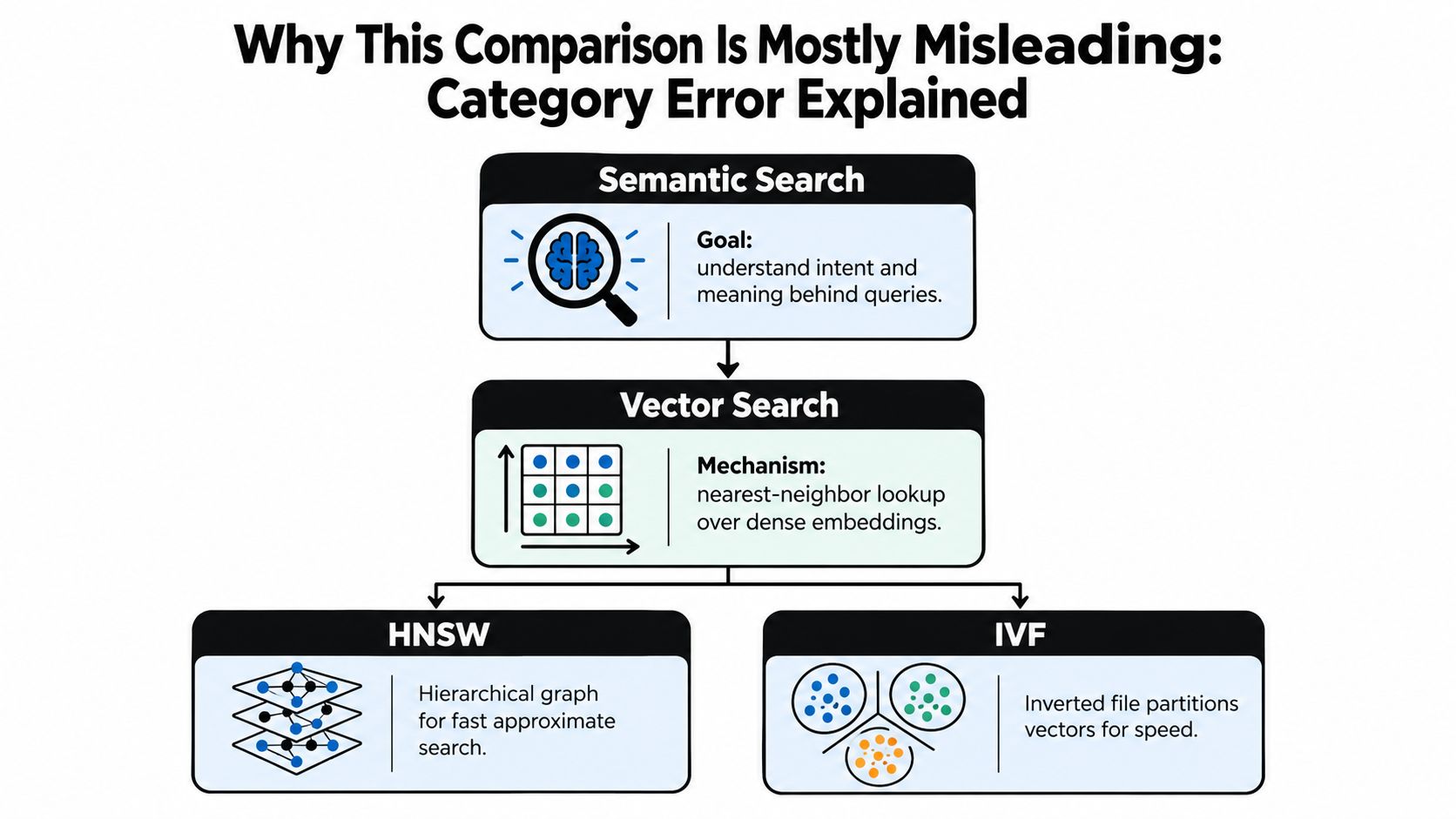
The category error
Comparing them directly is like comparing reporting with SQL. One describes the user outcome. The other describes technical plumbing.
Recent writing in the field keeps circling this same confusion. A vendor-neutral survey notes that people still mix up the terms, even though semantic search is often described as the broader intent-focused goal and vector search as the retrieval mechanism underneath it, with hybrid designs filling practical gaps (arXiv overview of semantic and vector retrieval terminology).
That framing also fits the historical path the industry took. Vector search became operationally significant in 2017 when Meta released Faiss and reported billion-scale nearest-neighbor search systems that were about 8.5x faster than the previously reported state of the art, including the first k-nearest-neighbor graph on 1 billion high-dimensional vectors (Faiss project documentation). A year later, transformer-based language models shifted the semantic side of retrieval. Google's BERT arrived in October 2018, was described as breaking records on 11 NLP benchmarks, and was integrated into Google Search where it affected about 10 percent of queries (history of large language models and BERT milestone).
The better question
The useful question isn't "which is better?" It's when does each break?
Pure dense retrieval usually breaks first on:
- Identifiers like ticket numbers, SKUs, commit hashes, and version strings
- Acronyms and local jargon that embeddings flatten into broader concepts
- Low-context queries where the user gives two words and expects exact intent
- Recall-sensitive corpora where missing one relevant document is unacceptable
Practical rule: If users regularly search with names, codes, or titles they already know, lexical retrieval isn't legacy infrastructure. It's the precision layer.
A lot of search stack confusion disappears once you accept this: vector search is not the opposite of semantic search. It's one of the main mechanisms semantic systems use, and it's not sufficient on its own for many real workloads.
How Each System Actually Works
Search discussions get fuzzy fast, so it's worth grounding this in pipelines rather than buzzwords.
Lexical retrieval path
A traditional lexical system starts with an inverted index. Documents are tokenized, normalized, and stored so the engine can jump from a term to the documents containing it. Ranking models like BM25 reward useful term overlap and term placement. Title hits, repeated terms, and shorter focused documents often rise naturally.
That design still wins on exact strings. If someone searches for a library name, invoice code, incident ticket, or function signature, token overlap is the feature, not a limitation.
| Component | Lexical (BM25) | Vector (Dense) |
|---|---|---|
| Document representation | Terms and postings lists | Embeddings as numeric vectors |
| Query processing | Tokenize and match terms | Encode query into embedding |
| Retrieval primitive | Inverted index lookup | Nearest-neighbor search |
| Strength | Exact terms and sparse signals | Paraphrase and intent matching |
| Common failure | Misses synonyms and rewording | Misses identifiers and exact phrases |
Dense retrieval path
Vector retrieval adds a different stack. Text gets converted into embeddings by an encoder model, then stored in an approximate nearest-neighbor index. At query time, the system embeds the query and finds nearby vectors by cosine similarity or dot product.
Under the hood, the important engineering choices are rarely glamorous:
- Embedding model choice: General-purpose encoders behave differently from domain-tuned ones.
- ANN index type: HNSW, IVF, and related structures trade RAM, build time, and recall differently.
- Distance metric: Dot product, cosine, and L2 only look interchangeable until the model and normalization assumptions drift.
- Metadata filtering: Good retrieval dies quickly if the store can't filter by tenant, type, language, or permission boundaries.
If you're comparing encoder options or request shapes across providers, a unified reference for model documentation and API compatibility is useful because retrieval stacks often end up testing multiple embedding backends before the rest of the pipeline stabilizes.
Most retrieval bugs start before ranking
Chunking causes more practical damage than most model debates. Teams often blame embeddings for mistakes caused by index preparation.
Common failure points include:
- Chunks too small. The system retrieves isolated fragments with no local meaning.
- Chunks too large. Relevant details get diluted inside generic surrounding text.
- Bad overlap windows. Definitions and examples split across chunk boundaries never rank well.
- Weak metadata. Even strong retrieval gets ruined when you can't constrain by source, document type, or freshness.
Search quality often improves more from fixing chunk boundaries and metadata than from swapping one embedding model for another.
The lexical pipeline stops at exact symbolic matching. The dense pipeline starts where lexical search gets brittle on paraphrase and concept matching. In production, you usually need both paths available even if one dominates your ranking.
Trade-offs That Matter in Production
The comparison isn't semantic search vs vector search as abstract ideas. It's lexical retrieval vs dense retrieval under latency, recall, cost, and debugging pressure.
Early comparison
As teams go live, they discover the same pattern after launch.
| Criterion | Lexical / BM25 | Vector / Dense |
|---|---|---|
| Precision on identifiers | Strong | Weak unless the identifier has meaningful context |
| Natural-language queries | Limited | Stronger |
| Explainability | Easy to inspect term matches and field boosts | Harder to explain why two vectors were "close" |
| Freshness management | Usually simple incremental updates | Often tied to embedding jobs and index refresh windows |
| Operational footprint | Familiar search infrastructure | Extra model, index, and re-embedding lifecycle |
Lexical systems are predictable. If a result is wrong, you can usually inspect the query tokens, the field boosts, and the postings list behavior and find the cause. Dense retrieval is less transparent. You can inspect neighbors and distances, but that rarely explains relevance in terms a support engineer or product manager can act on.
Where dense retrieval earns its keep
Dense retrieval earns its complexity when users don't know the document vocabulary. Support search, internal docs, and knowledge bases are full of this pattern. Users ask broad questions, phrase them differently from the source material, and expect the engine to infer the connection.
That's where contextual embeddings matter. Modern semantic retrieval depends on the combination of transformer-derived representations and vector indexing infrastructure. Product documentation and engineering guides have increasingly converged on this embedding-plus-retrieval framing, with more emphasis on hybrid search and operational constraints than on the old "meaning vs keywords" story (OpenSearch semantic search documentation).
The hidden costs
Dense retrieval has operational costs people underestimate:
- Embedding lifecycle: Change the encoder, and you may need to re-embed the corpus.
- Index tuning drift: ANN settings that looked safe in staging can change recall behavior in production.
- Memory pressure: Vector indexes and graph structures can dominate hot storage.
- Reranking overhead: If first-pass retrieval isn't enough, a second-stage model adds another latency tier.
For teams trying to estimate model-side spend and provider behavior around retrieval and reranking experiments, billing reference material helps because the cost usually isn't one API call. It's query embedding, sometimes document embedding, and often reranking on top.
Dense retrieval is not "better BM25." It's a different failure profile with a different operating model.
What works well in production is usually boring: lexical retrieval for exactness, vector retrieval for semantic breadth, and enough observability to know which side failed when relevance drops.
Benchmarking Beyond QPS Numbers
Vector search benchmarks are easy to misuse. Fast-looking numbers tell you very little unless you know what accuracy was sacrificed to get them.
What to measure instead
A rigorous benchmark should hold recall constant, then compare throughput and latency. Raw QPS alone is misleading because approximate nearest-neighbor methods can trade accuracy for speed. Sound benchmark practice recommends reporting p50, p95, and p99 latency together with recall, and only comparing systems at the same recall target on the same workload and data distribution (benchmarking guidance for vector search).
That principle matters more than any single chart. ANN tuning is full of hidden dials. Change graph connectivity, probe depth, candidate counts, or filtering patterns, and the curve moves.
| Method | p50 Latency (ms) | Recall@10 | Index Build Time | Cost per 1M Queries |
|---|---|---|---|---|
| Lexical only | Workload-dependent | Varies by corpus and query mix | Typically straightforward | Depends on infrastructure |
| Dense only | Workload-dependent | Must be measured at fixed target | Depends on ANN structure and embedding pipeline | Depends on compute, RAM, and model calls |
| Hybrid plus rerank | Higher than either single path | Often highest in practice | More moving parts | Usually highest due to multi-stage retrieval |
Throughput without recall is marketing
Large benchmark results can be impressive and still not answer your architecture question. One 1B-vector deployment reported 252,000 QPS at 2 ms p99 latency, while another k=10 experiment reached 12,840 QPS at 5.5 ms p99 with 92.0% recall. The same benchmark also showed a higher-quality setting reaching 99.2% recall and 99.1% nDCG, which is exactly the trade-off retrieval engineers deal with in practice (large-scale vector benchmark results from ScyllaDB).
Those numbers are useful, but only if you read them correctly. They don't mean your application will be fast and relevant. They mean there is a tunable latency-quality frontier.
The metric that wakes people up
Average latency rarely causes incidents. Tail latency does.
If your search stack uses ANN retrieval followed by reranking, p99 expands fast under load, especially when filters, cold caches, or hot shards show up together. That's why benchmark reviews should answer three questions:
- What recall target did you hold constant?
- What was p99 at that quality level?
- Was reranking included or excluded?
A retrieval benchmark without recall is a load test, not a relevance test.
Real-World Retrieval Scenarios
The cleanest way to understand semantic search vs vector search is to look at where each one falls over in real workloads.
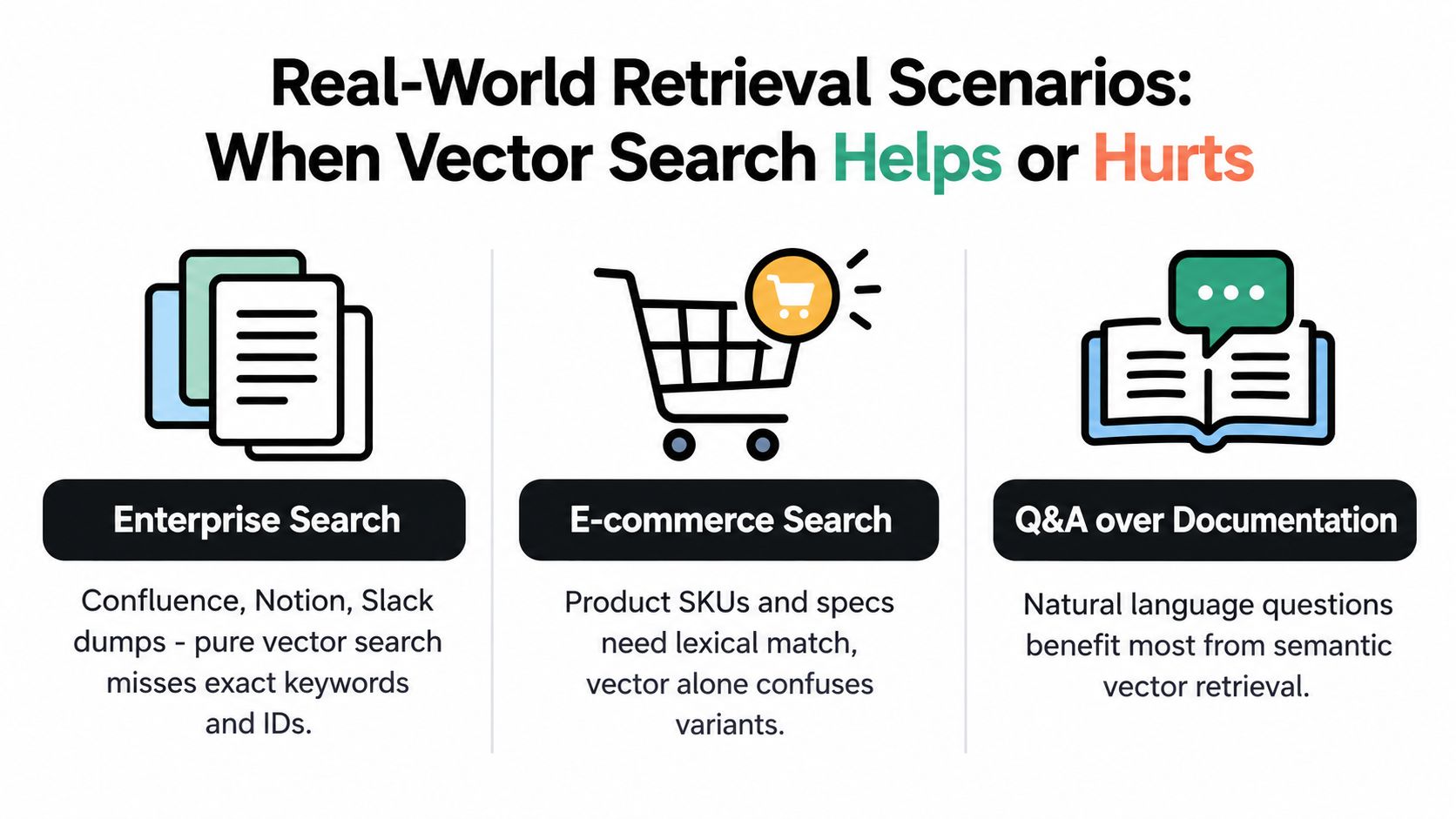
Enterprise search across messy internal tools
Enterprise search sounds like a semantic problem until you inspect the queries. People search for project names, acronyms, customer names, ticket IDs, and half-remembered page titles. Confluence pages, Notion docs, Slack exports, and incident notes all introduce different formatting and duplication patterns.
Pure vector retrieval tends to underweight exact organizational language. An acronym can map to the wrong concept. A team codename can look semantically close to a totally unrelated page. A reranker helps only if the right candidate makes it into the pool. If first-pass dense retrieval misses the exact page with the ticket ID, the reranker can't rescue it.
A practical setup here usually treats lexical retrieval as the anchor and semantic retrieval as recall expansion.
RAG over engineering documentation
Internal engineering docs are where dense retrieval looks great in demos and gets punished in production. Developers ask natural-language questions like "how do we handle retry storms," but they also search for exception names, config flags, endpoint names, and code fragments.
The failure modes are specific:
- Code import mistakes: Dense retrieval returns a conceptually similar example from the wrong library.
- Signature misses: Exact function names don't score highly unless token-preserving signals exist somewhere in the stack.
- Version confusion: Similar upgrade guides blur together semantically.
When retrieval feeds generation, exact-match misses become hallucinations with citations.
The answer isn't "use vectors carefully." It's to make sure exact lexical evidence can enter the candidate set before generation starts.
Product discovery and catalog search
E-commerce and marketplace search sits in the middle. Queries like "sneakers for flat feet" benefit from semantic intent matching. Queries involving SKU variants, dimensions, materials, or compatibility constraints don't.
A dense-only system may understand the broad concept and still surface the wrong product family. A lexical-only system may honor the filters and miss the intent. Hybrid retrieval earns its keep here because users alternate between exploratory language and exact narrowing.
Short query classes tell you a lot:
- Exploratory intent favors dense retrieval.
- Known-item lookup favors lexical precision.
- Attribute-heavy refinement needs retrieval plus structured filtering.
Rerankers improve ordering inside a candidate set, especially for nuanced natural-language requests. They don't fix missing candidates, weak filters, or broken metadata. That's why candidate generation remains the hard part.
Why Hybrid Search Keeps Winning
Hybrid search keeps showing up because real user traffic contains both symbolic and semantic intent. A single retrieval mode rarely survives the long tail.
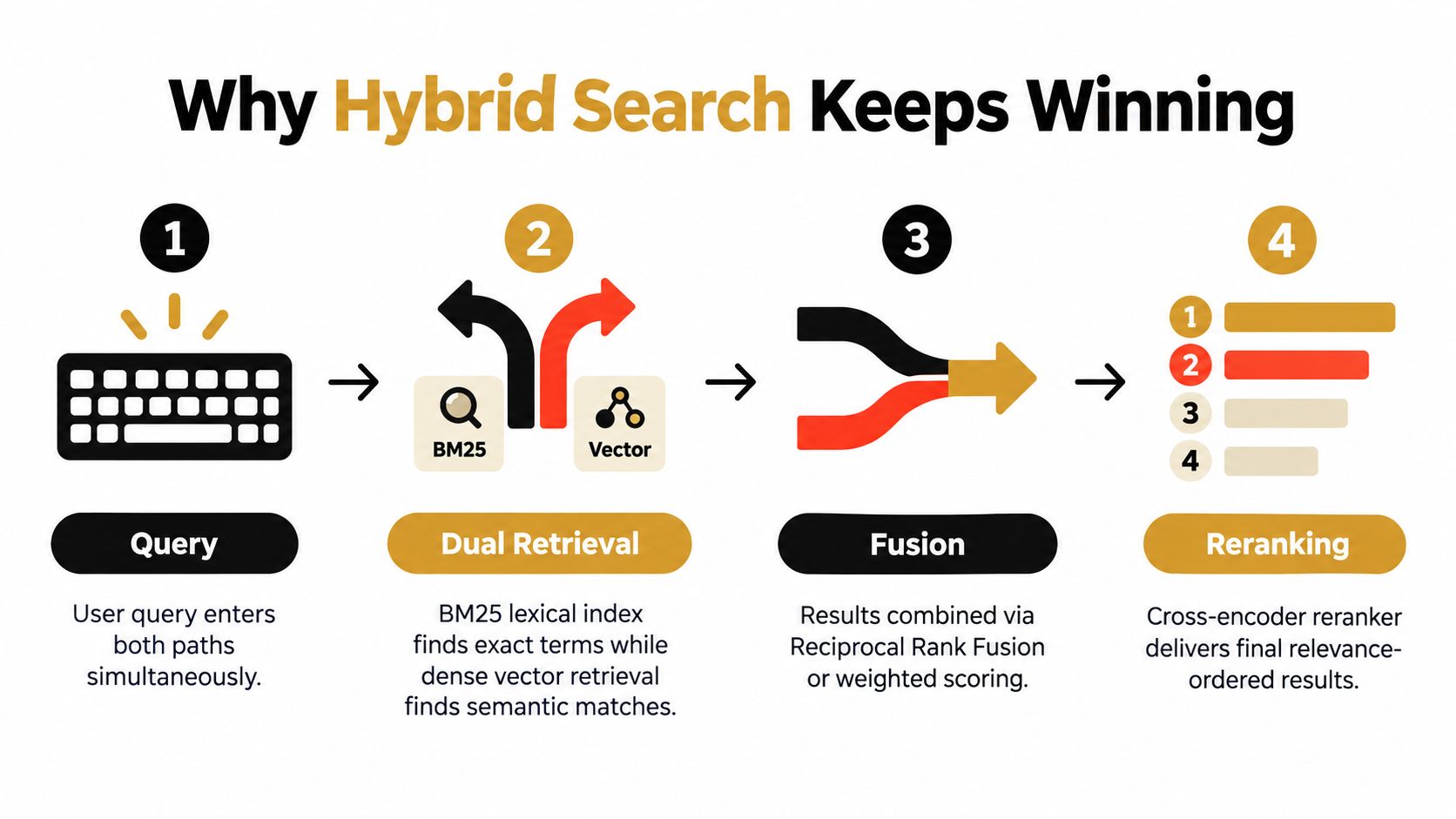
Why the combination is robust
The simplest hybrid architecture runs BM25 and dense retrieval in parallel, then fuses the rankings. Reciprocal Rank Fusion is popular because it doesn't require brittle score calibration between sparse and dense systems. Linear score blending can work, but normalized scores that look stable in one corpus often fall apart in another.
That shift toward hybrid retrieval isn't just fashion. Search platform guidance has increasingly moved away from a pure semantic-vs-vector framing and toward combined retrieval plus operational controls, especially where exact-match behavior, filtering, and explainability still matter.
What reranking adds
Hybrid retrieval improves candidate quality. Reranking improves final ordering.
A cross-encoder or similar reranker can look at the query and candidate text together, which usually gives better relevance judgments than either sparse or dense first-pass retrieval alone. The trade-off is obvious. You add another stage, another model dependency, and another chunk of latency.
This short walkthrough shows the layered shape clearly:
What gets harder
Hybrid search isn't free. You now operate:
- Two retrieval indexes
- Fusion logic
- Potentially a reranking tier
- More debugging paths when relevance drops
One useful pattern for teams already running LLM-driven retrieval or answer generation is to standardize the model access layer separately from the retrieval layer. Tools such as Openbase provide a unified API for multiple model providers with usage logging and failover, which can simplify the model side of embedding and reranking experiments while you keep the retrieval stack independent.
The reason hybrid wins isn't elegance. It's coverage. It handles more query failure modes than either retrieval method alone.
Choosing the Right Architecture for Your Stack
Architecture choice should follow query behavior and team capability, not trend pressure.
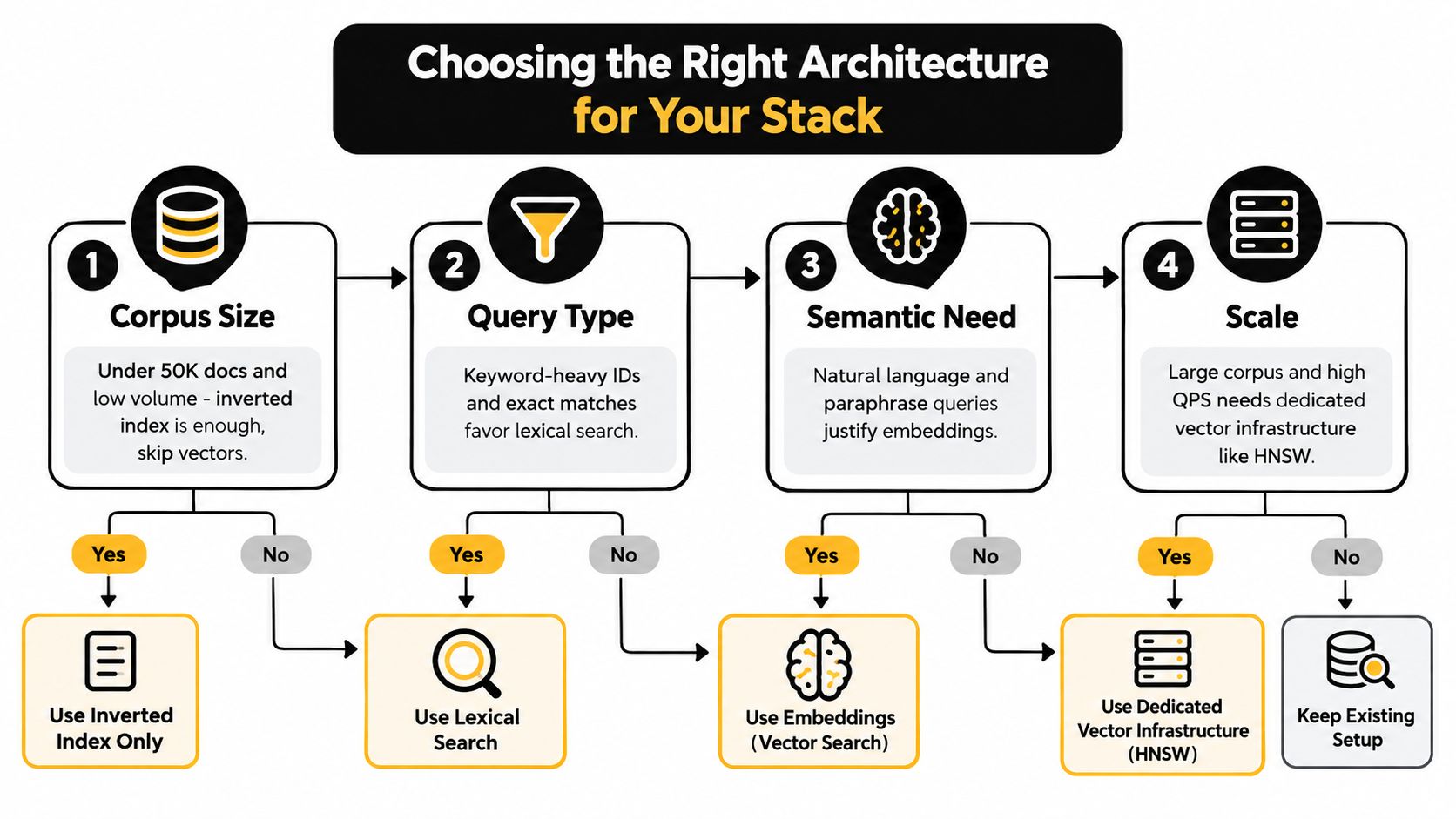
Start with query shape
If most user queries contain names, IDs, SKUs, legal phrases, or exact technical terms, start with lexical search. That's true even if you plan to add semantic retrieval later. Exact-match behavior is hard to bolt back in after a dense-first design has already shaped indexing and ranking assumptions.
If users ask open-ended questions in natural language and frequently rephrase failed queries, dense retrieval deserves a place early.
Match the stack to team maturity
A lot of teams can build a decent inverted-index search feature quickly. Fewer teams can operate embedding pipelines, monitor index freshness, understand ANN recall regressions, and explain semantic misses to stakeholders.
A workable decision tree looks like this:
- Small corpus, low traffic, exact lookups. Start lexical. Ship fast.
- Knowledge base with paraphrased questions. Add dense retrieval.
- Mixed corpus with both exact and natural-language search. Go hybrid early.
- High-stakes recall requirements. Assume you'll need hybrid retrieval plus reranking.
If you're standardizing implementation across services or environments, provider-compatible SDK examples and integration guides are useful because search systems often end up split across indexing jobs, query APIs, and generation services.
A practical checklist
Before choosing, answer these plainly:
- What do users type when they already know the answer format?
- Can the team detect when semantic recall regresses?
- How fresh does the index need to be after document updates?
- Is the latency budget compatible with multi-stage retrieval?
- Who debugs relevance incidents at 2 a.m.?
The right answer usually isn't "pick semantic" or "pick vector." It's "pick the failure modes you're equipped to operate."
When to Switch and What Breaks
Switch from lexical-only when users repeatedly reformulate queries because term overlap isn't enough. That's the usual sign that synonym handling, paraphrase, and concept matching matter more than exact phrase scoring can deliver.
Switch from vector-only when exact-match precision starts collapsing on identifier-heavy queries. Product codes, incident names, policy IDs, and internal acronyms are the usual triggers. That's where hybrid retrieval stops being an optimization and becomes table stakes.
The breakpoints are operational as much as architectural:
- Embedding changes can force corpus re-embedding and index rebuilds.
- ANN parameter changes can alter recall without obvious symptoms until users complain.
- Index staleness shows up when document ingest outpaces search refresh.
- Shard imbalance and filter skew push tail latency up when traffic concentrates on a subset of data.
Instrument the stack around those transitions. Sample recall at fixed query sets. Track query reformulations. Watch index lag. Measure p99, not just the median. If you're asking when to change architectures, the answer should come from those signals, not from a trend cycle.
If you're building retrieval systems that also depend on multiple embedding, reranking, or generation models, Openbase gives your team one OpenAI-compatible API, consolidated usage logging, and provider failover without changing your application shape. That doesn't solve retrieval design for you, but it does remove a lot of model-integration sprawl while you test lexical, dense, and hybrid pipelines. Visit Openbase if you want a cleaner control plane around the model side of search and RAG.
Authored using the Outrank app