
You've probably reached the same uncomfortable point as many platform teams. One service calls OpenAI directly, another uses Anthropic's SDK, a prototype depends on Google, and a production workflow has its own retry logic, credentials, dashboards, and billing trail. Then a model changes, a provider throttles traffic, or finance asks why the invoice no longer matches application usage.
That's the decision behind a unified LLM API. You can keep integrating each provider directly, or place a gateway between your applications and model vendors. The right answer depends less on SDK convenience than on operational control: who owns routing policy, retry budgets, provider credentials, cost allocation, and output-quality monitoring?
This guide compares both approaches from a platform engineering perspective. It focuses on integration effort, billing, failover, latency, and observability, while separating what a gateway can solve from what it can't. The aim isn't to declare one universal winner. It's to help you decide when direct APIs remain sensible and when the gateway has become infrastructure your team should manage deliberately.
Table of Contents
- Introduction Why Teams Reconsider Direct Provider Integrations
- What a Unified LLM API Actually Does
- Unified LLM API vs Direct Provider APIs Head to Head
- Reliability and Performance Under Real World Degradation
- Cost Control and Observability Beyond Basic Logs
- Use Cases Where Each Approach Fits Best
- Recommendation How to Choose and Migrate with Confidence
Introduction Why Teams Reconsider Direct Provider Integrations
Direct provider APIs feel simple at the beginning. A developer creates an account, stores an API key, installs an SDK, sends a request, and receives a response. The first integration often fits neatly inside one service and one deployment.
Complexity appears when the application grows around that call. A team might add Anthropic for a different reasoning profile, Google for another workload, or a self-hosted endpoint for a privacy-sensitive path. Each integration brings its own authentication method, model naming convention, rate-limit behavior, error schema, streaming details, and usage dashboard. The application code starts carrying decisions that belong in a platform layer.
Provider concentration has also become a moving target. An independent mid-year LLM market report from Menlo Ventures estimated enterprise LLM spend increased from $3.5 billion in November 2024 to $8.4 billion by mid-2025, more than doubling in six months. The same report put Anthropic at 32% enterprise share, OpenAI at 25%, down from 50% at the end of 2023, and Google at 20%. Those figures don't prove that every team needs a gateway, but they do explain why hard-coding one vendor feels increasingly risky.
Practical rule: If changing providers requires edits across application code, deployment configuration, dashboards, and finance workflows, you already have a platform problem, not merely an SDK problem.
A unified API creates a stable boundary. Applications send one request shape, while the gateway handles provider selection, credentials, retries, usage accounting, and policy enforcement. Direct APIs preserve maximum vendor-specific control, but your team owns the integration surface and the operational differences.
The comparison matters most for software engineering teams, platform engineers, product groups shipping AI features, data teams controlling spend, and enterprises that need vendor redundancy. A small prototype may benefit from direct access. A multi-service production environment may value centralized control more than the extra abstraction layer.
What a Unified LLM API Actually Does
A unified LLM API places a gateway in front of several model providers and exposes one client-facing interface. In the common pattern, that interface mirrors the OpenAI Chat Completions API, so existing OpenAI-compatible SDKs can continue sending messages, generation parameters, streaming requests, and tool calls through a different base URL.
The application usually changes three things:
- Base URL: Point the client at the gateway rather than a provider endpoint.
- Credential: Use a gateway key instead of embedding separate vendor keys in each service.
- Model identifier: Select a provider-prefixed model slug when the gateway exposes multiple vendors.
The request body can otherwise remain consistent. A model name might identify a model from OpenAI, Anthropic, Google, xAI, or DeepSeek through a common naming convention. The gateway maps that logical request to the selected upstream API, translates provider-specific details where necessary, and returns a normalized response.
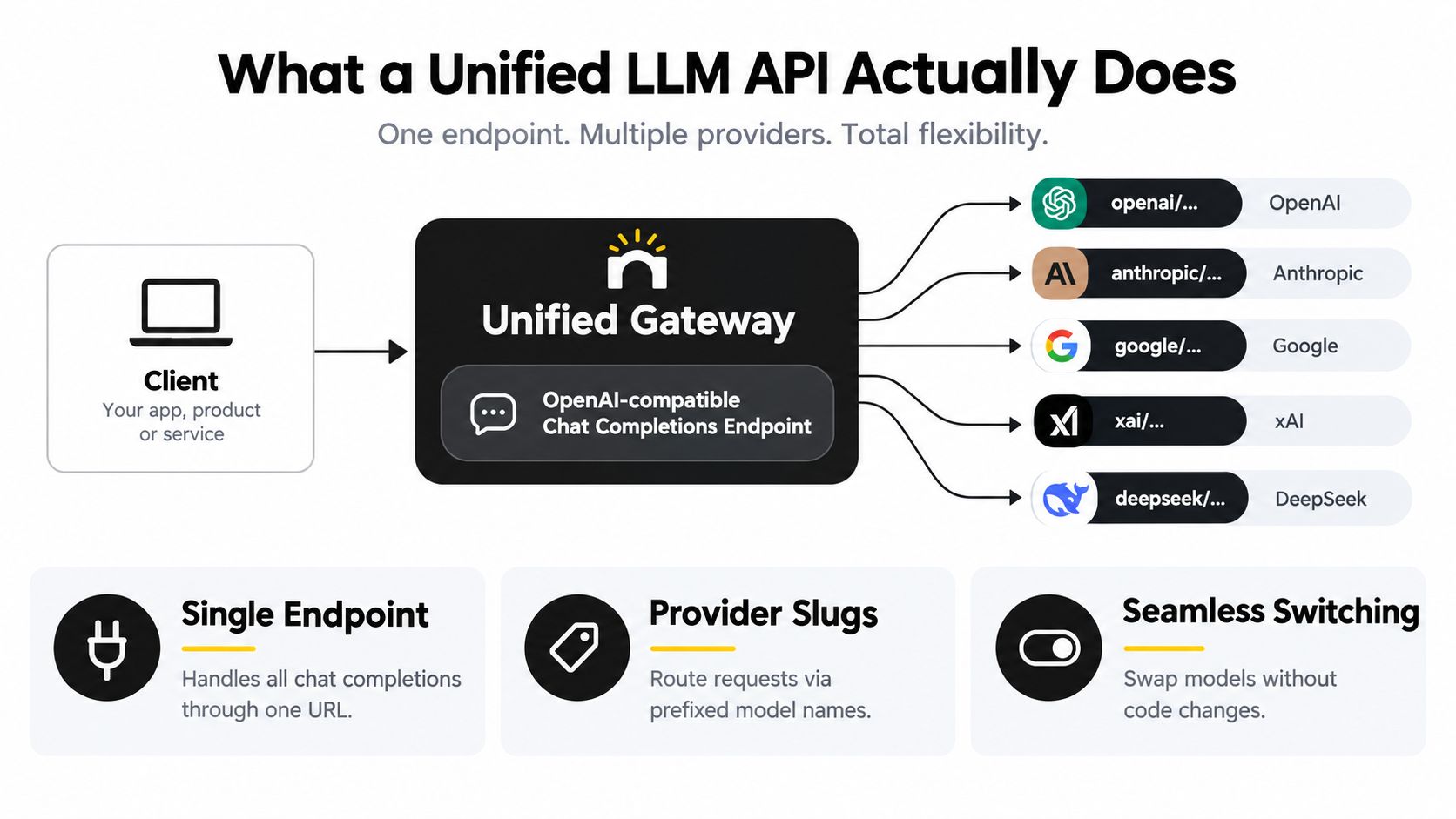
You can review available model mappings in the Openbase model documentation. The important architectural point is that the client talks to one endpoint while the gateway decides which upstream receives the request.
The request path
A typical request follows this sequence:
- Authentication: The gateway validates the application key and applies any per-key policy.
- Model resolution: The gateway interprets the requested model slug and identifies an eligible provider.
- Policy evaluation: Routing rules can consider provider priority, health, rate limits, workload type, or other configured constraints.
- Translation and dispatch: The gateway sends the request using the upstream provider's authentication and schema.
- Response handling: It streams or returns the normalized response, records usage, and applies retry or fallback behavior when the failure is eligible.
This pattern also separates application authentication from provider authentication. Services don't need access to every vendor credential, and platform teams can rotate upstream keys without changing every application deployment.
Compatibility has boundaries
OpenAI compatibility reduces migration work, but it doesn't erase provider differences. Tool calling, structured output, multimodal inputs, safety controls, context limits, reasoning settings, and error details can vary. A gateway can normalize common behavior, but it can't guarantee semantic equivalence between models.
That distinction matters during model swaps. Changing a model identifier may require no code change, yet it can still change response style, refusal behavior, latency, token consumption, or tool-call reliability. Treat compatibility as an integration contract, not a promise that models are interchangeable in quality.
Streaming and function calling can use the same request shape when the gateway supports them. Teams should still test partial responses, cancellation, malformed tool arguments, and provider-specific edge cases before moving a critical workflow behind the abstraction.
Unified LLM API vs Direct Provider APIs Head to Head
The cleanest comparison is operational. Direct APIs give each service a direct relationship with a vendor. A unified gateway gives the platform team a control point that can standardize relationships across vendors.
| Evaluation Criteria | Unified LLM API | Direct Provider APIs |
|---|---|---|
| Integration | One compatible request surface and shared client configuration | Separate SDKs, endpoints, schemas, and provider behavior |
| Credentials | Gateway keys for applications, provider credentials centralized | Provider keys distributed across services or environments |
| Billing | Consolidated balance, usage records, and invoice workflow | Separate provider accounts, dashboards, and reconciliation |
| Routing | Central policy can select or reprioritize providers | Routing logic must live in applications or a separate internal layer |
| Failover | Gateway can retry eligible failures and move to another provider | Each application must implement and test fallback behavior |
| Rate limits | Capacity may be pooled across eligible providers | Limits remain tied to each provider account and model |
| Observability | Central logs can include provider, model, tokens, latency, and cost | Signals are fragmented across applications and vendor consoles |
| Vendor-specific features | Common features are easier to consume, advanced features may need abstraction work | Full access to each provider's native capabilities |
| Operational ownership | Gateway team owns policy, availability, and compatibility | Application teams own provider behavior and resilience |
| Lock-in | Less dependence on one provider's endpoint and SDK | Stronger coupling to each provider's native interface |
The integration advantage is real, especially when several services need the same models. A single base URL and key reduce duplicated setup. They also make it easier to introduce a model without asking every application team to learn another SDK.
Direct integration wins when the application depends heavily on a provider-specific capability. If a workflow requires a native feature that the gateway doesn't expose cleanly, bypassing the abstraction may be simpler and safer. Direct access also removes one intermediary from the request path, although a gateway doesn't automatically create visible latency overhead.
Billing exposes a different trade-off. Separate provider accounts preserve direct financial relationships and may align with procurement or contractual requirements. A gateway centralizes metering, but finance and platform teams must trust its accounting, reconcile it against upstream records, and understand how failed attempts are treated.
For teams evaluating quotas and application isolation, the rate-limit documentation should be part of the review. Rate limits aren't only a throughput concern. They shape queueing, retry behavior, tenant fairness, and the blast radius of a noisy workload.
The gateway is valuable when it centralizes decisions your applications should not have to repeat.
Observability is where many comparisons become too shallow. Direct provider consoles can show vendor-side usage and errors, while application telemetry shows business context. A gateway can unify request-level model, provider, token, latency, and cost data, but it still won't know whether an answer was accurate or whether a decision based on that answer was safe.
That final point should drive the architecture. Choose direct APIs when native capability, contractual control, or minimal dependency matters most. Choose a unified API when provider diversity, centralized policy, and operational consistency outweigh the cost of another infrastructure component.
Reliability and Performance Under Real World Degradation
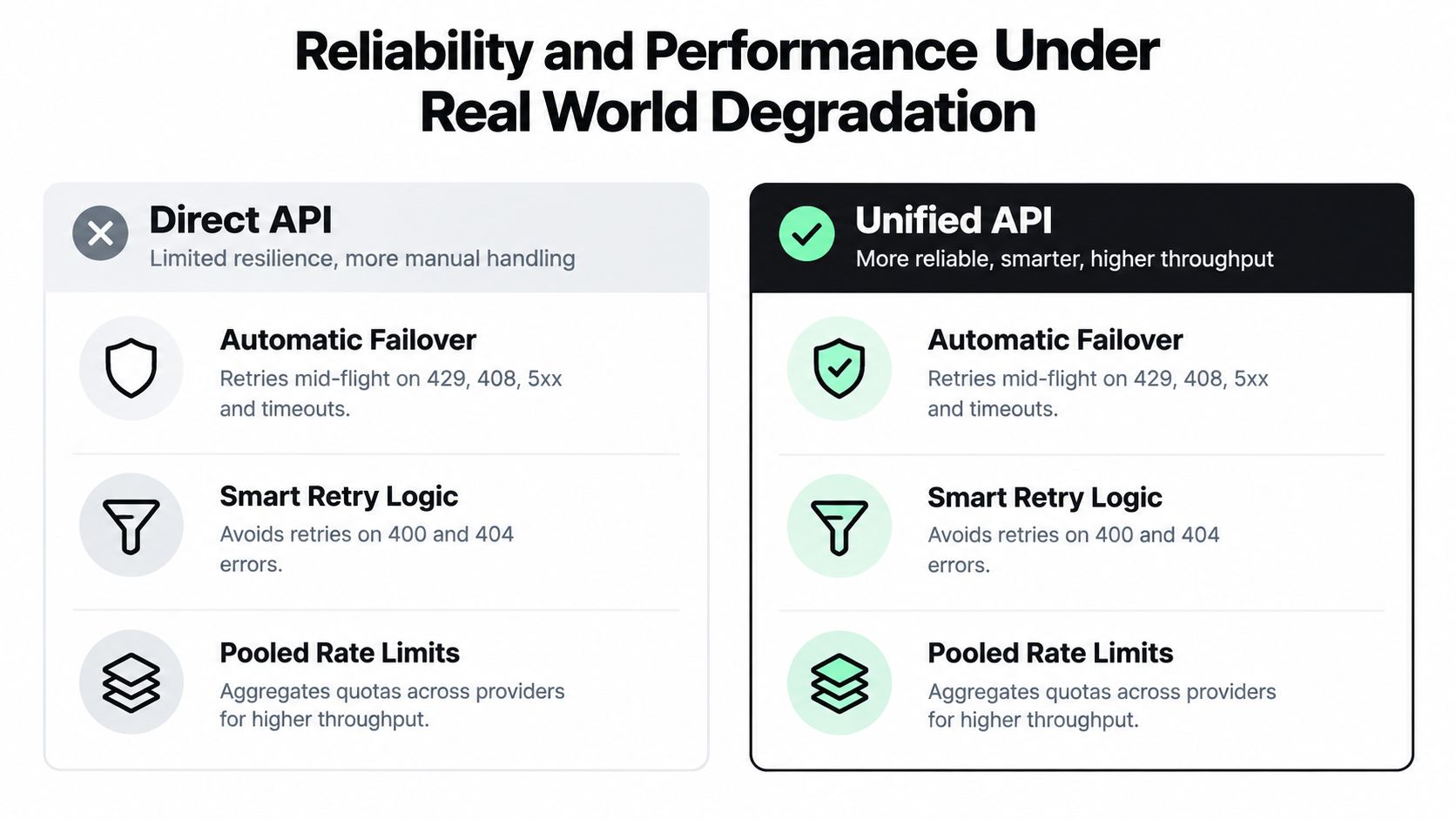
A fallback policy is only useful if it distinguishes recoverable failures from permanent request errors. Retrying every failure creates duplicate work, increases latency, and can amplify an outage. A production gateway should treat 429 rate limits, 408 timeouts, 5xx responses, and connection timeouts as candidates for controlled retry or failover, while generally avoiding retries for 400 and 404 errors, where changing providers won't repair an invalid request or missing resource.
The key word is controlled. A retry budget should cap how much additional time and upstream load a request can consume. The gateway needs to preserve streaming semantics, stop retrying after a response has produced billable output where appropriate, and record which provider handled each attempt.
Failover needs measurement
A provider can be reachable and still be a poor default. It may respond slowly, exhaust quota, return malformed tool calls, or produce outputs that fail downstream validation. Routing policy should therefore combine health signals with workload-level outcomes rather than relying only on an HTTP success rate.
Track these signals separately:
- Fallback trigger rate: How often the primary route gives way to another provider.
- Provider error rate: Which upstream produces 429, timeout, and server errors.
- Fallback-added latency: How much time retry attempts add to completed requests.
- Chain-position success: Whether the first fallback works or requests regularly exhaust several options.
- Workload success: Whether the response passes application validation, not merely whether the HTTP request succeeds.
The guidance in Maxim's failover routing analysis emphasizes these signals, while Datadog's LLM observability guidance is useful for viewing retry and provider latency together. A sustained increase in fallback traffic often means the routing priority is wrong, not that the system should add more retries.
Latency isn't one number
A gateway adds a control-plane decision, but that doesn't guarantee a noticeable penalty. A 2026 benchmark comparing direct OpenAI access with OpenRouter for GPT-4.1 recorded time to first token of 0.712 seconds direct versus 0.640 seconds through OpenRouter in a 200-call test, while throughput was 81.8 tokens per second direct versus 73.2 through OpenRouter. The published benchmark shows why teams must measure both TTFT and sustained throughput for their own workload.
Latency decisions should include queue time, retry time, time to first token, total completion time, and tokens per second. A router can improve first-token performance through provider selection while still producing different throughput at the destination. Benchmark the exact model, prompt shape, concurrency pattern, streaming mode, and fallback configuration you intend to operate.
Cost Control and Observability Beyond Basic Logs
Direct provider access spreads financial truth across vendor consoles, application logs, and internal spreadsheets. Each team may record tokens differently, especially when providers expose reasoning or hidden output usage through distinct fields. Reconciliation becomes a data engineering task before anyone can answer a basic question: which product feature consumed the budget?
A unified gateway can create a consistent metering boundary. It can attach model, provider, input tokens, output tokens, reasoning tokens where available, latency, time to first token, and request cost to one event. Per-key limits then support environment separation, tenant allocation, and revocation without distributing provider credentials to every service.
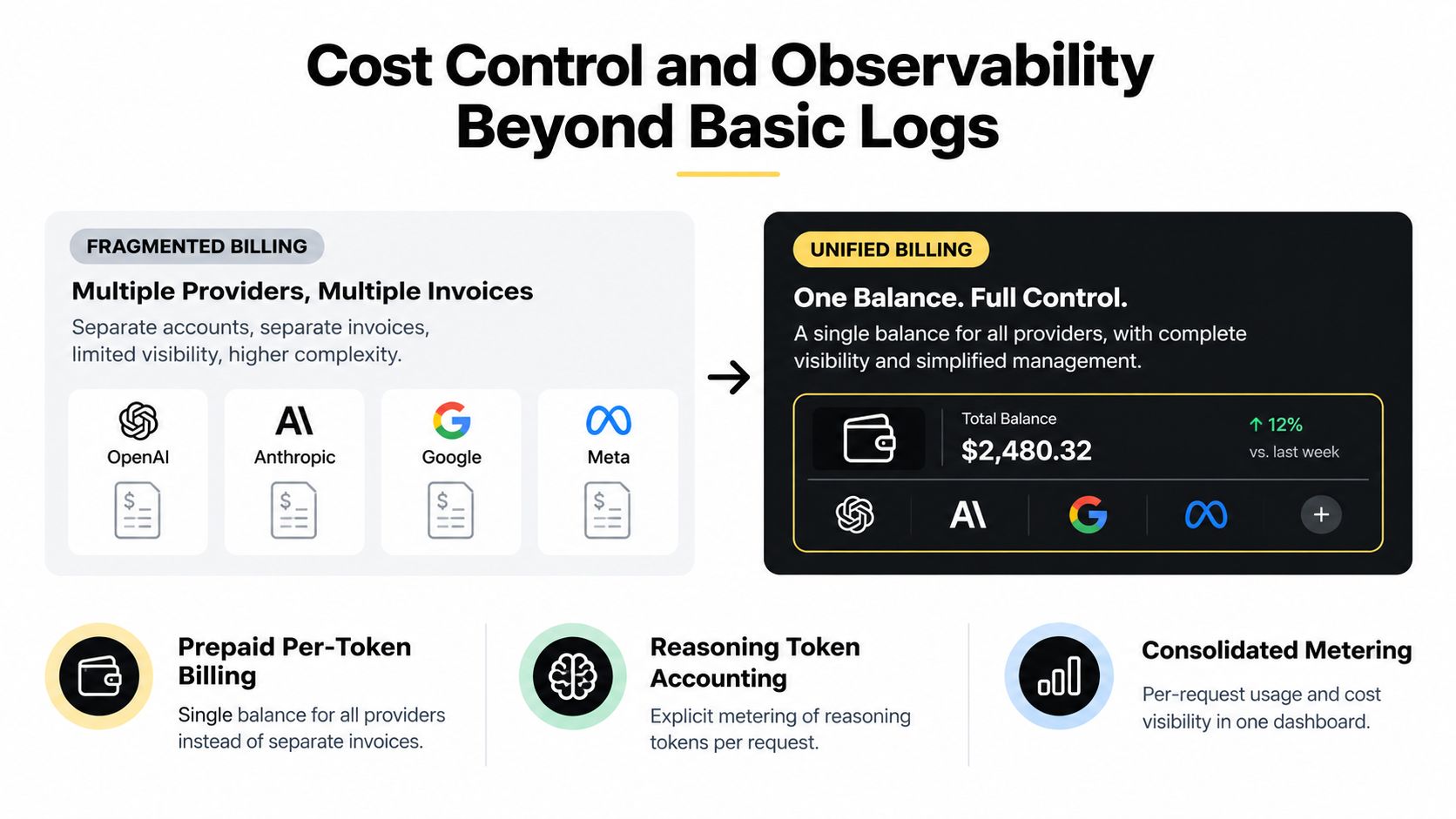
The Openbase billing documentation describes the type of workflow teams usually want from this layer, including a shared balance, per-request usage records, and invoice support. That structure can simplify finance reconciliation, but it introduces a responsibility: validate gateway usage against upstream statements during rollout.
Logs answer only part of the question
Gateway logs can tell you:
- Which provider served the request.
- Which model and route policy were selected.
- How many tokens the request consumed.
- How long the request took.
- Whether a retry or fallback occurred.
- What the request cost.
They can't, by themselves, tell you whether the answer was correct, policy-compliant, grounded in approved data, or suitable for the business decision it influenced. A successful HTTP response can contain an unsafe action, an incorrect extraction, or a tool call that changes application state.
That requires a second measurement layer:
- Evals: Run representative tests for correctness, refusal behavior, structured output, and domain-specific quality.
- Tracing: Connect the model span to retrieval, tools, application decisions, and downstream effects.
- OpenTelemetry: Export consistent traces and attributes across services without creating a separate custom format for every provider.
- Alerts: Trigger on quality regressions, schema failures, unusual token growth, fallback spikes, or policy violations.
Recent gateway guidance from Dataiku's LLM gateway overview describes the market's movement toward span-level tracing, OpenTelemetry, and evaluation workflows at the gateway layer. The practical lesson is straightforward. Centralize common instrumentation at the gateway, but preserve application-level context so platform telemetry can be connected to user and business outcomes.
Use Cases Where Each Approach Fits Best
The right architecture changes with the workload. A single experimental service has different constraints from a platform serving many teams, and neither should inherit the other's complexity by default.
Fast-moving product prototypes
Direct APIs are often the fastest route for a small prototype owned by one team. The developer can use the provider's native SDK, inspect every option, and avoid learning gateway-specific model mappings. This path works particularly well when the team has one preferred provider and doesn't need cross-provider failover.
The risk appears when the prototype becomes a shared dependency. Before production, review authentication boundaries, usage ownership, retry behavior, and the cost of replacing the provider. Replatforming after several provider-specific features have entered the codebase is harder than switching a compatible endpoint early.
Platform teams serving multiple workloads
A unified API fits platform teams that need a common entry point for many applications. Central routing lets the team maintain provider priority, apply per-key limits, standardize telemetry, and change upstream credentials without editing every service. It also gives application teams one integration contract while the platform team manages provider differences.
That doesn't mean the gateway should hide every capability. Expose a well-defined common path for ordinary requests, and provide an explicit escape hatch for features that require native provider access. An abstraction that blocks important capabilities will eventually be bypassed.
Enterprises with redundancy and governance requirements
Enterprises often care less about avoiding a few lines of SDK code and more about controlling access. A gateway can keep provider keys away from application teams, centralize usage policy, and create a consistent audit trail across model vendors. It can also support vendor redundancy when an outage or quota event affects one upstream.
Direct APIs may still be preferable for workloads with strict contractual, residency, or provider-specific requirements. In those cases, route only eligible traffic through the gateway, document the boundary, and avoid claiming that a common interface automatically resolves compliance obligations.
Data and ML teams controlling spend
Data teams benefit from centralized per-request usage when they need to attribute model costs to jobs, products, or environments. A common gateway record makes it easier to compare prompt growth, output length, model choice, and retry behavior in one place.
Direct billing can remain the better choice when procurement requires separate vendor ownership or when a team needs native usage exports with no intermediary. Either way, cost controls should be attached to workload identity, not only to a shared account. Otherwise, the team sees the total bill but can't explain who generated it.
Recommendation How to Choose and Migrate with Confidence
Choose direct APIs when one provider meets the workload, native features matter, and the owning team can operate retries, credentials, billing, and telemetry responsibly. Choose a unified LLM API when several providers are already present, model substitution is likely, outage tolerance is low, or finance and platform teams need one control surface.
Use this decision check:
- Model diversity: Are multiple vendors or model families part of the roadmap?
- Outage tolerance: Can the application wait for recovery, or does it need an alternate route?
- Billing complexity: Can finance reconcile separate provider accounts without custom work?
- Observability: Do you need provider, token, latency, retry, and cost data in one stream?
- Native features: Does the workload depend on capabilities the gateway may not normalize?
- Ownership: Is there a team prepared to operate gateway policy and availability?
A low-risk migration keeps the request body stable. Change the base URL and key first, preserve the existing SDK where compatible, then validate per-call logs, token accounting, streaming behavior, tool calls, and error mapping. Run deliberate failover tests, compare gateway usage with provider invoices, and measure TTFT, throughput, and application-level quality before moving all traffic.
Treat keys, limits, routing priority, and invoices as governed infrastructure. Start with one workload, define rollback criteria, and expand only after the gateway's records match what the application and finance teams expect.
Openbase provides a single OpenAI-compatible endpoint for models from multiple providers, with centralized keys, balances, invoices, automatic failover, and per-request usage logging. If your team is deciding whether those controls justify a gateway, visit Openbase to review the available models, billing behavior, and integration documentation.
Prepared with Outrank app