
An API key is a machine credential, usually a long, machine-generated string, that identifies an application when it calls an API. It ties requests to an account or project, helps enforce quotas, and lets the service record usage for billing or auditing.
You may be looking at a terminal error, wiring an AI feature into a backend, or reviewing a pull request where someone added a suspicious string to a configuration file. The immediate question is simple: what is an API key, and why does everyone treat it like a password?
The answer becomes more important as software starts calling more services automatically. A key can identify a workload without a browser session or human login, but possession may be enough to make requests. That creates two different security problems: accidental exposure, such as a key committed to a repository, and deliberate exfiltration, where an autonomous AI agent reveals or misuses a credential through tools, prompts, traces, or machine-to-machine workflows.
Table of Contents
- Understanding What an API Key Actually Is
- How API Keys Enable Secure Machine Communication
- Comparing Direct Provider Keys to Unified Gateway Keys
- The Critical Security Risks of API Key Exposure
- Implementing an API Key Lifecycle
- Best Practices for Enterprise API Key Management
Understanding What an API Key Actually Is
A developer adds an AI call to an application. The request works locally, then the key reaches a public repository, a frontend bundle, or an unredacted log. Someone copies it, sends requests under the same account, and the owner discovers unexpected usage. The failure wasn't that the string looked weak. The failure was treating a working machine credential as ordinary application text.
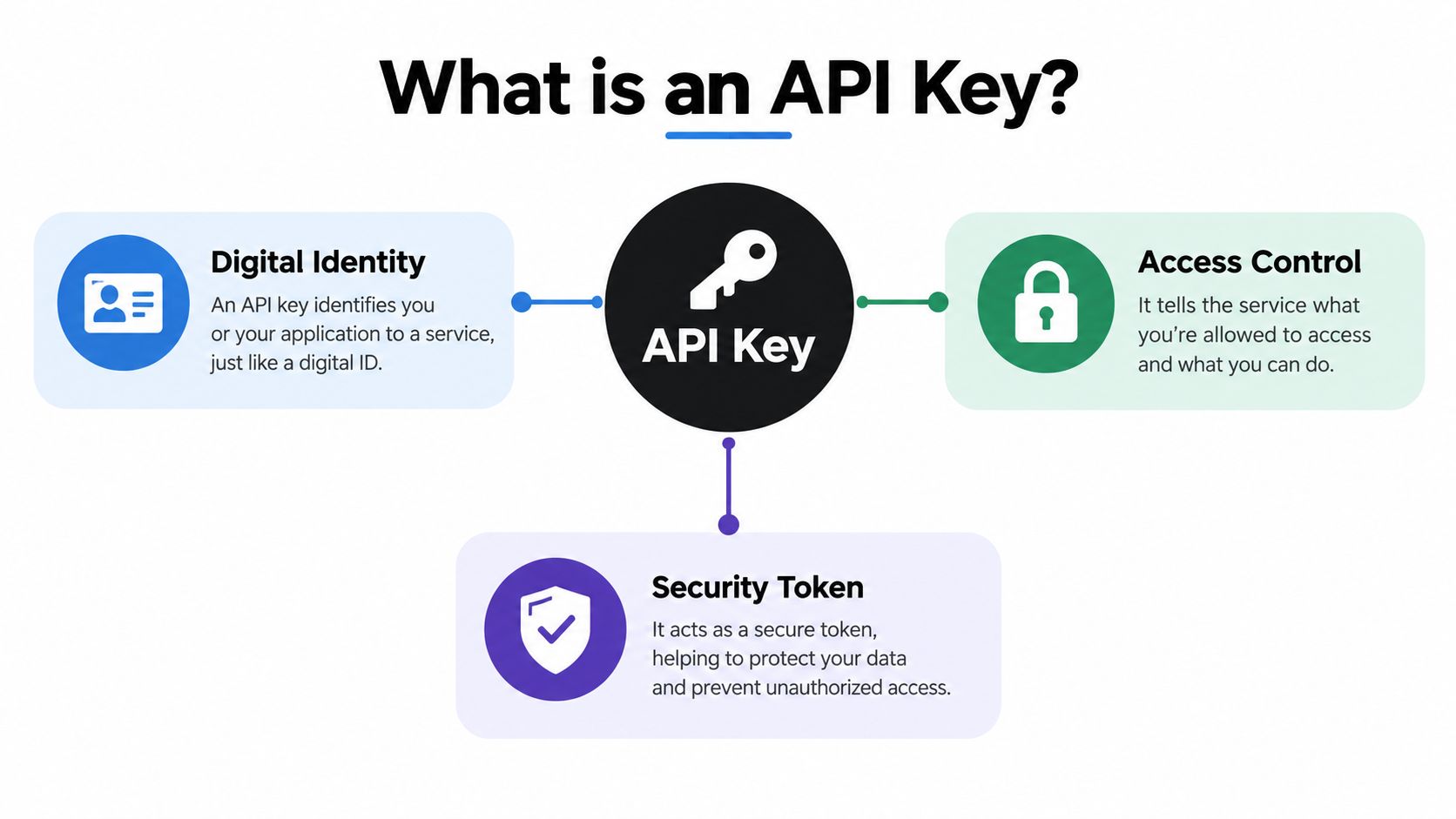
An API key is a credential that an application sends with an API request. The service uses it to identify the caller, associate activity with an account or project, enforce quotas, and record usage for billing. A key commonly appears as an opaque, high-entropy string, but its meaning comes from the service's records, permissions, limits, and status, not from its visual format. This explanation of API keys and leaked credentials describes the same basic model.
The key distinction is between software identity and human identity. A password or interactive login generally helps authenticate a person. An API key identifies an application, project, environment, or workload. It doesn't tell the service whether a human is trustworthy, and it usually doesn't provide the rich user context associated with modern identity systems.
Why possession matters
Many APIs use a key as a bearer credential. In practical terms, whoever possesses the key may be able to send an accepted request, subject to the permissions and restrictions attached to it. That's why you should handle it like a password even though its purpose is different.
A unified AI gateway adds useful accounting without changing this underlying principle. With Openbase, one key can represent the customer account while usage records distinguish the model, provider, token volume, latency, and cost. The key identifies the account at the gateway, while the request record explains what happened after authentication.
Practical rule: If a key can authorize a billable request, assume it is secret unless the provider explicitly documents a separate publishable-key design.
The phrase “API key” therefore describes a mechanism, not a complete security policy. A key may have narrow permissions and strict limits, or it may provide broad access to expensive services. Its safety depends on where it's stored, how requests are monitored, how quickly it can be rotated, and whether the service can revoke it independently of other workloads.
How API Keys Enable Secure Machine Communication
An API call usually follows a straightforward sequence. Your application prepares a request, adds the credential in a request header, sends it over HTTPS, and receives a response if the service accepts both the credential and the request.
The three jobs performed by a key
Identification comes first. The API uses the key to associate the request with an account, project, environment, or service. This gives the provider a caller identity even when no person is present.
Authorization follows identification. The service checks whether that key is active and permitted to use the requested API or operation. A key might identify a project but still fail because it has been disabled, restricted, expired, or sent to an endpoint outside its allowed scope.
Metering completes the exchange. The provider records activity against the key so it can apply quotas, observe consumption, support auditing, and calculate charges. For AI workloads, useful records can include the selected model, upstream provider, token counts, latency, and cost.
Keep the credential in an authorization header or the provider's recommended header. Don't place it in a query parameter. URLs can spread into browser history, proxy records, analytics systems, and server logs, which makes a secret harder to contain. The OWASP API Security guidance separates API keys used to identify client applications or projects from credentials intended to authenticate individual users.
Openbase applies this control-plane pattern to model access. It provides a gateway that mirrors the OpenAI Chat Completions interface, so an existing client can send a familiar request shape while the gateway selects among supported providers. The account has one key, balance, and invoice, while the gateway handles provider selection, automatic failover when an upstream service is degraded, and granular usage logging for cost and performance.
That architecture changes where your application authenticates. Instead of handing every workload a collection of upstream provider credentials, the application authenticates to the gateway. The gateway then manages the provider relationship and records the resulting activity. This can simplify integration, but the gateway credential becomes important infrastructure and needs its own restrictions, budgets, logging, and revocation process.
Comparing Direct Provider Keys to Unified Gateway Keys
A direct provider integration gives your application a credential issued by that provider. That approach is clear and can be appropriate when you need a service's native features, identity controls, or contractual boundaries. The operational cost appears when your application uses several model providers.
With direct keys, engineers typically manage separate credentials, billing accounts, dashboards, quotas, error behaviors, and SDK conventions. A model change may require more than changing a name because request and response formats, streaming behavior, tool calling, and usage fields can differ. Finance and platform teams also have to reconcile activity across multiple systems.
A unified gateway changes the boundary. Your application talks to one compatible endpoint, while the gateway handles upstream provider selection. Openbase describes a single key, balance, and invoice for access to models from multiple providers, with request and response bodies kept consistent when models change. Teams evaluating organizational controls can review the Openbase enterprise offering.
The trade-off in one view
| Direct provider keys | Unified gateway keys |
|---|---|
| Separate credentials for each provider | One gateway credential for the application or environment |
| Provider-specific billing and usage views | Consolidated balance, usage records, and invoice |
| Provider-specific request behavior | Consistent OpenAI-compatible request shape |
| Your application handles provider switching | Gateway can select providers and fail over |
| More upstream secrets to distribute | Fewer upstream credentials in application workloads |
The abstraction is valuable when resilience and operational consistency matter. A gateway can retry eligible failures, including rate-limit, timeout, server, and connection conditions, and route a request to another available upstream where its policy allows. It can also expose per-request accounting, including model, provider, token usage, latency, and cost, so developers can investigate performance without joining records from several provider dashboards.
That convenience doesn't eliminate security responsibility. A single gateway key reduces credential sprawl, but it can become a high-value target because it may authorize access to several models through one account. Use separate keys for development, staging, production, and distinct services. Apply per-key limits, inspect usage by workload, and revoke only the affected key when a service is compromised.
Choose direct keys when provider-specific control is the priority and your team can operate the resulting credential and billing estate. Choose a gateway when a stable interface, provider failover, consolidated accounting, and centralized observability reduce more risk than the gateway concentration introduces. In either design, the key still authenticates software, and its lifecycle still determines the practical security level.
The Critical Security Risks of API Key Exposure
A developer commits a configuration file before noticing that it contains a live key. A client bundle, URL, debug trace, or mobile application can expose the same credential to anyone able to inspect it. “Hiding” a key only makes discovery less convenient. It does not create an access boundary.

The scale of accidental exposure is substantial. GitGuardian's State of Secrets Sprawl report reported 1,275,105 leaked AI-service secrets in public GitHub activity during 2025, an 81% increase over 2024. The report also describes risks that AI credentials introduce into modern development workflows.
Repository leaks are only one exposure path. An autonomous agent can read files, process prompts, call tools, contact external services, and write traces. Give that agent a long-lived provider key, and prompt injection or tool poisoning may persuade it to disclose the credential or use it beyond the assigned task. An OpenID Foundation submission to NIST argued that static keys are particularly risky for agents that may make thousands of calls per hour.
Two exposure patterns need different defenses
Accidental publication occurs when a developer commits a secret, prints environment variables during debugging, embeds a key in a client bundle, or places it in a URL. Secret scanning, review controls, redaction, and server-side storage address these mistakes. They work like checks around a warehouse door: they reduce the chance that a credential leaves its intended location.
Intentional exfiltration follows a different path. An attacker manipulates an agent or one of its tools, and the agent may never place the key in source control. It could include the credential in a response, transmit it to an unauthorized endpoint, expose it through a tool result, or copy it into an observable trace.
Treat the agent as an untrusted execution boundary. Keep provider credentials on a server-side proxy, issue the agent a narrowly scoped proxy credential, authorize sensitive actions individually, enforce quotas, and redact secrets from logs and traces. Review the platform's controls in the Openbase security documentation before distributing any gateway credential.
If exposure is possible, respond before confirming misuse. Revoke the key, inspect request and billing logs, search repositories and build artifacts, rotate dependent credentials, issue a restricted replacement, and confirm that old copies no longer authenticate. Possession alone may provide access, so a leaked key is an incident even when no application database has been breached.
Implementing an API Key Lifecycle
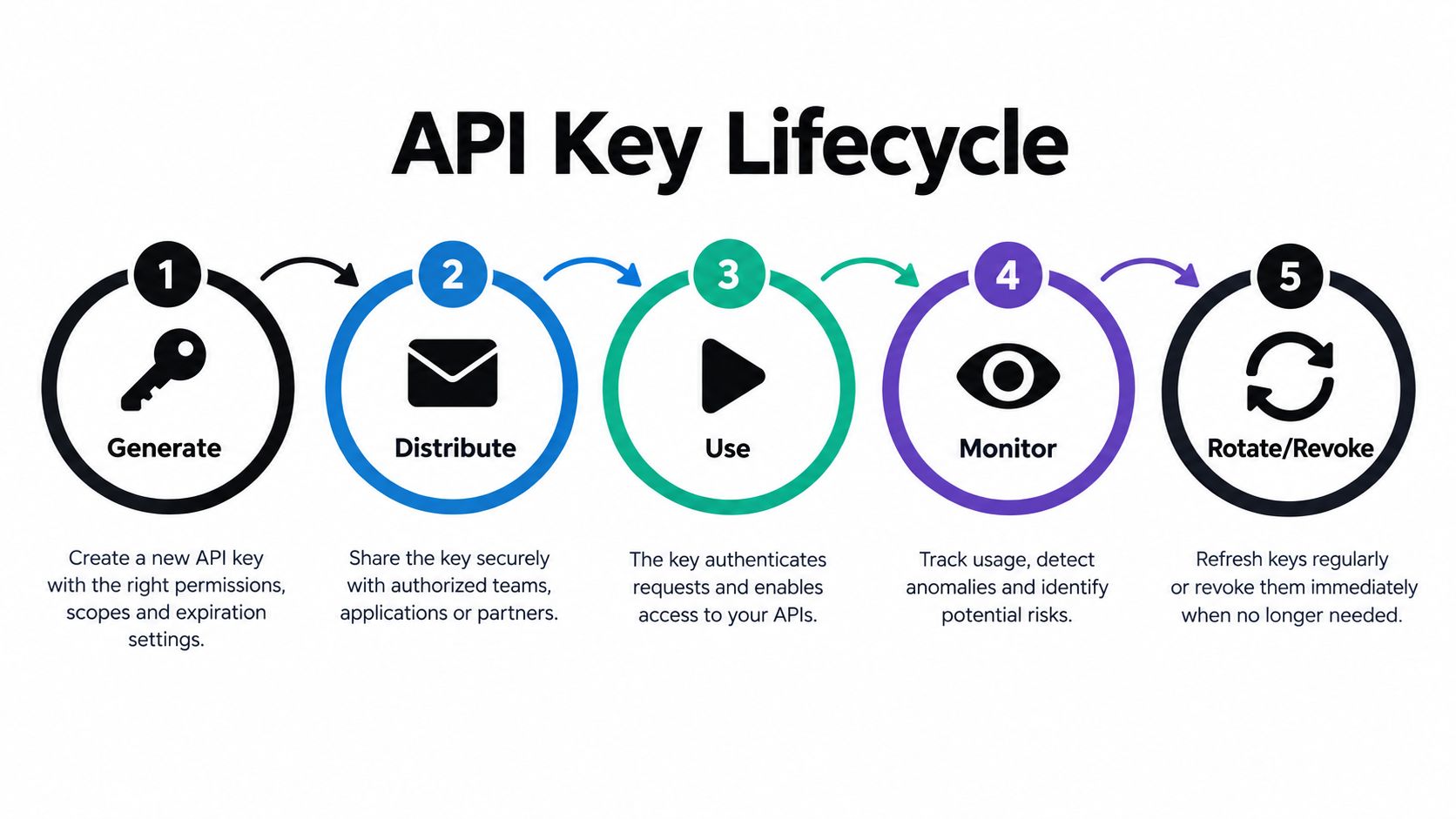
A key should have a planned path from creation to retirement. A defensible process covers generation, restriction, storage, monitoring, rotation, and revocation, so protection does not depend on whether someone remembers where the string should not be pasted.
Build the controls into normal operations
Generate securely. Create the key through the provider or gateway's cryptographically strong process. Do not invent a predictable value or reuse one credential across unrelated services.
Restrict its reach. Limit permitted APIs, client contexts, environments, and operations wherever the platform supports those controls. A restriction narrows the damage an exposed key can cause. The Openbase authentication documentation explains how to issue, scope, and revoke credentials through the gateway.
Store it server-side. Put the key in a secrets manager or protected runtime configuration, then retrieve it when the service starts or sends a request. Keep it out of source code, client bundles, notebooks, screenshots, support tickets, and unredacted logs. Google's API-key best practices recommend retaining only active keys, applying restrictions, replacing credentials periodically, and deleting superseded keys.
Monitor activity. Record enough context to identify who used the key, which workload sent the request, which model or provider received it, and the associated token volume, latency, errors, and cost. Set spending ceilings and investigate sudden consumption, unusual geography, or traffic outside the workload's normal pattern.
Rotate without disruption. Create a replacement with equivalent restrictions, deploy it to every consumer, and verify successful traffic and expected usage before revoking the old key. A short overlap supports deployment without downtime. Remove the older credential once the replacement is confirmed.
Revoke during suspicion. If a key appears in a public repository, log, prompt trace, or client bundle, disable it immediately. Search for copies, review request and billing logs, rotate related credentials, and confirm that the replacement serves only its intended workload.
Environment separation also shortens incident response. Because each credential maps to one workload, revoking it cannot strand an unrelated service, and the audit trail remains attributable.
Agents need an extra boundary. Add a proxy that authorizes each request instead of exposing broad upstream access. Keep provider keys outside the agent's context, use short-lived or identity-based credentials where supported, and make automatic rotation part of deployment. Repository exposure is accidental, while an autonomous agent may intentionally transmit a credential through a response, tool result, endpoint, or trace. A lifecycle must address both paths.
Best Practices for Enterprise API Key Management
Enterprise teams need to manage keys as operational assets, not isolated strings in a developer's environment. Start by assigning an owner to every credential, documenting its workload and permitted purpose, and separating environments so production access doesn't spread into prototypes or test jobs.
A practical governance model combines technical controls with financial visibility:
- Issue narrowly scoped credentials: Give each service or environment its own key, with only the APIs and limits it needs.
- Set spending boundaries: Apply per-key limits where available, then review usage against the workload's expected behavior.
- Keep an evidence trail: Retain request identity, model, provider, token counts, latency, errors, and cost so security and finance teams can investigate the same event.
- Review inactive access: Disable credentials that no longer serve an active workload and remove superseded keys after rotation.
- Test the response plan: Confirm that an on-call engineer can revoke a key, deploy its replacement, and verify recovery without waiting for the original developer.
A unified gateway can reduce the number of upstream provider credentials distributed across teams, but concentration changes the risk profile. Treat the gateway key as high value, use separate credentials per environment, restrict agent access through a proxy, enforce spending limits, and make rapid revocation visible to the people responsible for incidents.
Operational insight: Centralization works best when the gateway provides more than a shared login. Usage evidence, per-key controls, failover behavior, and clear ownership turn one credential into a governed access boundary.
Document the integration path in the same place as the code. Include how the service loads its secret, which environment owns the key, how requests are logged without exposing credentials, and what an engineer must do after a suspected leak. Safe examples should use placeholders, while quickstarts should encourage server-side configuration from the first request.
The objective isn't to make API access complicated. It's to make the secure path the easiest path, so developers can ship AI features without handing autonomous agents, browser code, or public repositories credentials that were meant for trusted server workloads.
Openbase provides a unified API for frontier language models, an OpenAI-compatible interface, provider failover, consolidated billing, and granular usage logs for cost and performance monitoring. Create environment-specific credentials, set appropriate limits, and review the platform's authentication and security controls by visiting Openbase.