
Federated search means one query is sent to multiple independent sources and the returned results are merged into a single ranked list. If you want one search box to look across Slack, Jira, Confluence, and Google Drive at the same time, you're asking for federated search.
That sounds simple because the user experience is simple. You type “incident review,” press enter, and expect the right postmortem, the Jira ticket, the Slack thread, and the design doc to show up together.
Most enterprise stacks don't work that way by default. Slack has its own index. Jira has its own query language and permissions model. Confluence scores documents differently. Google Drive may return files quickly for one query and slowly for another. Each system is its own little search island.
That gap between user expectation and system reality is where people start asking, what is a federated search, really. Not the textbook definition. The operational one. The version that has to survive connector failures, uneven scoring, SSO quirks, and real users who won't accept “some sources timed out” as an excuse.
Table of Contents
- The Search Problem Federated Search Solves
- How Federated Search Actually Works
- Two Architecture Patterns Behind Federated Search
- Federated Search vs Centralized Search
- Common Enterprise Use Cases for Federated Search
- Why Federated Search Breaks in the Real World
- Choosing Federated Search for Your Stack
The Search Problem Federated Search Solves
At 9:12 a.m., an incident commander types the same phrase into four tabs in a row. Slack for the first discussion. Jira for the follow-up ticket. Confluence for the postmortem draft. Google Drive for the runbook someone swears already exists. The problem is not remembering the topic. The problem is remembering which system ended up holding the answer.
Users ask one question. Enterprise software stores the answer in pieces.
That mismatch shows up everywhere. A support lead looks for a refund exception policy and finds half of it in a knowledge base, half in email, and the latest decision in a CRM note. An engineer searches for a production fix and gets a stale wiki page, while the answer sits in a chat thread linked from a ticket. Search feels broken even when the information exists, because retrieval is split across systems that were never designed to act like one.
Fragmented tools create retrieval gaps
As companies add tools over time, each one brings its own search behavior.
- Different query interfaces: One source accepts keywords. Another expects fields and filters. Another exposes only a narrow API.
- Different scoring models: A top Jira result and a top Confluence result are not comparable by default.
- Different permissions rules: Access may depend on workspace membership, document ACLs, group sync, or sharing links.
- Different response times: One system answers fast. Another takes seconds. Another starts rate-limiting under load.
The user usually does not care about any of that. They care that "PCI exception" should return the policy, the approval record, and the latest discussion without a scavenger hunt.
Before federated search, the fallback was manual repetition. Open each app. Re-enter the query. Skim each result page. Mentally merge the answers. That can work for a small team with two repositories. It fails during time-sensitive work, especially when the right answer might be buried in the slowest or least obvious system.
Practical rule: If people keep saying, “I know this exists somewhere,” the content problem is often a retrieval problem.
The problem is bigger than having many repositories
Textbook definitions usually stop at "search across multiple systems." In production, the harder problem is that those systems behave differently enough to resist being combined cleanly.
A federated setup has to decide whether to ask each source live at query time or to pull data into a separate index ahead of time. Those two patterns solve different versions of the same problem.
Query-time federation helps when data must stay in the source, permissions are complex, or freshness matters minute by minute. It starts to struggle when one slow system holds up the page, when APIs return inconsistent fields, or when ranking has to compare unlike objects such as tickets, chats, and documents.
Indexed federation helps when speed, ranking control, and result consistency matter more than perfectly live access. It starts to struggle when connectors fall behind, permission sync drifts, or a team is not allowed to copy source content into another store.
That trade-off is the search problem federated search tries to solve. The user wants one search experience. The enterprise stack is a collection of separate products with separate indexes, separate APIs, and separate rules.
The basic idea
Federated search inserts a coordinating layer between the user and those systems. The user submits one query. The coordinator sends requests to multiple independent sources or to indexes built from those sources, gathers the responses, and presents one results view.
The pattern is not new. A Microsoft Research review of federated search traces the area back to the 1980s, with practical systems appearing later as libraries needed one interface across catalogs and databases (Microsoft Research review of federated search history). The same basic need later showed up in enterprise software as companies tried to search SaaS tools, internal knowledge bases, and file stores together. Salesforce's Summer '17 release notes, for example, document federated search as a product feature in mainstream business software (Salesforce Summer '17 release notes).
Why teams still choose it
Teams adopt federated search because centralizing every byte into one search index is often unrealistic.
- Data may need to stay where it is. Legal, security, or vendor constraints can block full ingestion.
- Some answers must be current right now. A live query can reflect a source update immediately.
- Permissions may already be correct in the source system. Rebuilding every access rule elsewhere adds risk.
- Integration can start sooner. A team can connect a few important systems before building a full ingestion program.
Federated search exists to close the gap between how people ask questions and how enterprise data is stored. The idea is simple. The hard part is making that one search box behave reliably when every underlying system plays by different rules.
How Federated Search Actually Works
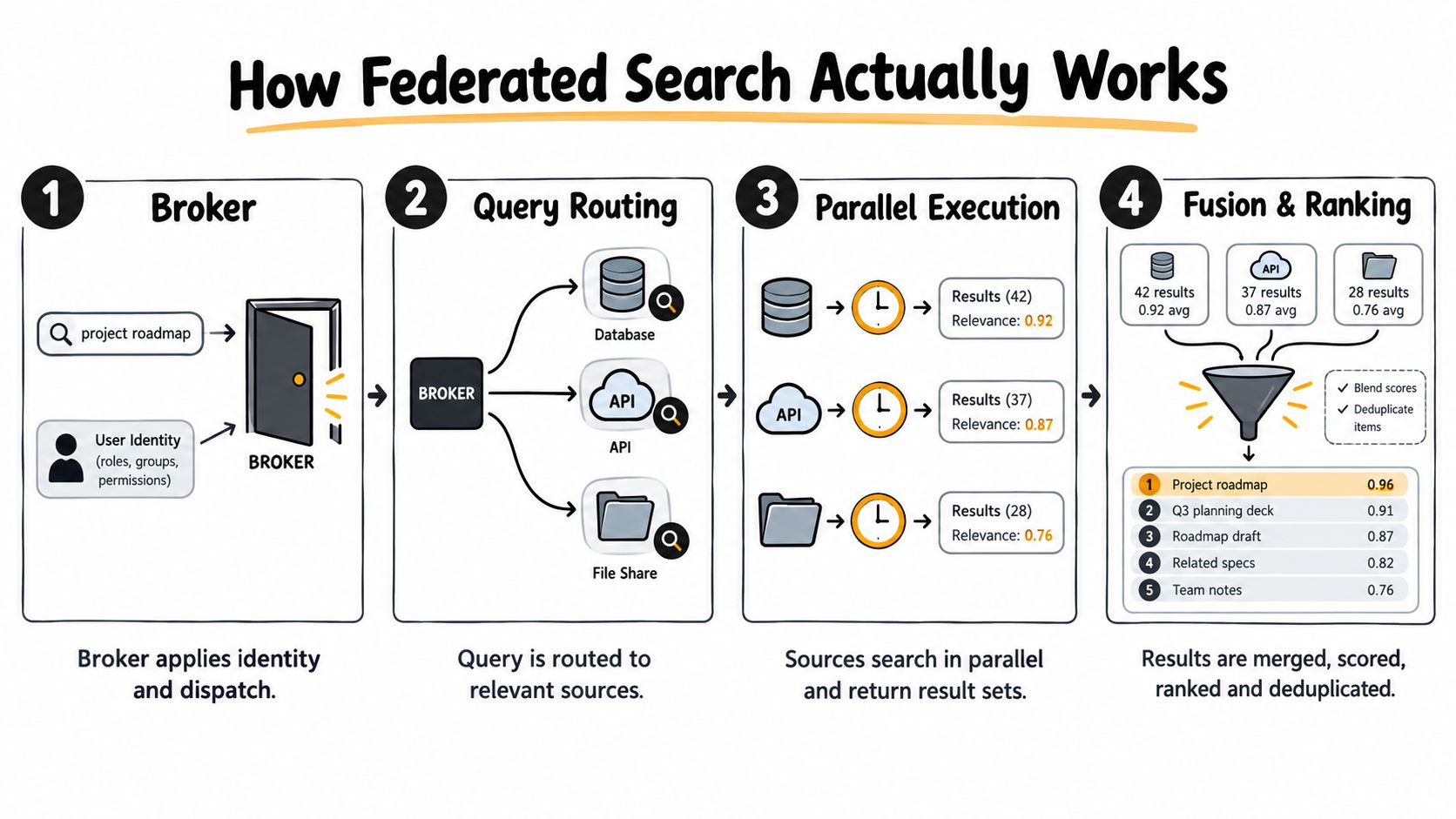
A support engineer searches for "customer renewal issue" and expects one answer stream. Under the hood, the system may contact a CRM, a ticketing tool, a wiki, chat history, and a file store, each with different query rules, ranking logic, and permission models. Federated search works by coordinating those systems at request time, then turning a pile of uneven responses into something a person can use.
The broker sits at the front door
The broker is the control point for the whole request. It receives the query, attaches the user's identity, checks which connectors are available, and decides how broad the search should be.
In real systems, that decision is rarely "send the query everywhere." Distributed information retrieval research describes a broker that selects likely relevant collections, queries only those sources, and then merges the returned results into one ranking. That pattern matters because every extra source adds latency, cost, and one more way for the request to fail.
A useful mental model is an air traffic controller. The broker does not fly the planes. It decides which runways are active, which arrivals get priority, and how to keep the whole system from colliding.
Resource selection decides where the query should go
The first hard problem is routing.
If the query is "SEV-2 rollback runbook," the broker may favor Confluence, Jira, and Drive. If the query is "customer renewal issue," it may give more weight to CRM records and support tickets. Good routing depends on source summaries, past relevance patterns, schema hints, and sometimes the user's department or current workflow.
Recent retrieval work also shows why routing quality matters for cost, not just relevance. A benchmark across 16 BEIR-derived domains evaluated constrained routing methods and found that careful routing can sharply reduce unnecessary query fan-out and communication volume compared with naive broadcast approaches (EMNLP Findings paper on federated retrieval routing).
Teams implementing this layer often keep the gateway thin and rely on shared client abstractions. If your connectors already use an OpenAI-style request shape, a common SDK layer can simplify orchestration and retries, which is why some teams use the Openbase SDK documentation as a reference point for adjacent multi-provider routing work.
Query dispatch happens in parallel, but each source speaks a different dialect
After routing, the broker dispatches requests in parallel. That sounds straightforward until you look at the connectors.
A single user query often has to be rewritten several ways:
- a keyword query for Slack
- a structured issue query for Jira
- a document search for Confluence
- a file-content request for Drive
The translation work is where federated search starts to feel less like one engine and more like an adapter layer. One source supports field filters. Another only supports plain text. One returns highlights. Another returns raw records. One times out after a few seconds. Another paginates aggressively and caps result windows.
A short walkthrough helps here:
This is also the point where the practical split between query-time broadcasting and indexed federation starts to matter, even before naming those architectures directly. In a live broadcast flow, the broker is waiting on remote systems during the user's request. In an indexed federation flow, some of that work has already been done ahead of time in a central index. The user still sees one search box, but the latency, freshness, and failure modes are very different.
Result merging is where the system earns its keep
Every source returns its own scores, snippets, metadata, and object IDs. Those outputs are not naturally comparable. A score of 0.92 from one system may be weaker than a score of 12 from another, because each source defines relevance differently.
So the broker has to do several jobs at once:
- Normalize scores so one source's ranking scale does not overwhelm the rest.
- Deduplicate records when the same document appears through multiple connectors or shared links.
- Blend source-level signals such as freshness, title match, authority, document type, and user context.
- Apply security trimming so items returned from a source are still filtered correctly for the current user.
- Handle partial failure when one source is slow, unavailable, or returns malformed data.
This step is also where enterprise stacks often show their rough edges. A source may return excellent permission data but poor ranking. Another may rank well but expose little metadata for deduplication. The broker has to compensate without making the results feel arbitrary.
A demo looks clean when every connector responds quickly and returns tidy scores. Production quality shows up when the system still behaves predictably after one connector lags, another returns duplicates, and a third changes its API response shape overnight.
Two Architecture Patterns Behind Federated Search
A user types "customer refund policy" into the company portal and expects one good answer. Under the hood, the team still has to choose how that answer gets assembled. Enterprise teams typically evaluate two patterns: query-time broadcasting and indexed federation.
They can look similar in a demo. In production, they fail in different ways.
Query-time federation
In query-time federation, the broker sends the query to each connected system at search time, waits for live responses, and merges what comes back. CMSWire describes this as one of the two core federated search models in its discussion of why federated search is often harder to run than it first appears (CMSWire discussion of federated search models).
This pattern fits teams that cannot rely on copied data. A support workspace is a common case. An agent searching CRM records, order history, and IT tickets usually needs the current status from each system of record, not a snapshot from an earlier sync.
The trade-off shows up fast under load. Every search becomes a small distributed systems problem. One connector returns in 80 milliseconds. Another takes 2 seconds. A third has rate limits. A fourth only supports basic keyword search, so its results arrive with weak ranking signals. The broker still has to present one results page that feels coherent.
Security behavior is often the deciding factor here. If permissions change often and must be checked live against the source, query-time federation is attractive. The cost is operational volatility. Timeouts, retries, partial responses, and per-source API changes become part of normal search operations.
Indexed federation
In indexed federation, the platform pulls content or metadata from source systems into a local index, then serves queries from that index instead of broadcasting every search to remote systems. The user still experiences one search surface, but retrieval happens mostly inside one search layer rather than across many live endpoints.
This is common in intranets, knowledge portals, and document discovery tools. A company might crawl Confluence on a schedule, sync selected Google Drive folders, ingest SharePoint metadata, and store all of that in one index built for ranking and fast retrieval. That setup gives the search team much more control over scoring, field weighting, synonyms, and result presentation.
It also introduces a new class of failure. The index can drift away from the source. Deleted files may linger until the next crawl. New documents may not appear yet. Permission changes can lag if access control data is synced on a different schedule from content. Query performance usually gets steadier, but freshness becomes an ingestion problem instead of a connector problem.
A helpful way to frame the difference is this: query-time federation spends work during the search request. Indexed federation spends work before the search request.
The practical tradeoff
The useful question is not which model is more "federated." The useful question is which failure mode your users will forgive.
| Dimension | Query-Time Federation | Indexed Federation |
|---|---|---|
| Freshness | Reflects source changes immediately | Depends on crawl or sync timing |
| Ranking control | Limited by source scoring and merge logic | Stronger control in one local ranking layer |
| Query latency | Sensitive to connector fan-out and source delays | Usually more predictable at query time |
| Storage | Keeps content in source systems | Requires a replicated index, metadata store, or both |
| Permissions | Can check access against the source live | Can drift if permission sync lags |
| Operational burden | Heavy connector, timeout, and API management | Heavy ingestion, sync, and reindex management |
In practice, teams rarely choose based on definitions alone. They choose based on where the stack is already weak. If the organization has strict data residency rules or rapidly changing permissions, query-time broadcasting may be the safer fit. If users care most about stable speed, stronger relevance tuning, and consistent ranking across systems, indexed federation usually gives the search team more control.
Federated Search vs Centralized Search
A product manager types "customer refund policy" into the company search bar and expects one clear answer. What happens next depends on the architecture. One system fans the query out to live repositories and waits for each one to respond. The other searches a local index built earlier from those repositories. Both can power one search box. They behave very differently once latency, permissions, and ranking start colliding.
Centralized search pulls content into one place first, then searches it there. Federated search keeps content in its home systems and coordinates results across them. The user may see a similar interface. The search team inherits a very different set of constraints.
The real trade is where the system pays the cost
Centralized search spends effort before the query. It crawls, normalizes, enriches, and indexes content so retrieval can happen from one engine under one ranking model. That usually makes response time easier to control, especially when the user query touches many systems.
Federated search spends more effort during the query. The broker has to ask multiple sources, wait for uneven response times, and merge results that were scored by different engines with different fields, analyzers, and permission models.
That difference sounds abstract until a source gets slow.
If one repository takes four seconds to answer, a federated system has to choose. Wait longer and hurt the whole search experience, or cut off that source and return partial results. A centralized system usually answers on time because it already copied what it needed earlier. Its failure mode shows up differently. The result may be fast but stale because the sync job has not caught up yet.
| Criterion | Federated Search | Centralized Search |
|---|---|---|
| Freshness | Often reflects the current state of each source | Reflects the last successful crawl or sync |
| Query latency | Varies with source response time, connector overhead, and network conditions | Usually steadier because retrieval happens locally |
| Ranking quality | Harder to normalize across systems with different scoring logic | Easier to tune because one engine ranks the whole corpus |
| Permissions | Can check access against the source at request time | Depends on accurate permission sync into the index |
| Data residency | Useful when content must remain in the source system | Harder where policy restricts copying or indexing |
| Storage overhead | Lower local storage, because the broker may keep only metadata | Higher, because content or detailed metadata is replicated |
| Failure mode | Missing or partial results when a source, API, or connector fails | Outdated results when ingestion or permission sync falls behind |
Ranking is where the gap becomes obvious
This is the part new teams often underestimate.
In centralized search, one ranking layer can decide how much to trust title matches, recency, document authority, click signals, and field weights. In federated search, each source has already made some of those decisions for itself. One system may rank by BM25 over full text. Another may boost recent tickets. A third may only expose a narrow API with no explainable score at all.
Now the broker has to merge those outputs into one list.
That is why federated search often feels less consistent, even when every connector is technically working. The problem is not only fetching documents. It is comparing unlike scores, unlike schemas, and unlike notions of relevance. Centralized search usually wins when teams need one result list to behave predictably across the whole corpus.
Compliance can outweigh pure search quality
Enterprise architecture is rarely picked on relevance alone. Legal, security, and governance teams can narrow the options before search engineers tune a single ranking rule.
If a repository contains regulated records, contract data, or sensitive customer information, copying it into a shared index may create review work the organization does not want. In that situation, federated search is often the practical choice because the content stays where it already belongs and access can be checked at the system of record.
Many production stacks end up mixed rather than pure. Teams centralize the content they can safely copy and tune heavily. They federate the systems that need stricter residency or live permission checks. In other words, "federated vs centralized" is often a boundary decision inside one stack, not a winner-take-all choice.
Common Enterprise Use Cases for Federated Search
You can usually tell federated search is a fit when the user is trying to answer one question across tools that weren't built together.
The workplace search box
A company wants one search field in its internal portal. Employees expect it to surface Slack threads, Jira issues, Confluence pages, Google Drive docs, and GitHub references together.
This is the classic use case because no one wants to repeat the same search across five tabs. The search layer doesn't erase tool boundaries. It just stops forcing the user to care about them.
Regulated records that must stay in place
In healthcare, finance, and legal workflows, copying records into another system can trigger governance problems. Teams still need broad discovery, but they can't casually mirror everything into a new index.
Federated access helps because the system can query the record where it lives and return a result pointer rather than a full replicated copy. That's often more realistic than trying to unify storage first.
Mergers, partnerships, and temporary cross-company access
When two companies merge, shared search becomes urgent long before the data architecture is unified. The same thing happens in joint ventures, supplier portals, and partner support programs.
Federated search is useful here because it can bridge repositories before anyone agrees on a new master platform.
Support and operations consoles
A support agent may need product docs, account notes, past tickets, and incident updates in one place. A developer may need package docs, runbooks, internal wiki pages, and issue history during an outage.
That is where productized search layers often appear. Some teams buy SaaS workplace search. Others build internal portals. Others use platforms that already connect common systems. For example, Openbase enterprise features include connecting company data sources such as Slack, Gmail, Drive, Confluence, Notion, HubSpot, Jira, and Asana, then indexing them with source references for traceable answers.
Research and discovery across unlike repositories
Research-heavy environments often search across systems that don't share a schema or ownership model. The user may need papers, datasets, notes, approvals, and archived reports in one workflow.
What these environments have in common:
- Heterogeneous content: Files, tickets, chats, records, and knowledge pages all need to appear together.
- Multiple authorities: No single team owns all the source systems.
- Low tolerance for missed context: The right answer may live in the least obvious repository.
Federated search is less about building one perfect index. It's about reducing the tax users pay for organizational fragmentation.
Why Federated Search Breaks in the Real World
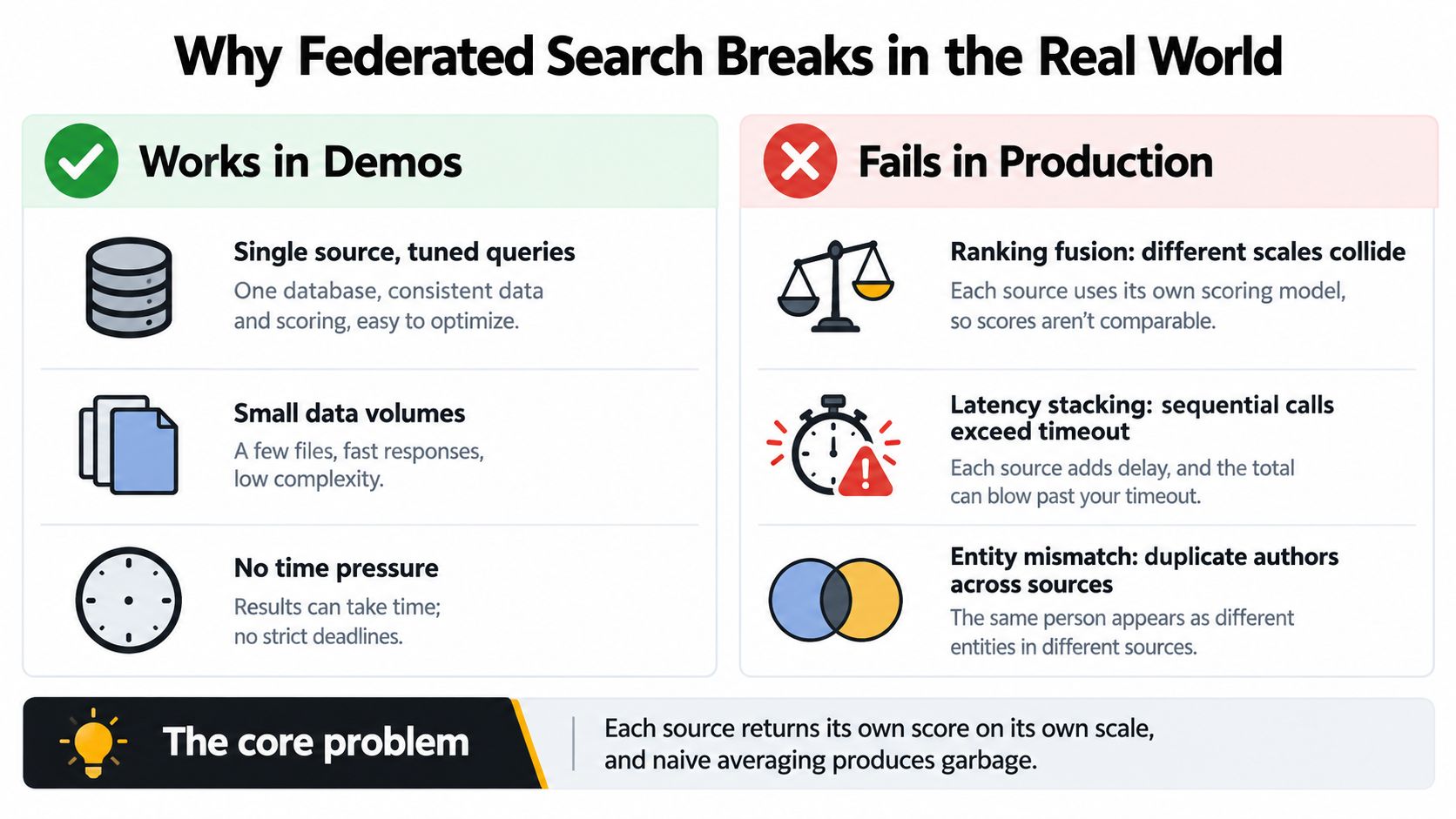
A demo query for "expense policy" across three clean systems looks reassuring. Production looks different. The user searches during an outage, one connector is timing out, another source uses a different permission model, and the ranking layer has to compare a Slack message, a ticket, and a wiki page as if they were the same kind of document.
Relevance breaks before availability does
Users usually tolerate an occasional slow source. They stop trusting search when the top results feel wrong.
That happens because federated search is doing score fusion across systems that were never calibrated together. A "9.8" from one source may mean "near perfect match." In another source, it may just mean "matched the title field." Query-time broadcasting makes this worse because each engine ranks with its own tokenizer, fields, boosts, and freshness rules. Indexed federation helps by normalizing content into one ranking pipeline, but then you inherit sync lag and schema-mapping loss.
A common failure case is simple. A noisy chat result with a high local score lands above the policy page or incident doc the user needed.
Tail latency turns one weak source into a page-wide problem
Federated search behaves like a group project where the slowest participant sets the pace. If the broker waits for every source, the results page drags. If it cuts sources off aggressively, recall drops and users miss documents that do exist.
Teams usually patch around this with timeout budgets, partial rendering, source-specific quotas, and stale-result fallbacks. Those controls help, but they also make behavior harder to explain. Users see results appear in waves, disappear between searches, or differ by a few seconds depending on which source responded in time.
Permissions fail in quiet, confusing ways
Authentication bugs rarely announce themselves clearly. They look like incomplete search.
The broker may know the user's identity, but each source still decides access through its own rules, tokens, and group mappings. One connector supports delegated identity. Another only works with a stored service credential. A third can return the document title but not the body. If your team is evaluating connector or gateway behavior, it is sensible to review security controls for connected enterprise data sources alongside search relevance and latency.
The worst outcome is an empty or partial result that looks legitimate. Users assume search missed the document. In fact, the document may have been filtered after retrieval, hidden at the field level, or blocked because the source interpreted the user's identity differently.
Architecture choice changes the failure mode
Query-time broadcasting usually breaks under load through latency and ranking inconsistency. Every search fans out across live systems, so traffic spikes hit remote APIs directly. A single degraded source can poison the experience for everyone.
Indexed federation tends to fail differently. Search is faster and ranking is easier to control, but freshness becomes the tax you pay. Connectors fall behind. ACL snapshots drift. Deleted content lingers in the index longer than anyone wants. In enterprises, neither pattern is "done" once the UI works. Both require ongoing connector maintenance, schema decisions, and permission audits.
Routing can reduce unnecessary fan-out, as noted earlier, and that matters for cost and response time. It does not remove the harder question: did the system skip a source that held the one result the user cared about?
Federated search often fails by returning a believable answer set that is incomplete, misranked, or permission-filtered in ways the user cannot see.
Choosing Federated Search for Your Stack
The right way to evaluate federated search isn't to ask whether the concept is good. It's to ask whether your sources, constraints, and team can support it.
Start with the shape of your environment
Federated search tends to make sense when you have several high-value systems, no easy path to one canonical index, and a real reason to preserve source autonomy.
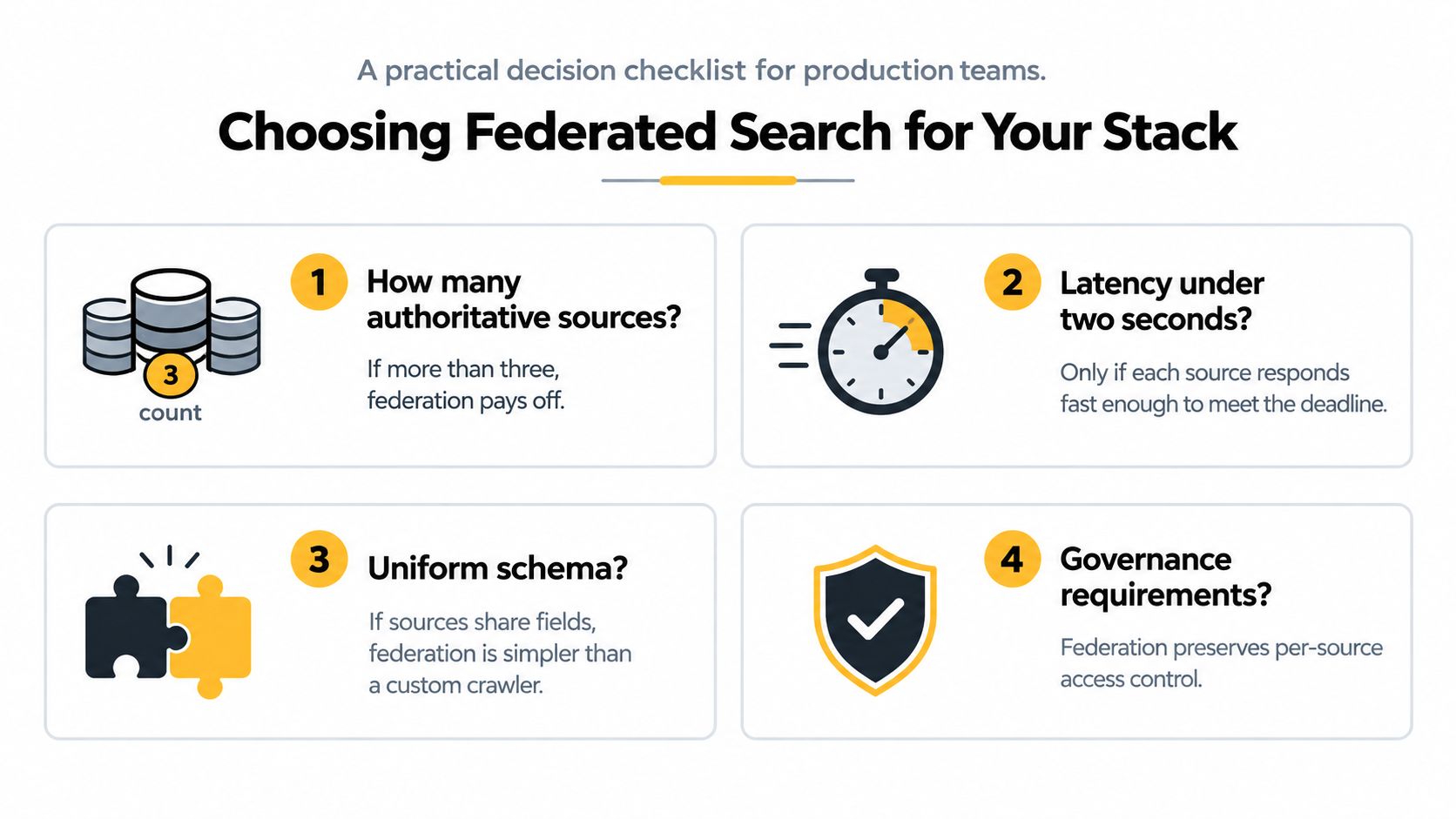
Use this checklist before you commit:
- Count your authoritative systems: If users regularly search across many systems of record, federation becomes more attractive.
- Inspect the source APIs: Fast, reliable connectors matter more than a polished search UI.
- Check governance boundaries: If content can't be copied, federation may be the only workable pattern.
- Look at your engineering capacity: Connectors need maintenance. Auth flows drift. APIs change.
Validate with a narrow pilot
Don't start with every repository in the company. Start with two sources that users need together. Make one of them easy and one of them messy.
Then test for:
- Result trust: Do users believe the top results belong together?
- Latency stability: Does the experience hold up when one source slows down?
- Permission correctness: Do users ever see links they can't open?
- Operational visibility: Can your team tell which connector caused a degraded search?
A pilot should force ugly questions early. What happens when a source times out? Do you show partial results? Do you label missing sources? Do you retry, or fail fast?
Know when to choose something else
Federation isn't always the smartest answer.
You may want centralized indexing instead when:
- Most content can be copied safely
- Users need strong cross-source ranking quality
- Connector APIs are inconsistent or weak
- Your team can support ingestion better than live fan-out
And sometimes the best answer is hybrid. Index the broad, low-risk content centrally. Federate the systems that need live freshness or strict source-native controls.
If you're building AI features on top of fragmented systems, Openbase offers a practical layer for unifying model access and, in enterprise workflows, connecting company data sources with traceable references. That matters when search, retrieval, and answer generation all have to work across multiple tools without multiplying infrastructure. If that sounds close to your stack, visit Openbase.
Written with Outrank tool