
You've probably felt the problem before you knew its name. A small application starts with one backend, then adds a checkout service, a user service, and a notification worker. Soon, the web client knows several base URLs, the mobile app has its own authentication logic, and every team has implemented retries and logging slightly differently. Adding a partner integration makes the system harder to change because each consumer now depends on your internal topology.
So, what is an API gateway? It's a client-facing entry point between application consumers and backend services. The gateway receives requests, applies shared policies, and forwards traffic to the right destination without forcing every client to understand how your services are arranged. It often becomes the place where routing, authentication, rate limiting, and observability meet.
The pattern has grown from a convenience for distributed systems into a significant infrastructure category. One market projection puts the API gateway component at 38.2% of the global API management market in 2026, while another estimates the API gateway market at $5.1 billion in 2025, with a projection of $17.8 billion by 2034. These are projections from different methodologies, but they point to the same architectural shift, gateways now sit at the center of many cloud, mobile, and microservices platforms (market analysis of the API gateway category).
Table of Contents
- The Problem an API Gateway Solves
- Core Responsibilities of an API Gateway
- API Gateway vs Reverse Proxy and Load Balancer
- How Gateways Are Built Under the Hood
- Why AI Workloads Change the Gateway
- A Look Inside an AI-Focused Gateway
- Common Misconceptions About API Gateways
- Choosing and Adopting an API Gateway
The Problem an API Gateway Solves
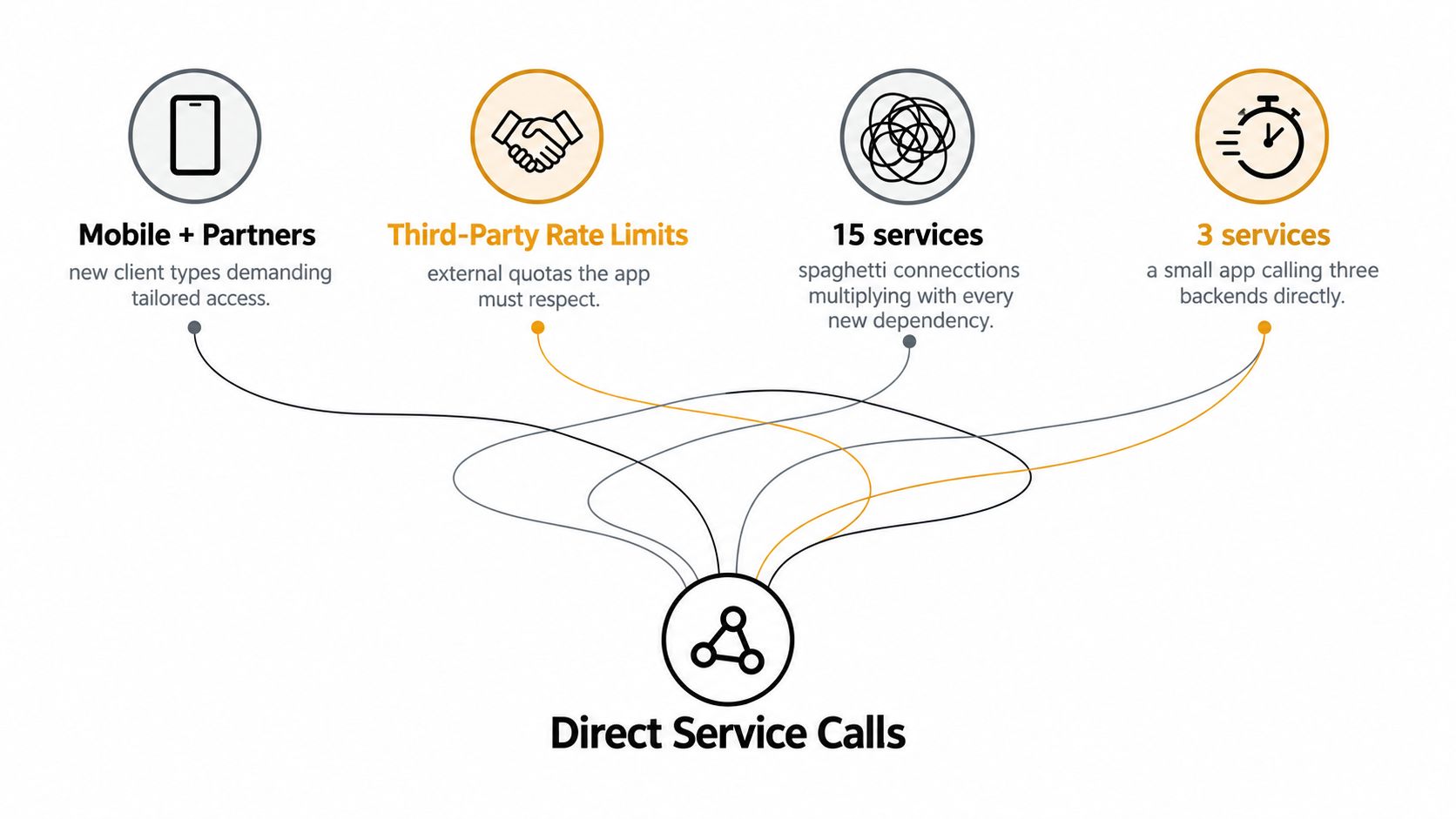
Your first version may call three services directly. That feels manageable because each client knows where to send a request and what response to expect. As the application grows toward fifteen services, however, every new dependency creates another connection, another URL, another failure mode, and another place to implement credentials.
Mobile clients and partner applications make the situation more difficult. They may need different response shapes, separate access rules, or stricter quotas than your internal web application. If each client handles those differences itself, your backend details leak outward and changes become expensive.
A single boundary for shared policy
An API gateway gives consumers one stable destination. A client might call /v1/orders, while the gateway privately forwards parts of that request to checkout, inventory, and payment services. The client doesn't need to know service names, internal routes, or which region currently hosts a backend.
That boundary removes repeated work from individual services:
- Routing: The gateway matches a path, method, header, or other request property to a backend route.
- Authentication: It checks credentials or tokens before a request reaches a protected service.
- Rate limiting: It applies quotas consistently for clients, API keys, tenants, or subscription plans.
- Observability: It attaches correlation information and collects request outcomes across the edge and downstream services.
The gateway doesn't eliminate backend responsibility. Services still need authorization, input validation, and business rules where those decisions belong. Its value comes from handling concerns that must be applied consistently across many APIs.
Practical rule: Add a gateway when client complexity and shared policy have become harder to manage than the gateway itself.
A gateway can also aggregate responses. Instead of making a mobile application call several services to render an order screen, the gateway can coordinate those calls and return a client-oriented response. That can simplify clients, but it also means you must design timeouts, partial failures, and response contracts carefully.
Core Responsibilities of an API Gateway
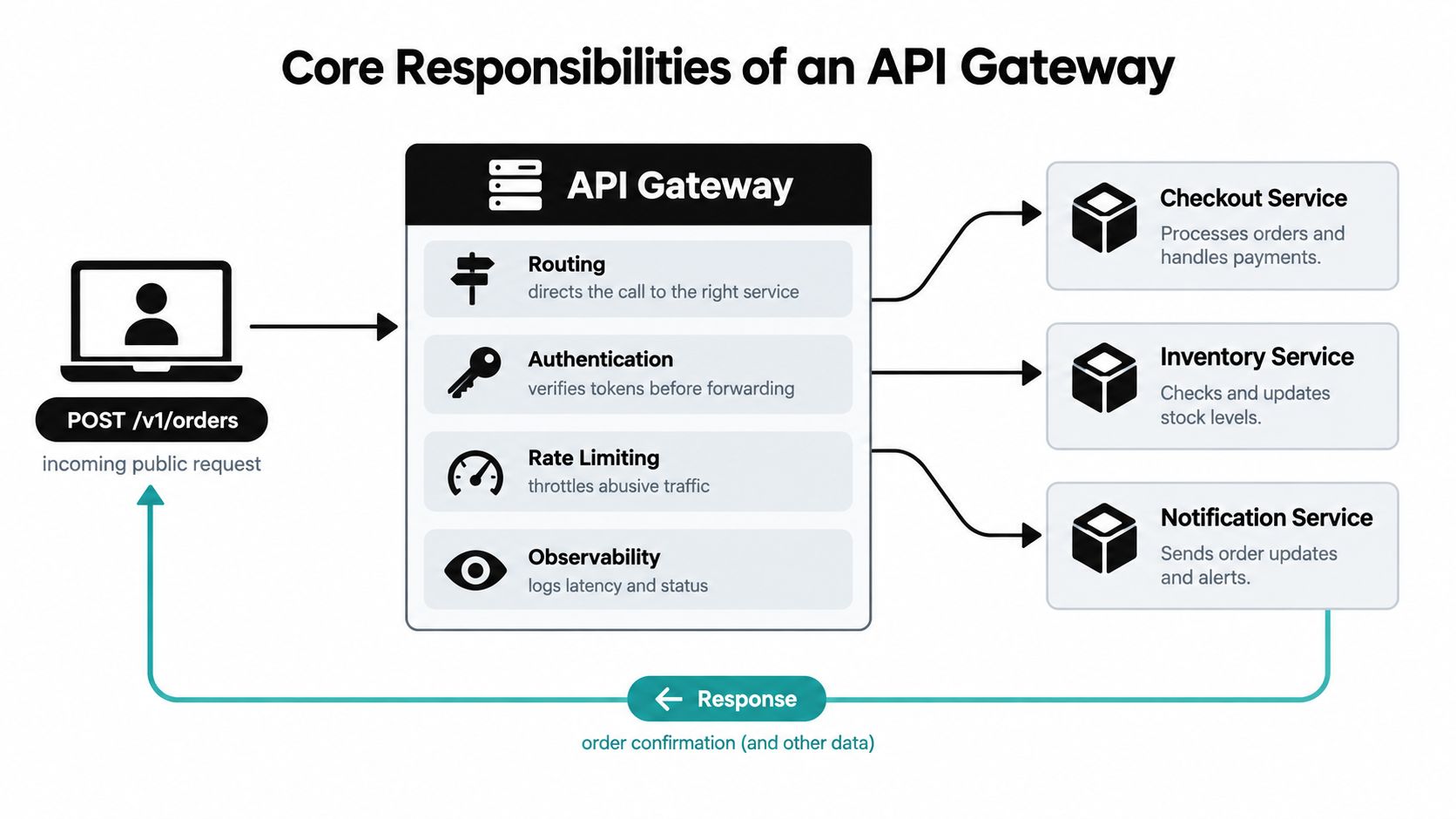
Consider a public POST /v1/orders endpoint. A customer submits an order, but the operation involves more than one backend. The gateway can provide a controlled path from the public request to the internal services without turning each service into a separate public API.
Routing starts the request
The gateway first matches the request to a route. It may use the URL path and HTTP method, then forward the order operation to a checkout service. That service can coordinate the transaction or call other internal components, depending on your architecture.
Routing can also hide version changes. External consumers may continue using /v1/orders while the gateway sends traffic to a newer backend implementation. The gateway becomes a controlled transition point, not a place to hide incompatible contracts indefinitely.
Authentication establishes identity
Before forwarding the request, the gateway can validate an API key, OAuth token, or JWT. It may verify the token's issuer, audience, signature, and expiration through its identity configuration, then pass trusted identity context to the backend.
Authentication answers who is calling. Authorization answers what that caller may do. The checkout service should still enforce business permissions, such as whether the authenticated user can place an order for a particular account.
Rate limiting protects shared capacity
A gateway can associate traffic with a client, tenant, API key, user, or token and reject requests that exceed the applicable policy. That protects payment and inventory systems from abusive traffic, accidental loops, and uneven usage by one consumer.
For implementation details, teams can consult rate-limit configuration documentation. The important design point is that a quota isn't just a number. You need to decide what identity it applies to, whether bursts are allowed, and what clients should do after receiving a limit response.
Observability follows the transaction
The gateway can create or propagate a request ID before forwarding the call. Logs from checkout, inventory, and notification services can then be connected to the same transaction, giving engineers a way to follow the request from ingress to response.
Useful signals include status codes, route-level latency, upstream errors, and traces. The gateway should expose enough context to diagnose failures without becoming the only place where teams look. A request that reaches the gateway successfully can still fail because an internal service times out or returns an invalid response.
API Gateway vs Reverse Proxy and Load Balancer
These components overlap, which is why teams often use the terms interchangeably. The distinction is less about product branding and more about what the component understands and which problem it owns.
| Component | Primary Role | Typical Use Case |
|---|---|---|
| Load Balancer | Distribute traffic across healthy instances | High-availability traffic distribution and health checks |
| Reverse Proxy | Forward requests and handle functions such as TLS termination, caching, or path rewriting | Simple ingress for web servers and backend applications |
| API Gateway | Enforce API-level policies, route requests, and provide API-aware analytics | External APIs, partner access, quotas, authentication, and governance |
| Service Mesh | Manage service-to-service communication and service identity | East-west traffic between internal services |
A load balancer may operate at the connection level or understand basic HTTP traffic. It can send requests to healthy gateway instances, but it usually doesn't decide whether a particular API key has permission to call a route.
A reverse proxy is closer to a gateway. It can terminate TLS, rewrite paths, cache responses, and forward requests. If your application has one backend and needs a clean ingress layer, a reverse proxy may be enough.
An API gateway earns its additional complexity when you need API-shaped policies. Those include per-client quotas, token validation, request transformation, partner analytics, version routing, and centralized enforcement across multiple services.
A service mesh addresses a different direction of traffic. It manages communication between services inside the platform, often with service identity and mutual TLS. The gateway usually handles north-south traffic from external consumers, while the mesh handles east-west traffic between internal workloads.
Choose the simplest component that solves the problem. A gateway can contain a reverse proxy, and it often sits behind a load balancer rather than replacing one.
How Gateways Are Built Under the Hood
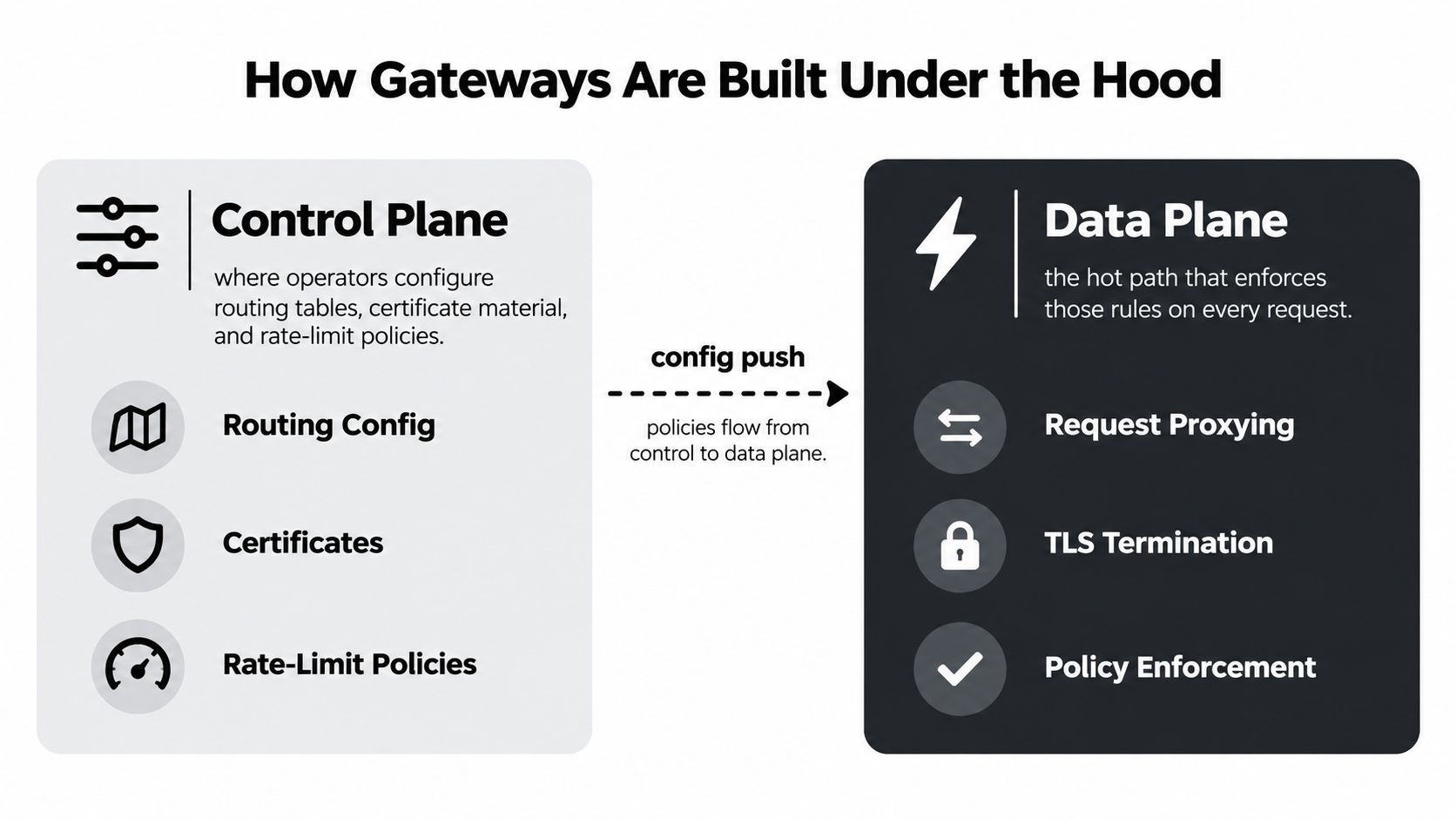
Most production gateways are easier to understand when you separate configuration from request processing. The control plane is where operators define routes, certificates, authentication policies, rate limits, plugins, and tenant settings. The data plane is the runtime that receives live traffic and enforces those rules.
Think of the control plane as air traffic control and the data plane as the runway. Operators update the flight plan in the control room, while the runway handles aircraft already arriving and departing. A configuration change can then move from the control plane to one or more data-plane instances without requiring every backend service to change.
The control plane defines intent
The control plane commonly stores or manages:
- Routing configuration: Which paths, methods, and headers map to which upstreams.
- Certificate material: How the gateway establishes secure client connections.
- Policy configuration: Which authentication, quota, transformation, and logging rules apply.
- Deployment state: Which environments or gateway instances should receive a configuration update.
Teams may manage these settings through a dashboard, management API, declarative files, or infrastructure-as-code. The mechanism matters less than keeping changes reviewable and reproducible.
The data plane pays the runtime cost
The data plane terminates the client connection, matches the request to a route, evaluates policy, forwards traffic, and returns the response. It must do that work efficiently because every request passes through it.
The separation improves governance, but it introduces a genuine trade-off. The gateway adds a network hop and runtime processing for policy checks, transformations, and telemetry. The resulting latency depends on topology, TLS settings, plugins, and logging depth, so teams should benchmark under production-like traffic instead of assuming a universal figure.
The data plane is also an operational scaling unit. You need to monitor its resource use, protect it from overload, patch it, and design for failure. Once several teams or regions share gateway policies, that responsibility can be worthwhile. For a single service with simple authentication, it may be unnecessary machinery.
Why AI Workloads Change the Gateway
Traditional API gateways generally treat a request as a bounded transaction. A client sends a compact payload, a backend responds, and the gateway records status and latency. LLM traffic changes that model in three important ways.
First, responses may stream gradually rather than arrive as one completed JSON document. The gateway must keep connections open, forward partial output, handle client cancellation, and avoid treating an incomplete stream as an ordinary successful response.
Second, the economic unit changes. A request to a language model doesn't necessarily cost the same as another request. Input tokens, output tokens, cached reads, and reasoning tokens can affect usage, while a fallback to another provider may create additional operational and accounting questions. A gateway that records only HTTP status codes can't explain which team or feature consumed the model budget.
Third, providers expose different interfaces and capabilities. One application may route requests across hosted providers and self-managed models while preserving provider-specific headers, tool-calling behavior, context limits, or embedding characteristics. The gateway needs an abstraction that simplifies application code without hiding meaningful differences.
| Capability | Traditional Gateway | AI Gateway |
|---|---|---|
| Request lifecycle | Usually short, bounded transactions | Streaming and long-lived connections |
| Usage measurement | Requests, bytes, status codes | Input, output, cached, and reasoning tokens |
| Routing | Paths, methods, headers, and backend health | Providers, model families, tenants, regions, and policies |
| Resilience | Timeouts, retries, and upstream failover | Provider failover, retry budgets, and model fallback |
| Caching | Exact response or resource caching | Exact and potentially semantic prompt caching |
| Governance | Authentication, quotas, and audit logs | Spend caps, prompt safety, model access, and cost attribution |
Market coverage describes gateways moving toward smarter traffic management, threat controls, and AI-assisted routing as generative AI creates demand for streaming, token-based limits, and multi-model routing (industry coverage of AI gateway requirements). That shift isn't just a feature expansion. It changes what the gateway must observe and what failure means.
For example, a request might receive several useful tokens before a provider disconnects. A retry could duplicate content or continue from the wrong context unless the gateway and client understand streaming semantics. AI traffic therefore needs policies designed around tokens, connection duration, provider behavior, and safety controls. Teams evaluating those controls can review security capabilities for AI access.
A Look Inside an AI-Focused Gateway
An AI-focused gateway places model access behind a consistent ingress. The application sends one request shape, while the gateway chooses or forwards to an upstream provider according to routing, availability, tenant, and environment rules.
Openbase provides an example of this pattern by exposing an OpenAI-compatible endpoint across multiple model providers. It supports automatic failover when an upstream provider is degraded, retries eligible failures with exponential backoff, and can send the request to a backup model without requiring each application to implement provider-specific retry logic.
Routing and resilience live together
A provider abstraction is useful only if it preserves the parts of the request that matter. The gateway must carry streaming behavior and tool calls correctly while handling provider-specific differences behind the endpoint.
Routing rules can pin a tenant, feature flag, or environment to a model family. A team might use one model for an internal test environment and another for a production feature, while keeping the application's integration stable. Failover then becomes an infrastructure policy rather than a collection of conditional branches in every service.
Cost requires token-level accounting
AI usage is difficult to govern if every call appears as one indistinguishable request. A useful gateway records prompt tokens, output tokens, cached reads, and reasoning tokens separately when the upstream supports those distinctions. That data can feed consolidated billing, team dashboards, environment limits, and product-level cost analysis.
Semantic caching adds another layer. If two prompts are sufficiently similar for the product's quality requirements, the gateway may reuse a prior response or intermediate result instead of sending another request. That policy requires careful attention to tenant boundaries, privacy, freshness, and whether a generated response is safe to reuse.
Observability needs new signals
HTTP latency alone doesn't explain an LLM experience. Operators also need signals such as time to first token, token generation rate, provider identity, refusal behavior, and total usage. Those measurements help distinguish a slow connection from a slow model and a provider failure from a prompt or policy issue.
An AI gateway therefore becomes a shared control point for reliability, spend, and compliance. It doesn't remove the need for application-level evaluation, prompt design, or model testing. It gives platform teams a place to apply common controls before requests spread across multiple providers.
Common Misconceptions About API Gateways
A gateway is useful, but it isn't automatically the right answer. The strongest architecture decisions come from challenging the assumptions that make gateways sound universal.
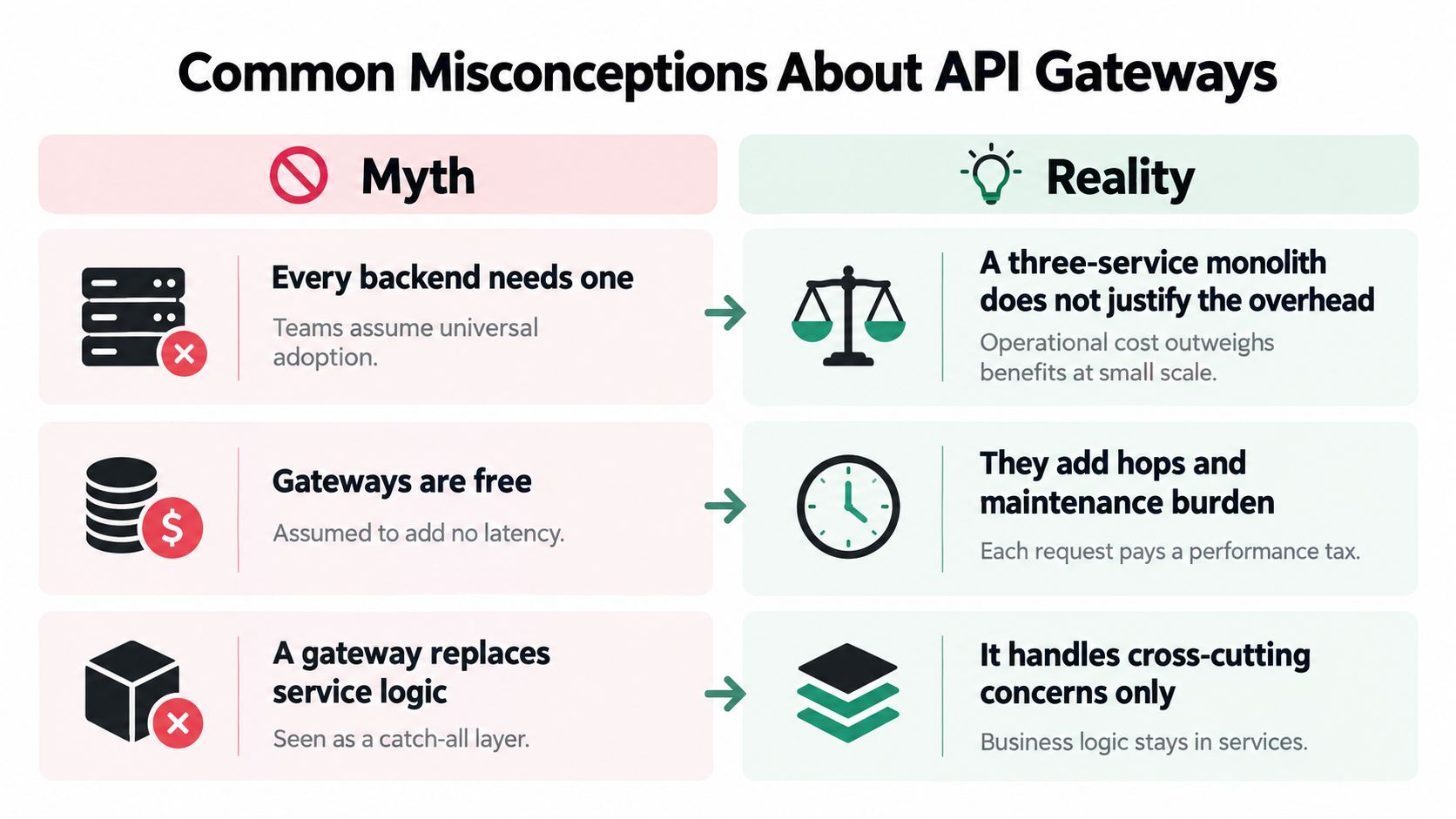
Myth one says every backend needs one
A small application with a few tightly coupled components may gain little from an additional policy layer. If one team owns the client, service, and deployment, direct calls or a lightweight reverse proxy may be easier to operate.
The condition changes when several consumers need different access rules or when multiple teams must apply the same policies. At that point, the gateway can reduce duplication and provide a consistent boundary.
Myth two says gateways are free
A gateway adds a hop, a runtime to operate, and a new place where configuration can fail. Policy chains can also make debugging harder because a request may be rejected or transformed before it reaches the backend.
Measure the complete request path, including authentication, logging, transformations, and upstream behavior. Keep the hot path short, and make gateway configuration observable and versioned.
Myth three says an AI gateway is only a traditional gateway with a new label
LLM traffic introduces streaming, token accounting, provider abstraction, model fallback, and spend controls. A conventional REST proxy may forward an AI request, but forwarding alone doesn't solve the operational problems created by model-specific costs and long-lived responses.
Teams can review authentication controls for model access as part of a broader design that also covers authorization, tenant isolation, and auditability.
Myth four says the gateway replaces service design
A gateway should handle cross-cutting concerns, not become a second application full of business rules. It can route an order request and enforce identity, but the order service should decide whether inventory can be reserved or a payment can be captured.
A gateway amplifies your API contracts. It doesn't repair unclear ownership, incompatible schemas, or missing failure semantics.
Choosing and Adopting an API Gateway
Start with the problem, not the product catalog. Ask whether your system has enough services, consumers, authentication variation, or observability gaps to justify a shared ingress. Include LLM traffic in the assessment, because streaming and token budgets can rule out gateways designed only for short REST transactions.
Use this checklist:
- Traffic profile: Understand request patterns, burst behavior, streaming connections, and upstream dependencies before sizing the data plane.
- Service surface: Count the backends and client types that would benefit from centralized routing.
- Identity model: Document API keys, OAuth flows, machine identities, tenant boundaries, and authorization ownership.
- Operational gaps: Identify missing correlation IDs, route metrics, traces, quota visibility, and failure diagnostics.
- AI requirements: Decide whether you need provider failover, token metering, model routing, semantic caching, or spend controls.
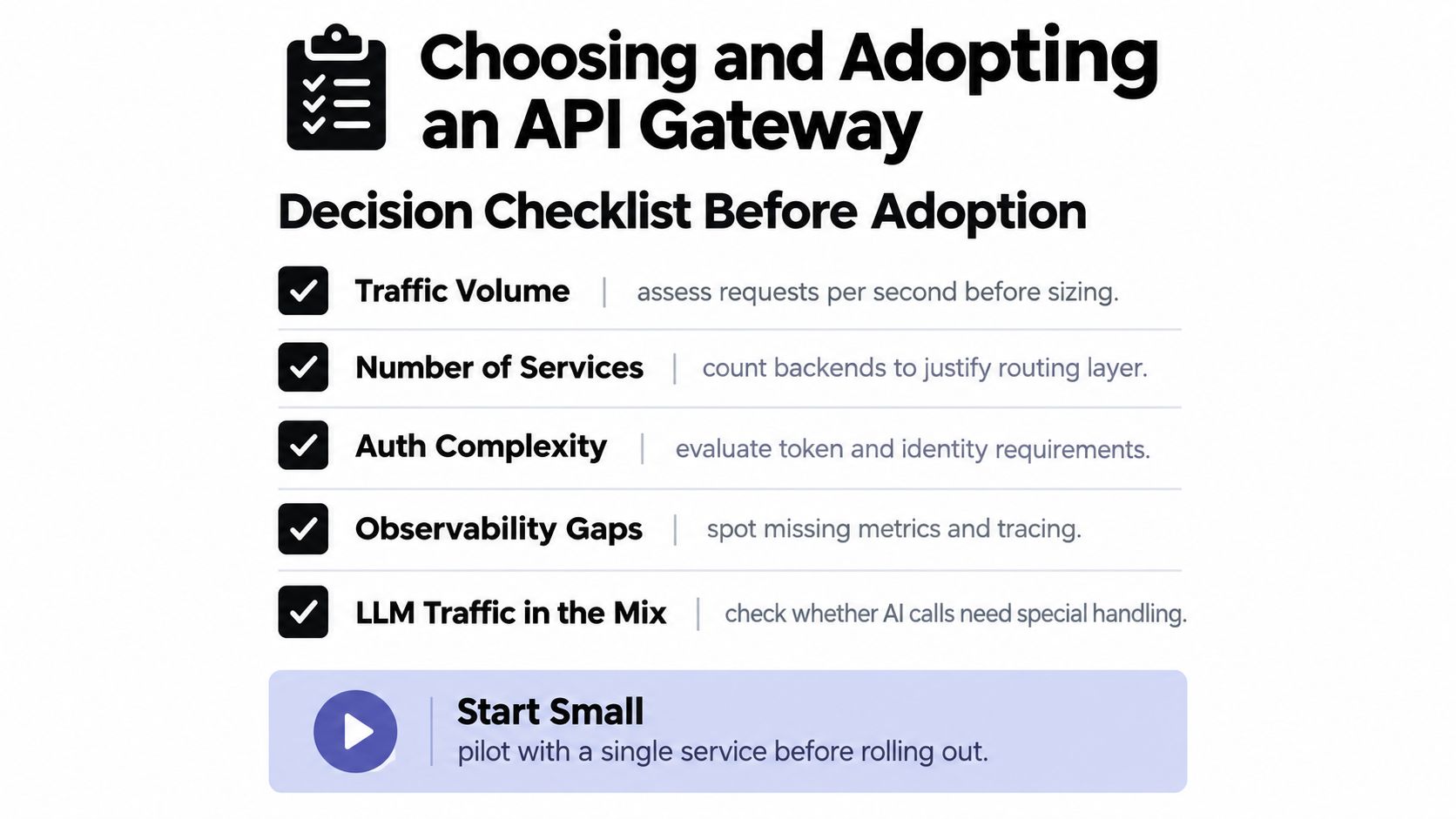
Start with a managed or lightweight deployment if your team hasn't operated a gateway before. Run it in shadow mode, mirror representative traffic where appropriate, compare routing decisions with real traces, and cut over one service before expanding the policy surface.
The category is moving toward tighter token budgets, policy-as-code for prompt safety, and gateway functions embedded inside agent runtimes. That means your next gateway decision may involve not only where requests enter the platform, but also how agents select tools, models, and permissions during execution.
Openbase provides a unified, OpenAI-compatible gateway for accessing models from multiple providers, with automatic failover, streaming support, token-level usage logs, and consolidated billing. If you're designing an AI gateway or trying to control multi-provider LLM traffic, visit Openbase to evaluate the integration and operational model.